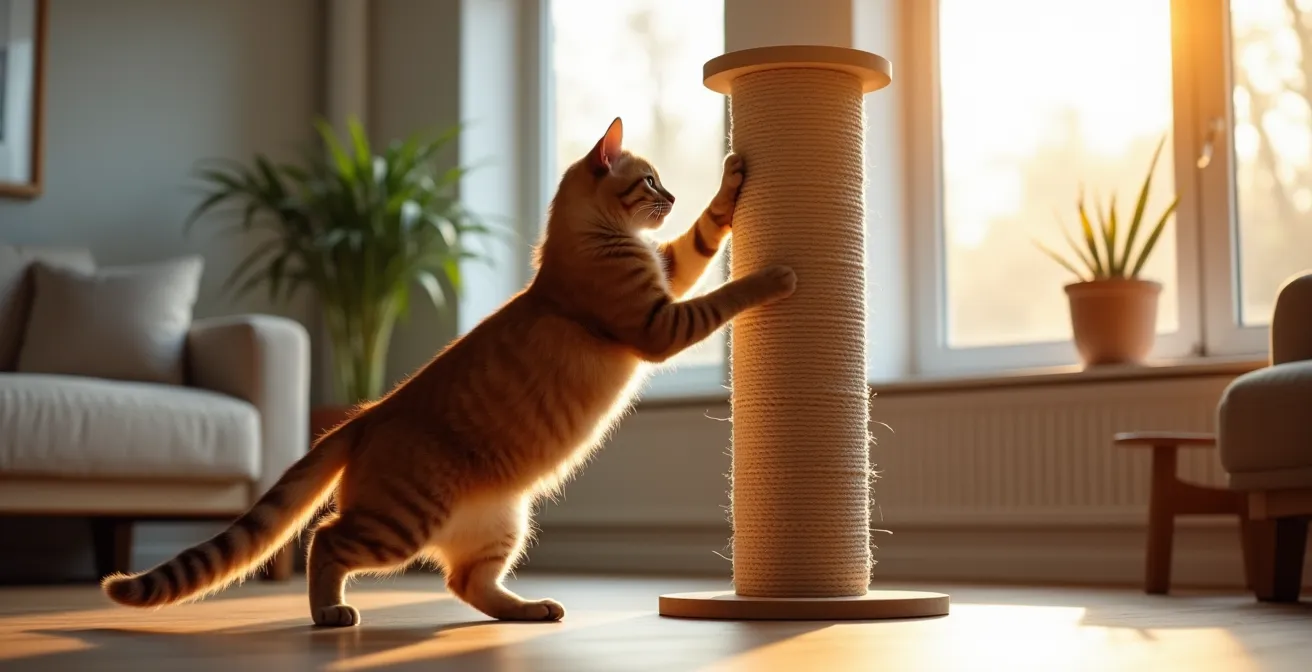
Your cat ignores its expensive tree not out of spite, but due to critical engineering flaws that compromise its sense of security and biological needs.
- A stable, tall structure is a non-negotiable biomechanical requirement for stretching and climbing, not a luxury feature.
- Material choice and perch dimensions are not aesthetic decisions; they are matters of functional ergonomics and safety for your cat.
Recommendation: Stop thinking like a furniture buyer and start thinking like a feline structural engineer. Audit your cat tree for stability, material integrity, and spatial placement to meet your cat’s core needs.
You’ve spent a significant amount of money on a multi-level, carpeted cat palace, only to watch your feline companion gleefully take up residence in the cardboard box it came in. This frustrating scenario is a common complaint among cat owners. The typical advice involves sprinkling catnip or placing treats, but these are superficial fixes for a much deeper, structural problem. The issue isn’t your cat’s preference; it’s a failure in engineering and a fundamental misunderstanding of feline biomechanics and psychology.
Most commercial cat trees are designed to appeal to human aesthetics and budgets, not to the rigorous safety and functional standards of their intended user. A cat, a creature of instinct that is both predator and prey, evaluates its environment with a simple question: “Is this structure safe and effective for my needs?” A wobbly post, a too-small perch, or a poorly textured surface is not merely an inconvenience; it’s a safety hazard that a cat’s survival instincts will reject. This article will not offer simple tricks. Instead, we will conduct a structural autopsy of the common cat tree, diagnosing the specific engineering failures that lead your cat to choose the box over the tower.
This guide deconstructs the essential components of a functional cat tree from an engineering perspective. We will examine the physics of stability, the science of scratching surfaces, the ergonomics of perching, and the crucial role of spatial positioning. By understanding these principles, you can either modify your existing furniture to meet specifications or make an informed decision on a future purchase that your cat will actually use.
Summary: An Engineering Autopsy of the Modern Cat Tree
- Why a post shorter than 30 inches ruins the stretching mechanism?
- How to stabilize a cheap cat tree with paving stones?
- Carpet vs Sisal Rope: Which texture encourages scratching over the sofa?
- The “Perch Size” Error: Why Maine Coons need double-wide platforms?
- Where to put the tree: Why next to the sofa is better than in the corner?
- Why the cat on the highest shelf is the confident “owner” of the room?
- Kong vs Nylabone: Which holds up to a Power Chewer without cracking teeth?
- Why Vertical Territory Is More Important Than Floor Space for Indoor Cats?
Why a post shorter than 30 inches ruins the stretching mechanism?
From an engineering perspective, a cat tree is not a toy; it is a piece of exercise equipment. Considering that cats sleep between 12 and 16 hours a day, the post-sleep stretch is a critical biomechanical function. This “pandiculation” process resets the nervous system and lengthens muscles to prepare for action. A cat’s full, satisfying stretch is a vertical motion. They anchor their rear paws and extend their front paws upwards, elongating their spine and engaging their back and shoulder muscles. This requires a contiguous, vertical surface that exceeds their fully-extended body length.
A post shorter than 30 inches (approximately 76 cm) is a catastrophic design failure for the average adult cat. It forces the cat into a compromised, bent-elbow posture, preventing full muscle and spinal extension. This is not just unsatisfying; it’s dysfunctional. A cat that cannot get a proper stretch will seek out other vertical surfaces that meet its biomechanical needs—often the arm of your sofa or a door frame. The industry standard should be a minimum height derived from the cat itself. A practical engineering rule is to measure your cat from nose to the base of its tail and ensure the post height is at least 1.5 times that length. For most cats, this results in a requirement of 30-36 inches of uninterrupted scratching surface.
Any structure that fails to meet this primary biomechanical directive is, by definition, a flawed piece of equipment. It’s the equivalent of a human trying to do a full pull-up on a bar positioned at chest height. It simply doesn’t work, and the user will abandon the equipment for a more effective alternative.
How to stabilize a cheap cat tree with paving stones?
The single most common point of failure in budget cat trees is structural instability. A cat’s decision to ascend a structure is a calculation of risk versus reward. Any wobble or sway, especially at height, signals unacceptable risk to an animal hardwired for survival. The root cause is almost always a base that is too small and too light to properly counteract the torque generated by a cat leaping on or off the top perch. The base-to-height ratio is fundamentally flawed in most consumer-grade models.
Retrofitting for stability is a problem of physics: you must either widen the base or increase its mass. Paving stones, concrete blocks, or even dumbbells are excellent for adding mass. However, simply placing weight on the existing small base is inefficient. To truly solve the problem, you must first increase the footprint. Using a piece of plywood at least double the size of the original base creates a much wider, more stable platform. This new, larger base can then be loaded with weights like paving stones, which can be concealed with a carpet remnant for aesthetics and comfort.
This process transforms a dangerously unstable tower into a secure, trustworthy structure. It’s a practical engineering solution to a common design flaw, addressing the core issue of torque and center of gravity rather than just masking the symptoms. Regular maintenance, such as tightening all screws and brackets monthly, is also a critical part of ensuring long-term structural integrity.
Your Action Plan: DIY Cat Tree Stabilization
- Widen the Base: Acquire a piece of plywood at least twice the size of the cat tree’s existing base. Secure the original base to the center of the plywood using wood glue or screws for a permanent bond.
- Add Mass: Place heavy, flat objects like paving stones, sandbags, or dumbbells onto the extended plywood base. Distribute the weight evenly around the central post.
- Increase Rigidity: Install metal L-brackets at the junction between the vertical posts and the base. This dramatically reduces wobble at the most critical joint.
- Conceal and Finish: Cover the entire weighted base with a piece of carpet or a heavy-duty mat, cutting it to fit. This improves aesthetics and provides an additional scratching surface.
- Perform Monthly Audits: Manually check and tighten all screws, bolts, and brackets. A structure is only as strong as its weakest connection.
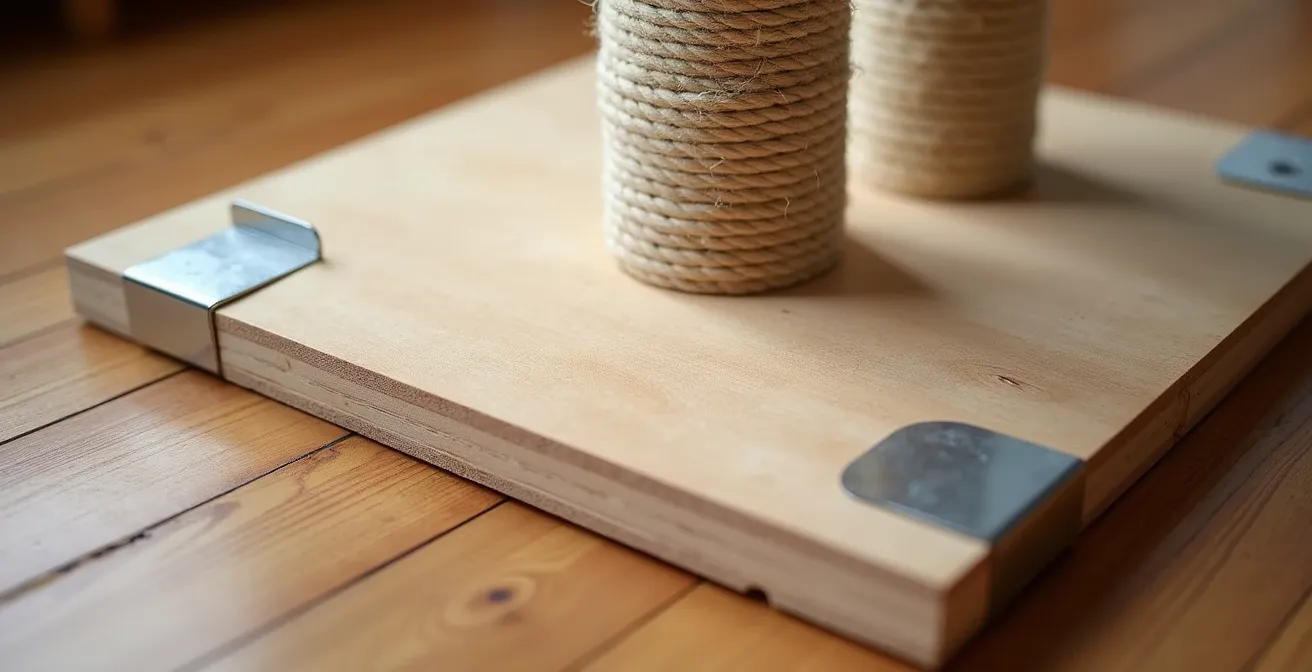
As this detailed view shows, the combination of a wider plywood platform and the addition of significant weight directly addresses the fundamental physics of instability. The L-brackets provide crucial reinforcement against the lateral forces a cat exerts when jumping.
Carpet vs Sisal Rope: Which texture encourages scratching over the sofa?
The choice of material on a scratching post is a critical element of material science that directly impacts a cat’s willingness to use it. This is not a matter of aesthetic preference but of satisfying a deep-seated biological imperative. As researchers from Ohio State University have noted, this behavior is essential for claw maintenance and communication.
Scratching behavior maintains claw health and is a form of visual and pheromonal marking.
– Herron & Buffington, Environmental Enrichment for Indoor Cats Study, Ohio State University
This “marking” requires a material that shreds satisfyingly under claw, providing both a tactile and visual result. This is where many cat trees fail. The plush, looped carpet common on cheap models is a disastrous choice. A cat’s claws can easily snag in the loops, creating a sensation of being trapped rather than a clean, shearing action. Furthermore, carpet is a texture that is ubiquitous in the home—on the floor, on rugs, and sometimes on furniture. Using it on the cat tree fails to send a clear signal that “this is the designated object for scratching.” It creates textural confusion, making it more likely the cat will see the similarly-textured sofa as an equally valid option.
Sisal rope, conversely, is an almost perfect material from an engineering standpoint. Its rough, fibrous texture provides excellent resistance, allowing for deep claw engagement and a satisfying shred. It dulls the claws effectively and provides a clear visual marker of use, which is part of the territorial aspect of scratching. A tree wrapped in sisal provides a distinct tactile experience that is completely different from the soft furnishings in the room. This textural differentiation is key to behavioral redirection. You are providing a superior, more satisfying alternative to the sofa, not a confusingly similar one. Therefore, a tree with vertically-oriented sisal rope is structurally and behaviorally superior to one covered in carpet.
The “Perch Size” Error: Why Maine Coons need double-wide platforms?
The “perch” is the primary reward at the top of the cat tree structure; it is the destination. Yet, it is often designed with a critical ergonomic flaw: it’s too small. Many manufacturers, in an effort to save costs and reduce shipping volume, produce perches that are barely large enough for a small cat to crouch on. This completely misunderstands the function of the perch. It is not just a lookout point; it is a sleeping platform, a lounging area, and a safe-zone. A cat needs to be able to lie down, turn around, and sleep deeply without the fear of falling.
This design flaw is exacerbated by a stark reality of modern pets: with obesity affecting 60% of indoor cats in the U.S., even average-sized domestic shorthairs are larger and heavier than they were a decade ago. For large breeds like Maine Coons, Ragdolls, or Norwegian Forest Cats, a standard 12-inch circular perch is not just uncomfortable—it’s dangerously inadequate. These cats require “double-wide” platforms that allow them to fully recline with their entire body supported.
Case Study: Multi-Cat Platform Load Requirements
An analysis of the Babylon 76-inch Extra Large Multi-Cat Tree Tower revealed key engineering specifications for load-bearing platforms. To comfortably support 2-4 cats simultaneously, platforms required a minimum width of 18 inches and a total weight capacity of 60-80 lbs. The study confirmed a crucial ergonomic formula: a platform’s primary dimension should be at least 1.5 times the cat’s shoulder-to-hip length. This ratio provides the necessary space for a cat to adopt various sleep positions and turn around without feeling precarious, significantly reducing the risk of falls and increasing the platform’s perceived safety.
A cat that feels unstable or cramped on a perch will not use it. They will seek out other elevated, secure surfaces like the top of a bookshelf, a dresser, or the back of the sofa. The perch must be engineered for the actual size and weight of its user, not an idealized, undersized version.
Where to put the tree: Why next to the sofa is better than in the corner?
The placement of a cat tree is a question of spatial ergonomics, not just interior decorating. Shoving the tree into an unused, out-of-the-way corner is one of the most common reasons a cat will ignore it. Cats are social animals that want to be part of the household’s daily life, even if from a safe distance. They are also masters of observation, driven by an instinct to survey their territory from a high vantage point. An isolated corner offers them nothing to see and no social interaction.
The optimal location is at the intersection of social activity and strategic observation. Placing the tree next to the main sofa in the living room integrates the structure into the social hub of the home. The cat can be “with” the family while maintaining a comfortable, elevated distance. As noted in research on feline environmental needs, providing adequate social distance is key, and vertical space is a perfect way to achieve this. A position near a window is also highly effective, as it provides “cat TV”—a constant stream of stimulus from birds, people, and other outdoor activity. This engages their predator instincts in a safe, non-destructive way.
Conversely, a dead-end corner is a tactical nightmare for a cat. It offers only one escape route, which can induce anxiety, especially in multi-cat households where an escape path is paramount. The tree should be positioned to allow for multiple avenues of approach and retreat. Placing it near the sofa also serves a practical purpose: it positions a superior scratching object (the sisal post) right next to a potential scratching target (the sofa), making behavioral redirection far more intuitive for the cat. The message becomes clear: “Don’t scratch this (sofa), scratch this better thing right next to it.”
Why the cat on the highest shelf is the confident “owner” of the room?
In the world of feline social dynamics, height is equivalent to status and security. The cat occupying the highest physical point in a room is often the most confident and socially dominant. This isn’t about aggression; it’s about control and a clear view of the territory. From an elevated perch, a cat can observe all comings and goings, monitor potential threats (like a vacuum cleaner or a boisterous toddler), and see other household pets without being in the middle of the fray. This vantage point provides a powerful sense of safety and control.
This preference for height is a deeply ingrained evolutionary trait. As creatures that are both predators and prey, vertical space offers a dual advantage. It’s the perfect spot to stalk from (predator) and an unassailable refuge to retreat to (prey). Denying an indoor cat access to vertical territory is to deny a fundamental aspect of its nature, which can lead to stress and anxiety. The positive physiological impact is measurable; a 2024 study indicated that cats with access to vertical spaces had 20% lower cortisol levels than those without.
When a cat climbs its tree, it is not just playing; it is managing its stress and asserting its place in the household hierarchy. The top perch of a tall, stable cat tree becomes a throne. By providing this “throne,” you are giving your cat a tool to self-regulate its anxiety and interact with the home environment on its own terms. The cat on the highest shelf is not just relaxing; it is broadcasting a state of calm confidence, secure in its ownership of the vertical domain you have provided.
Kong vs Nylabone: Which holds up to a Power Chewer without cracking teeth?
While Kong and Nylabone are brands typically associated with canine power chewers, the underlying engineering problem—material durability versus dental safety—is a critical consideration for cat furniture as well. Cats may not be “power chewers” in the same way as dogs, but a significant number engage in chewing behavior, particularly on the corners of their cat trees. This can be due to teething in kittens, boredom in adults, or even a medical condition called pica. This makes the material composition of your cat tree a matter of health and safety.
Many cheap cat trees are constructed from particleboard held together with industrial glues and covered in synthetic carpets treated with chemicals. When a cat chews on these materials, it can ingest toxic adhesives, formaldehyde from the particleboard, and indigestible plastic fibers. This is a significant health risk. The testimony of K.A. Riley from Ontario is a stark reminder that this behavior can appear unexpectedly. Her cat, Jones, ignored his tree for two years before suddenly developing an obsession with chewing it when it was moved. This highlights a critical engineering principle: you must design for unexpected but plausible use cases. A cat that has never chewed before could start tomorrow.
From a structural engineer’s perspective, this means specifying non-toxic materials. Look for cat trees made from solid wood or high-quality, formaldehyde-free plywood. Ensure that any glues used are certified as non-toxic and that dyes in fabrics are pet-safe. If your cat is a known chewer, redirecting this behavior is essential. Providing safe alternatives like silver vine sticks, licorice root, or specially designed cat chew toys made from food-safe rubber can satisfy their urge to chew without the risk of ingesting harmful chemicals or splintered wood from a poorly made structure.
Key Takeaways
- Stability Is Paramount: A wobbly cat tree is a safety hazard that a cat’s instincts will reject. The base must be wide and heavy enough to eliminate all sway.
- Height for Health: A scratching post must be tall enough (min. 30 inches) to allow a full, vertical stretch, which is a critical biomechanical need.
- Material Matters: Sisal rope offers a satisfying, shreddable texture that encourages scratching, while carpet can snag claws and create behavioral confusion.
Why Vertical Territory Is More Important Than Floor Space for Indoor Cats?
In the limited geography of an indoor environment, square footage is not the most valuable currency for a cat—vertical space is. A home with 2,000 square feet of floor space but no accessible vertical territory is a less enriching environment than an 800-square-foot apartment with well-designed cat shelves and a tall, stable cat tree. This is because vertical space multiplies the usable area of a home from a cat’s perspective and, more importantly, satisfies core behavioral needs that floor space cannot.
This principle is rooted in the domestic cat’s evolutionary history. As expert analysis from the “Environmental Enrichment for Indoor Cats” study explains, “Because of their heritage as both a predator and a prey species, domestic cats naturally climb for observation and safety.” Vertical space allows a cat to survey its environment, retreat from perceived threats, and establish a clear social hierarchy without conflict. In multi-cat households, vertical territory is an essential resource that allows cats to share a space peacefully by creating distance and avoiding direct competition. It turns a two-dimensional environment into a three-dimensional one, vastly increasing its complexity and interest.
The impact of this enrichment is not just psychological; it’s physiological. Providing access to vertical spaces is one of the most effective ways to reduce stress and a host of related behavioral problems like over-grooming, aggression, or inappropriate urination. Studies have shown that a well-designed program of environmental enrichment reduces stress-related behaviors in cats by up to 30%. Investing in a tall, stable cat tree is not about buying a piece of furniture; it is a direct investment in your cat’s mental and physical well-being, providing a far greater return on investment than simply having more empty floor space.
Frequently Asked Questions About Cat Chewing Behavior
Why do cats chew on cat trees and furniture?
Cats may chew due to a variety of reasons, including the discomfort of kitten teething, boredom and lack of stimulation in adult cats, a compulsive disorder known as pica (the ingestion of non-food items), or dental pain that they are trying to soothe. Identifying the root cause is key to addressing the behavior.
What are safe chewing alternatives for cats?
It is crucial to redirect chewing onto appropriate items. Safe alternatives include natural options like silver vine sticks or licorice root, which are highly attractive to many cats. Additionally, food-safe rubber toys specifically designed for feline dental health can provide a safe and satisfying chewing experience, unlike the potentially toxic particleboard and adhesives found in cheap furniture.
How can I redirect destructive chewing behavior?
Redirection involves a two-pronged approach. First, provide an abundance of appropriate, cat-safe chew toys to satisfy the urge. Second, increase their daily mental and physical stimulation through interactive playtime. A bored cat is more likely to be a destructive cat. Finally, ensure the cat furniture you provide is made from non-toxic, durable materials to minimize risk if chewing does occur.