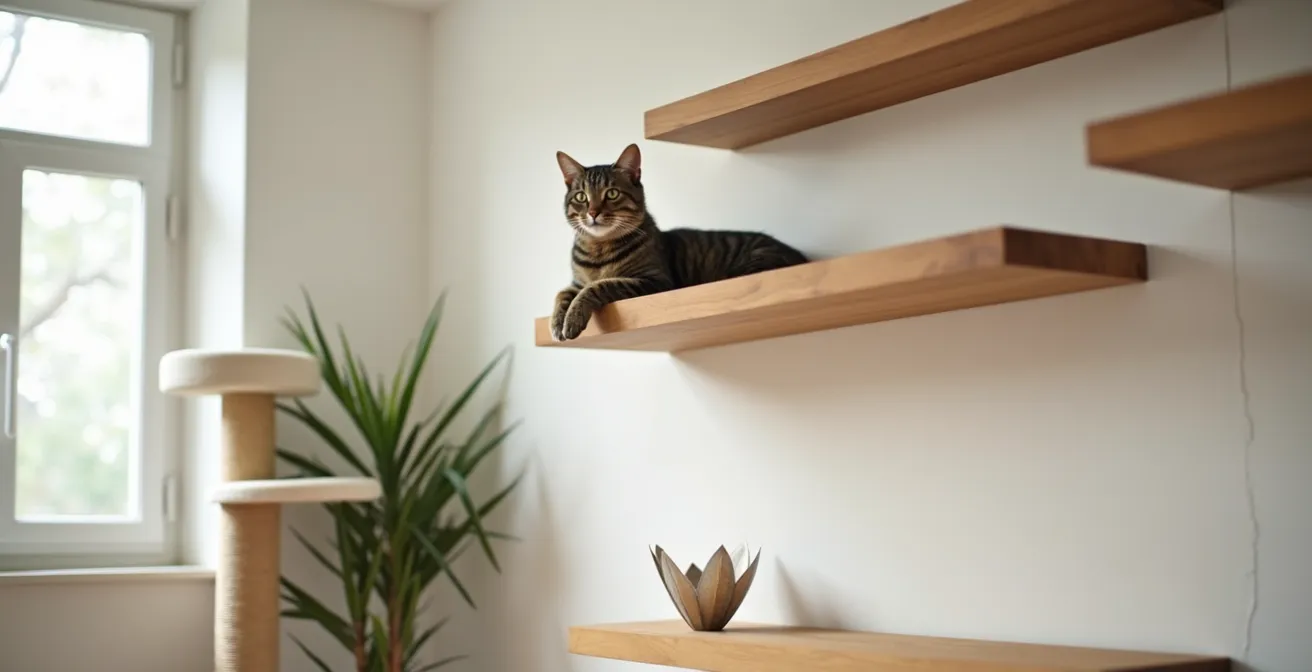
The belief that a small apartment is unsuitable for a cat is based on a fundamental misunderstanding of feline needs; happiness isn’t measured in square feet, but in cubic feet.
- Vertical space directly impacts a cat’s psychological well-being by providing security, status, and environmental control, effectively reducing stress.
- Even the smallest rooms can be transformed into a rich, stimulating environment by creating “cat superhighways” on the walls, using furniture, and adding no-drill solutions.
Recommendation: Stop looking at your floor plan and start looking at your walls. By implementing vertical design principles, you can give your cat a kingdom, not just a room.
For many apartment dwellers, the dream of feline companionship is often clouded by a nagging guilt: “Is my space big enough?” We measure our homes in square footage, a flat, two-dimensional metric that dictates where we place our sofas and coffee tables. This human-centric view is the single biggest mistake we make when assessing our home’s suitability for a cat. Cats, unlike us, are not floor-dwellers. They are masters of three-dimensional living, and their entire world, from their sense of security to their social standing, is built on a vertical axis.
The common solution—a lone, carpeted cat tree in a corner—is a good start, but it’s like giving a human a single chair in an empty warehouse. It fails to grasp the true nature of feline needs. A cat’s instinct is to survey, to escape, and to establish hierarchy through elevation. They require pathways, vantage points, and a sense of ownership over their environment that floor space alone can never provide. The key isn’t more floor space; it’s a paradigm shift in thinking.
This article will guide you, the feline interior designer, through this paradigm shift. We will deconstruct the psychology behind a cat’s need for height and prove that vertical territory is not a luxury, but a fundamental necessity. We’ll explore how to transform your walls into a volumetric territory that unlocks your cat’s confidence, reduces anxiety, and turns even a studio apartment into a sprawling feline empire. We’ll move beyond the problem and dive into actionable, stylish, and even renter-friendly solutions to create a home where your cat doesn’t just live, but truly thrives.
This guide will explore the core principles of feline architecture, from the psychology of high perches to the practicalities of stylish and safe installation. Discover how to design a home that speaks your cat’s native spatial language.
Summary: Rethinking Feline Real Estate: A Guide to Vertical Design
- Why the cat on the highest shelf is the confident “owner” of the room?
- How to arrange furniture so older cats can climb down without impact?
- Window Perch vs Room Corner: Which location reduces anxiety more?
- The “Trap” Mistake: Why every shelf needs two exit routes?
- How to create vertical space without drilling holes in the wall?
- How to build a sensory garden on a balcony without using toxic plants?
- Why your dog’s bed placement might violate the “thermal comfort” freedom?
- How to Design a Cat Wall Superhighway That Looks Stylish in Your Living Room?
Why the cat on the highest shelf is the confident “owner” of the room?
In the feline world, height is not just a preference; it is a language of power, safety, and status. When a cat claims the highest point in a room, they are making a clear statement about their place in the social hierarchy. This isn’t aggression, but an expression of spatial confidence. From a high vantage point, a cat has a supreme visual advantage, allowing them to survey their entire territory, spot potential threats—be it the vacuum cleaner or an approaching housemate—and feel a sense of control over their environment. This feeling of control is a powerful antidote to stress.
The psychological impact is measurable. Research on environmental enrichment shows a direct correlation between vertical access and reduced stress levels. A 2024 study confirmed that cats in enriched environments with vertical territory had almost half the cortisol level compared to those with fewer resources. By providing vertical space, you are not just offering a fun climbing spot; you are actively contributing to your cat’s mental and physiological health. In multi-cat households, this becomes even more critical. The highest perch often belongs to the cat with the highest status at that moment, a position that can be fluid and shared, reducing the need for physical conflicts over resources on the floor.
Essentially, providing vertical territory allows a shy or timid cat to observe the household from a safe distance, building their confidence over time. For an assertive cat, it provides an outlet to express their status without confrontation. It is a cornerstone of creating a peaceful, well-adjusted multi-cat home where each individual feels secure in their own space. The cat on the top shelf isn’t just enjoying the view; they are secure, in control, and psychologically at ease.
How to arrange furniture so older cats can climb down without impact?
As cats age, their desire for height remains, but their physical abilities change. Arthritis, decreased muscle mass, and reduced agility can make high-impact jumps dangerous, potentially leading to injury or causing a senior cat to avoid their beloved perches altogether. The goal of feline architecture for a senior cat is to create a “path of least resistance”—a gentle, stepped descent that minimizes stress on their joints. This means thinking less about single, high-impact leaps and more about creating a series of low-impact transitions.
The key is to arrange furniture, shelves, or cat-specific structures as a multi-level staircase. Instead of one tall cat tree, consider placing an ottoman next to a sofa, which then leads to the back of the sofa, and finally to a window perch. The distance between each level should be manageable, eliminating the need for a cat to take a giant, jarring leap down. According to advice from feline behavior experts, you should measure distances between shelves carefully to ensure they facilitate easy movement, not daunting jumps.
Surface texture is equally important for a safe descent. Slippery surfaces can cause a senior cat to lose their footing. Using materials with good grip can dramatically increase their confidence and safety.
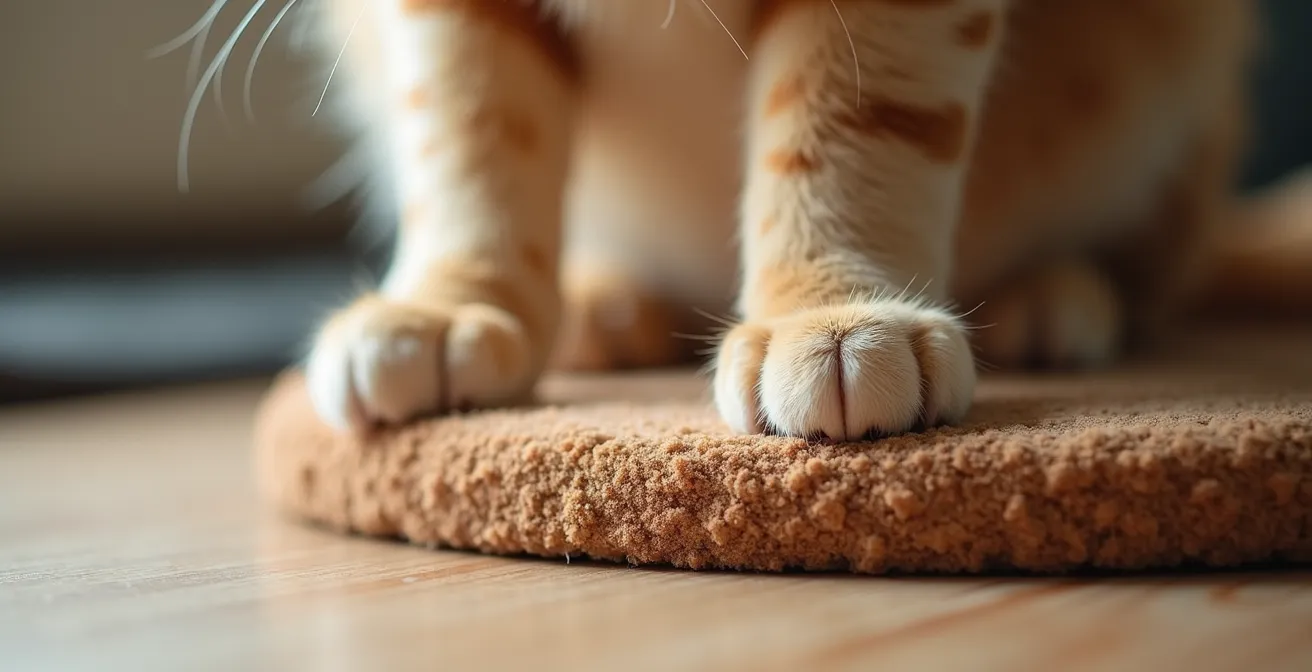
As shown by the detail in the textures, materials like low-pile carpet remnants, cork tiles, or sisal fabric provide excellent traction for aging paws. Ensure any cat tree or structure has a wide, heavy base to prevent it from toppling over when your cat makes a move. By creating these thoughtful, accessible pathways, you honor your senior cat’s instinctual need for height while respecting their physical limitations, ensuring they can continue to enjoy their vertical world comfortably and safely.
Window Perch vs Room Corner: Which location reduces anxiety more?
The placement of a vertical perch is as crucial as its existence. The two most common locations—a window and a room corner—serve fundamentally different psychological purposes for a cat. A window perch acts as ‘Cat TV,’ offering a constant stream of external stimulation from birds, pedestrians, and rustling leaves. This is ideal for a confident, curious cat who thrives on mental engagement. However, for an anxious cat, this same stimulation can become a source of stress and frustration if they see perceived threats, like a neighborhood dog or another cat, that they cannot interact with or escape from.
A corner perch, on the other hand, prioritizes security over stimulation. Tucked into a corner, a cat has its back and sides protected, providing a 270-degree view of the room’s interior. This predictable, controllable territory allows an anxious or timid cat to relax fully, knowing nothing can sneak up on them. It is a defensive position that provides maximum security, making it the superior choice for reducing anxiety. As Cat Behavior Specialists from The Cat Advocate note, this is about providing a safe retreat within a shared family space.
Cats feel safe up high and it provides a great view of their territory. If you have small children or dogs, vertical spots can be places where your cat can escape to and still be in the same space as the family
– Cat Behavior Specialists, The Cat Advocate
The choice between these two locations depends entirely on your cat’s personality. A bold explorer might get bored in a quiet corner, while a nervous newcomer might be overwhelmed by a busy window. The following table breaks down the key differences to help you make the best decision for your feline’s emotional well-being.
| Feature | Window Perch | Corner Perch |
|---|---|---|
| View Type | External stimulation (‘Cat TV’) | 270-degree view of room, backs against wall for security |
| Stress Level | Variable – can increase if threats visible | Lower – predictable, controllable territory view |
| Best For | Confident, curious cats | Anxious or timid cats |
| Stimulation | High mental stimulation | Low stimulation, high security |
| Ideal Setup | Near window with sunny exposure | Corner location with sweet vantage point of home |
The “Trap” Mistake: Why every shelf needs two exit routes?
A common mistake in DIY feline architecture is designing perches and shelves as destinations rather than as part of a larger network. A single shelf high on a wall, with only one way up and down, can easily become a “trap.” In a multi-pet household, another cat or a playful dog can block the only escape route, cornering the cat on the perch. This experience can be highly stressful and may teach the cat that vertical spaces are unsafe, causing them to avoid them entirely.
The solution is to think in terms of “highways, not dead ends.” As outlined in a design guide on creating effective vertical spaces for cats, every single raised location should have at least two entry and exit points. This allows a cat to always have an escape route, preventing them from feeling trapped or cornered. This principle of fluid movement is fundamental to creating a low-stress environment. A cat who knows they can always retreat will use the space with far more confidence.
This concept of interconnected pathways transforms a series of static shelves into a dynamic “cat superhighway.” The design should allow for a continuous flow of movement around the room, connecting different perches, cat trees, and furniture tops.
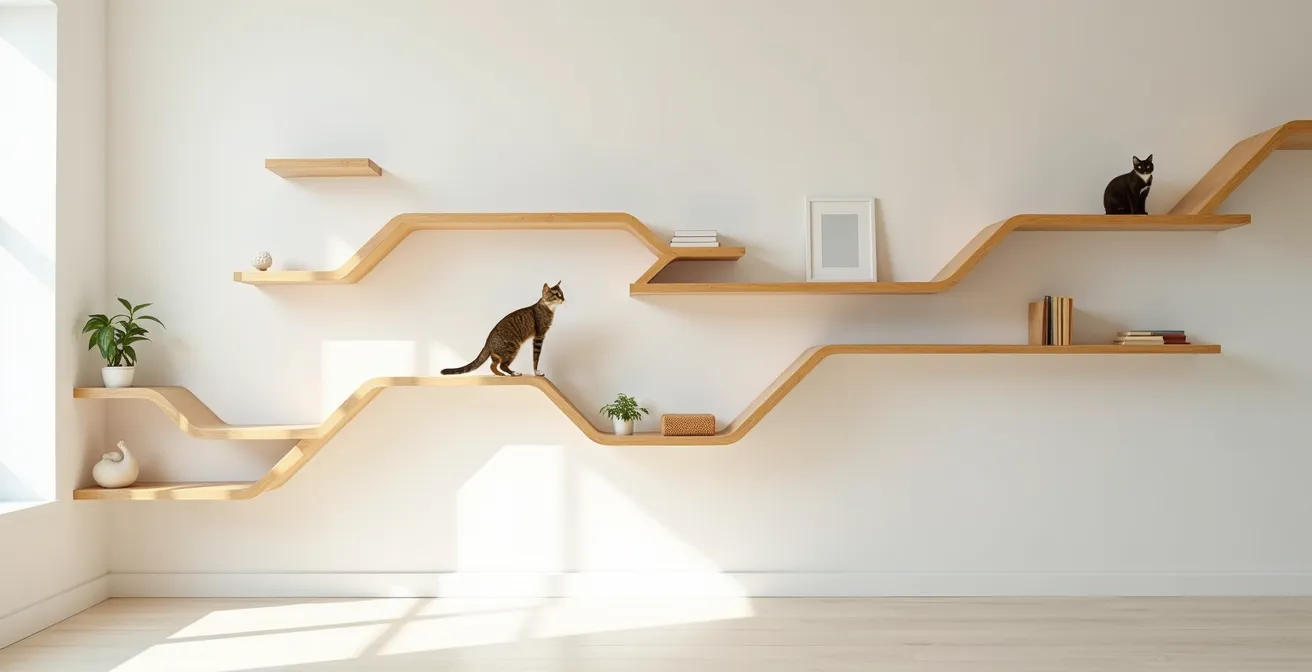
As this layout demonstrates, creating bridges, alternate step-downs, or “racetrack” configurations that loop back on themselves ensures there are no dead ends. This is not just about physical safety—preventing a panicked cat from taking a dangerous leap—it’s about psychological security. By ensuring every perch has a plan B, you are designing a space that respects your cat’s innate need for control and escape, making their vertical world a true sanctuary.
How to create vertical space without drilling holes in the wall?
For renters or homeowners hesitant to commit to permanent wall fixtures, the idea of creating vertical territory can seem daunting. Fortunately, a new wave of innovative, drill-free solutions allows you to build an extensive feline playground without leaving a single mark on your walls. The most effective of these are floor-to-ceiling tension pole systems. These are sturdy, adjustable poles that use pressure to wedge securely between the floor and ceiling, serving as a robust foundation for a variety of accessories like steps, platforms, and hammocks.
These systems are modular, allowing you to customize a layout that perfectly fits your space and your cat’s preferences. They free up the floor space that bulky, traditional cat trees often consume, making them ideal for smaller apartments. Beyond tension poles, you can get creative with existing furniture. Sturdy, ladder-style bookshelves can be repurposed by wrapping the rungs with sisal rope for grip and scratching. Modular cube storage units, like the popular IKEA Kallax series, can be arranged in a stepped formation to create a stable and functional climbing structure that doubles as storage for you.
The success of these systems lies in their stability and appeal. A wobbly structure will be ignored by any self-respecting cat. The feedback on high-quality tension pole systems is overwhelmingly positive, confirming their effectiveness even for less athletic felines.
We went all in with two poles, two bridges, three steps… our 6 year old cat, not the most athletic and a bit of an over-thinker, loves being able to perch high up and look out the window. He adores curling up in the hammock, it’s his new favourite place
By combining these drill-free options, you can create a rich, multi-level environment that satisfies your cat’s climbing instincts while keeping your security deposit safe. It’s about leveraging gravity and tension to build up, not drill in.
How to build a sensory garden on a balcony without using toxic plants?
Vertical space isn’t just about climbing; it’s an opportunity to create a multi-layered sensory experience. For apartment cats with access to a balcony or “catio,” a vertical sensory garden can provide crucial mental and physical enrichment. The key is to use vertical planters, tiered stands, and hanging baskets to create a safe, explorable jungle that engages all their senses without using plants that are toxic to felines.
Start by creating different “scent zones.” Place low, wide planters on the ground level with cat-safe “grazing” options like cat grass, catnip, and valerian. On higher tiers or in wall-mounted planters, introduce plants with interesting textures and sounds. Ornamental grasses such as Spider Plant and Lemon Grass are safe and provide tactile stimulation and satisfying rustling noises. As the Young-Williams Animal Center points out, this exposure to natural elements is a powerful tool against boredom and anxiety.
In addition to offering vertical space, catios provide exposure to constantly changing sights and sounds. From the rustling of leaves to the chirping of birds, these outdoor elements offer endless sensory stimulation that helps prevent boredom and anxiety
– Young-Williams Animal Center, The Hidden Benefits of Vertical Space
To encourage climbing and interaction without consumption, place certain “sensory-only” plants in higher or hanging baskets. This invites your cat to climb and sniff without being able to chew. Incorporating a small, pet-safe water fountain adds a crucial auditory element with its gentle trickling sounds. By layering these elements vertically, you create a rich, three-dimensional world that mimics the complexity of the outdoors, providing endless opportunities for discovery right on your balcony.
Why your dog’s bed placement might violate the “thermal comfort” freedom?
To truly understand why vertical space is so uniquely critical for cats, it is useful to contrast their behavior with that of dogs. Both animals seek “thermal comfort,” one of the five freedoms of animal welfare, but they achieve it in fundamentally different ways. Dogs are primarily horizontal regulators. They move across the floor to find a cool patch of tile in the summer or a warm, sunny spot in the winter. Their comfort is largely dictated by the placement of beds in relation to drafts, heat sources, and floor surfaces. A badly placed dog bed can trap them in a hot or cold zone, violating their need for thermal comfort.
Cats, on the other hand, are vertical thermoregulators. They instinctively understand that heat rises. On a cool day, they will climb higher up a cat tree or onto a tall shelf to find warmer air. On a hot day, they may retreat to a lower, cooler level. This use of the third dimension gives them a much more nuanced ability to regulate their body temperature within a single room. While a dog needs multiple beds in different locations, a cat can achieve the same goal by simply changing their altitude on a multi-tiered cat tree.
This fundamental difference in spatial usage highlights why a floor-based perspective is so inadequate for felines. The following table illustrates the contrasting strategies these two species employ to stay comfortable.
| Species | Primary Method | Space Usage | Comfort Solutions |
|---|---|---|---|
| Cats | Vertical movement | Establish territory without taking up floor space | Multiple height perches at different temperatures |
| Dogs | Horizontal movement | Floor-level transitions | Multiple bed locations: cool tiles, warm corners, sunny spots with shade access |
This comparison makes it clear: providing vertical territory for a cat isn’t just for play or status; it’s a vital tool for their basic physiological comfort, something that floor space alone cannot offer.
Key Takeaways
- A cat’s well-being is measured in cubic feet, not square feet; vertical space is more critical than floor area.
- Height provides cats with security, status, and environmental control, which directly reduces stress and anxiety.
- Safe design is paramount: always provide multiple exit routes from perches and create low-impact “staircases” for senior cats.
How to Design a Cat Wall Superhighway That Looks Stylish in Your Living Room?
The ultimate execution of vertical territory is the “cat superhighway”—an integrated system of shelves, perches, and bridges that creates a functional and aesthetically pleasing network on your walls. The goal is to make this feline infrastructure look intentional and stylish, not like a chaotic afterthought. This begins with mapping your walls and identifying the vertical real estate above furniture, along hallways, or near windows where your cat already likes to be. The design should feel like a natural extension of your home’s decor.
Move beyond bulky, carpeted towers and embrace modern materials. Sleek wooden shelves, minimalist metal brackets, and refined finishes can complement your interior design. The key is to create a logical flow. As the legendary cat behaviorist Jackson Galaxy explains, you must design for cats with the same intentionality you use for human spaces.
You create conversation areas in living rooms, a reading cubby for rainy days, and a dining area that can accommodate everyone… The same sort of thing needs to be done for cats, except their highway and areas will be vertical; this is the cat superhighway… Begin in the most significant areas such as the living and bedroom and use the vertical space by staggering shelves and ledges
– Jackson Galaxy, Cat Care Secrets
A successful design connects the floor to the shelves and higher perches in a way that makes sense to a cat. Randomly placed shelves create dead ends and will be ignored. Instead, use a freestanding tower as an “on-ramp” to the wall-mounted highway. Modular systems are an excellent choice as they allow for a cohesive look with matching finishes and the ability to expand the system over time. The most beautiful cat superhighways look like a piece of functional art—a deliberate and stylish element of your home that serves both your aesthetic and your cat’s deepest instincts.
Your Action Plan: Designing a Stylish Cat Superhighway
- Map the Real Estate: Identify wall space above furniture and near windows. Sketch out a potential route that flows logically around the room.
- Select a Cohesive Style: Choose modular shelves or systems with finishes (e.g., wood, metal) that match your existing decor to ensure the design looks intentional.
- Create On-Ramps and Off-Ramps: Use a freestanding cat tree, a sturdy bookshelf, or low-placed shelves to create a clear starting point that connects the floor to the highway.
- Ensure Flow and Safety: Connect shelves to create continuous pathways, not dead ends. Every perch must have at least two escape routes to build confidence.
- Integrate Enrichment: Cover some support posts or shelves with sisal rope to double as scratching surfaces, adding scent-marking opportunities along the route.
Your role as a feline interior designer is to become a translator—to interpret your cat’s instinctual needs into a physical language of shelves, perches, and pathways. Start small. Add one shelf. Connect it to a bookcase. Watch how your cat’s behavior changes. You have the power to transform your home and, in doing so, transform your cat’s world.