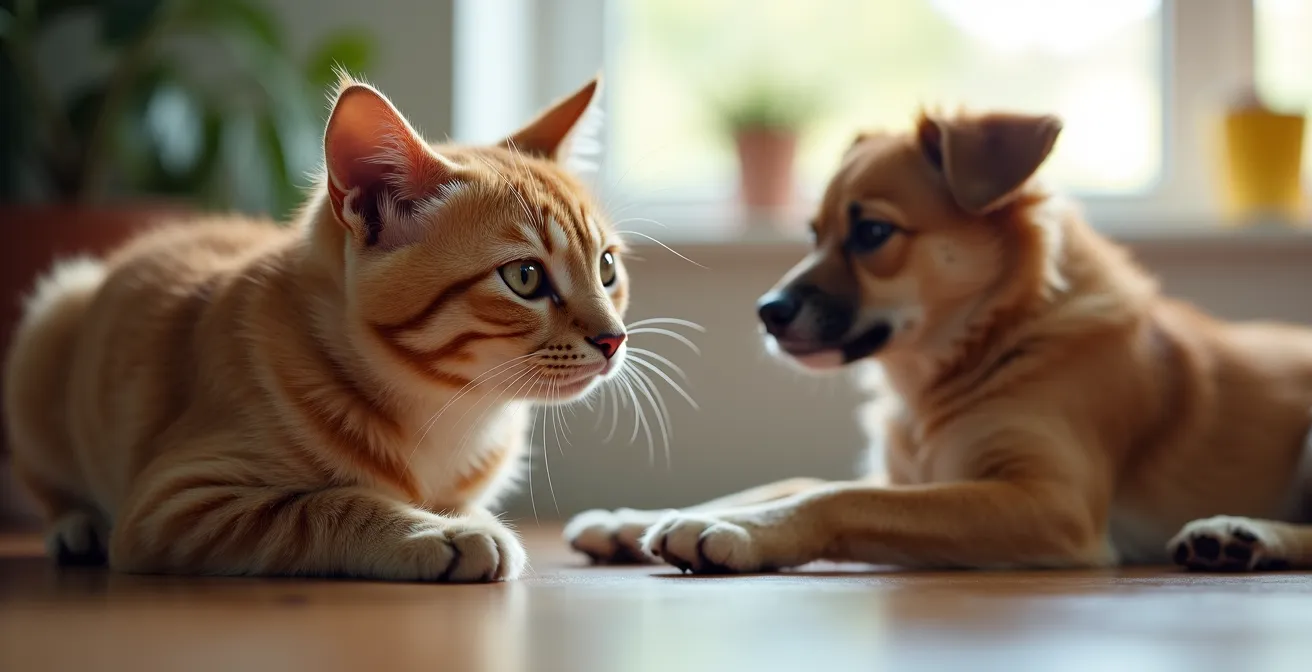
Contrary to popular belief, your pet’s ‘annoying’ behaviors are not signs of disobedience but the expression of non-negotiable biological needs hardwired by evolution.
- Suppressing instincts like scratching, digging, or chasing creates a “behavioral vacuum,” leading to chronic stress, anxiety, and even depression.
- Providing appropriate outlets for these behaviors (enrichment) is as critical to their health as food and water.
Recommendation: Instead of trying to stop a natural behavior, your goal should be to redirect it onto an appropriate object or environment.
As pet owners, we dream of a harmonious life with our animal companions. We envision a dog that walks politely on a leash and a cat that only scratches its designated post. So when our dachshund excavates the garden or our cat treats our sofa like a personal nail file, the common reaction is frustration. We label these actions as ‘bad behaviors’ and embark on a mission to train them away, seeking a ‘perfect’ pet that fits neatly into our human world. We try discipline, redirection, and a vast array of corrective products, often with limited success.
The prevailing advice often reinforces this view, focusing on methods to stop or manage these unwanted habits. But this approach is fundamentally flawed because it operates on a misunderstanding of animal psychology. It treats the symptom—the behavior—without ever addressing the root cause. From an evolutionary biology perspective, these are not behavioral flaws to be erased. They are deeply ingrained, species-specific instincts, or ethological needs, that have ensured survival for millennia. Trying to suppress them is like trying to hold a beach ball underwater; the pressure builds, and eventually, it will surface, often in more destructive or distressing ways.
But what if the key wasn’t to suppress these instincts, but to celebrate and accommodate them? This article will reframe your understanding of your pet’s inner world. We will explore the profound psychological and even neurological consequences of denying an animal its innate nature. By understanding the ‘why’ behind the behavior, you can move from a role of ‘trainer’ to one of ‘facilitator,’ creating an environment that meets their deep-seated needs and alleviates the silent distress you may not even realize they are experiencing.
For those who prefer a visual guide to understanding the subtle signals our pets are sending, the following conference recording offers a deep dive into canine body language. It’s a perfect complement to understanding the internal state that drives the behaviors we will discuss.
To help you navigate this new perspective, this guide breaks down the most common ‘problem’ behaviors, explaining the evolutionary science behind them and providing practical ways to meet your pet’s needs. We’ll explore everything from a cat’s need to ‘kill’ its toys to a dog’s obsession with sniffing every single post on a walk.
Summary: The Unseen Toll of Suppressing Your Pet’s Natural Instincts
- Why your cat needs to “kill” the toy at the end of the play session?
- How to build a digging pit for your dachshund in 30 minutes?
- Vertical vs Horizontal: Which scratching post matches your cat’s stretch style?
- The “Small Dog” Risk: Why your Husky sees the Chihuahua as prey, not a friend?
- How to replace the food bowl with foraging mats to mimic hunting?
- Why a lack of mental stimulation causes brain atrophy in indoor pets?
- Why stopping every 5 feet is mental algebra for your dog?
- How to Spot Signs of Chronic Depression in Indoor Cats?
Why your cat needs to “kill” the toy at the end of the play session?
Have you ever watched your cat play? The intense focus, the stalk, the pounce… it’s captivating. But the play session often ends with the cat grabbing the toy, shaking it vigorously, and kicking it with its back feet. This isn’t just ‘play’; it’s the finale of a deeply ingrained biological script known as the predatory sequence. For a cat, the sequence is Hunt, Stalk, Chase, Pounce, Catch, Kill, and finally, Eat. When we wave a laser pointer or feather wand and then simply put it away, we are interrupting this sequence mid-act. This leaves the cat in a state of unfulfilled arousal and frustration, creating a behavioral vacuum.
Allowing the cat to perform the ‘kill bite’ and ‘bunny kicks’ on a physical toy provides crucial psychological closure. It completes the hunt and satisfies the instinct. In fact, the drive is so strong that many cats invent ways to satisfy it. A fascinating 2023 study in *Scientific Reports* found that 94.4% of cats that exhibit fetching behavior developed it without any human training, demonstrating a powerful, innate need to complete this sequence by bringing the ‘prey’ to a secure location. Denying this finale is a primary source of play-related aggression and anxiety.
The most effective way to structure play is to follow the “Hunt, Kill, Feast” model. This ensures the entire predatory sequence is honored, leading to a deeply satisfied and psychologically balanced cat. By mimicking this natural cycle, you’re not just playing; you’re providing a critical form of mental and emotional enrichment.
Action plan: The “Hunt, Kill, Feast” Method
- Engage: Initiate short, frequent play sessions (5-10 minutes) using a wand toy to mimic the unpredictable movement of prey.
- Allow the Catch: Towards the end of the session, let your cat successfully catch and ‘kill’ the toy. Let them bite, hold, and kick it with their back feet.
- Reward with a Feast: Immediately after the ‘kill’, provide a high-value treat or a small portion of their meal to simulate the ‘eating’ part of the sequence.
- Groom and Rest: Allow your cat to groom and settle down after eating. This is the natural conclusion to a successful hunt.
- Schedule Strategically: Plan these play sessions right before your cat’s regular mealtimes to maximize their instinctual satisfaction.
How to build a digging pit for your dachshund in 30 minutes?
For many dog breeds, especially terriers and dachshunds, digging isn’t a naughty habit; it’s a genetic calling. These dogs were selectively bred for centuries to ‘go to ground,’ hunting badgers, foxes, and other burrowing animals. The urge to dig is as fundamental to their being as a retriever’s urge to fetch. When they are punished for digging up flowerbeds, they are being penalized for an action that their entire genetic history screams at them to perform. This creates immense conflict and stress, as they are forced to suppress a core part of their identity.
The solution is not to stop the digging but to redirect it. Providing a designated, ‘legal’ digging area gives them a safe and appropriate outlet for this powerful instinct. A simple digging pit can transform a source of conflict into a fantastic form of physical and mental enrichment, preventing destructive behavior elsewhere and satisfying their ethological need. You don’t need a massive construction project; a simple, contained space is more than enough to provide hours of fulfillment.
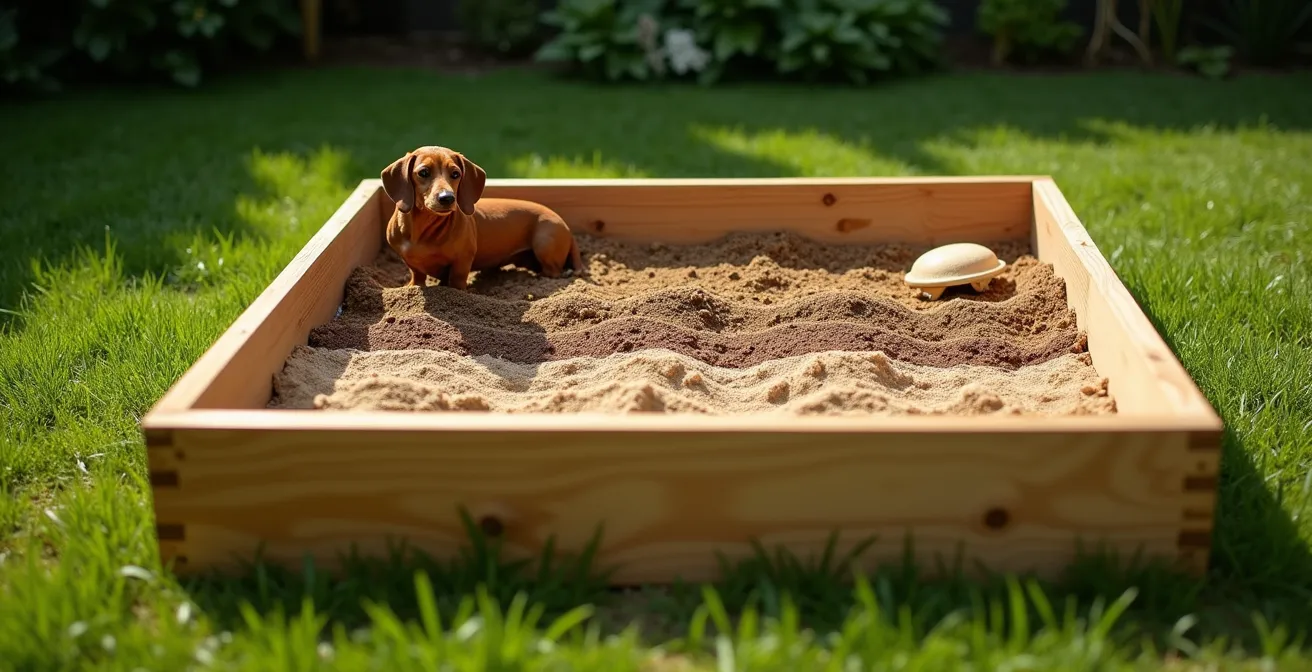
As shown in the setup above, a dedicated pit can be an attractive and controlled part of your yard. To build one in under 30 minutes, you can use a large wooden planter box, a child’s sandpit, or even a designated corner of the garden bordered by logs. The key is to fill it with a variety of exciting, dog-safe materials. Start with a base of sand or soil, then layer in leaf litter, straw, or cork granules. You can make it even more engaging by burying high-value toys or long-lasting chews for your dog to discover. This transforms the act of digging from a ‘bad habit’ into a rewarding treasure hunt that stimulates both their body and their brain.
Vertical vs Horizontal: Which scratching post matches your cat’s stretch style?
Scratching is one of the most misunderstood feline behaviors. Owners often believe it’s simply about claw maintenance, but it’s a far more complex and vital activity. When a cat scratches, it’s engaging in a multi-faceted behavior that serves several critical functions. First, it’s a necessary form of exercise, allowing for a full-body stretch of the muscles and tendons from their claws to their spine. Second, it leaves behind both a visual marker (the scratch marks) and an olfactory one (pheromones from scent glands in their paws). This combination is a powerful form of territorial communication to other cats. Suppressing this behavior is akin to telling a person they are not allowed to speak or stretch.
The key to saving your furniture is not to stop the scratching, but to provide a more appealing alternative. The reason many store-bought scratching posts fail is that they don’t match the cat’s specific preferences. Observe your cat: does it stretch up against the vertical arm of the sofa, or does it stretch out horizontally on a rug? This will tell you what kind of scratcher it prefers. A cat that likes to stretch upwards needs a tall, sturdy vertical post (at least 32 inches high) that won’t wobble when they lean their full weight against it. A cat that prefers to stretch out flat will be much happier with a horizontal or angled scratching pad.
As the experts at International Cat Care aptly put it, this behavior is far more than a simple reflex. Their insight highlights the deep-seated need behind the action.
Scratching is multi-modal communication combining visual signals, olfactory signals from paw glands, and kinesthetic displays of strength.
– International Cat Care, Understanding the hunting behaviour of cats
The material also matters. Sisal rope is a popular choice for vertical posts because its texture mimics tree bark, while corrugated cardboard is often preferred for horizontal pads. Providing multiple options in different locations, especially near sleeping areas (for a good morning stretch) or near ‘illegally’ scratched furniture, will dramatically increase the chances of them using the appropriate outlets. You are satisfying a biological imperative, not just correcting a habit.
The “Small Dog” Risk: Why your Husky sees the Chihuahua as prey, not a friend?
One of the most dangerous misunderstandings of animal instinct is the assumption that all domesticated animals of the same species will see each other as kin. This is particularly risky when it comes to a dog’s prey drive. A prey drive is the instinct to find, pursue, and capture prey. In many breeds, particularly those with a history of hunting or working independently like Huskies, Terriers, or Hounds, this drive is incredibly high and can be triggered by the size and movement of smaller animals. A small, fast-moving, and sometimes yappy dog like a Chihuahua can trigger the exact same predatory sequence as a rabbit or squirrel.
The Husky is not ‘being mean’ or ‘aggressive’ in the human sense; it is operating on a deeply embedded evolutionary software that says “small, fast-moving thing = prey.” This instinct can override socialization and training in a split second. The owner’s belief that their dogs are ‘friends’ or ‘part of the same pack’ is a human-centric view that ignores the powerful, non-negotiable reality of the prey drive. This instinct is not limited to dogs. For example, a 2023 global assessment of feline behavior revealed that domestic cats are hardwired to hunt, with cats preying on 2,084 different species globally, the vast majority being small animals. This illustrates the indiscriminate nature of the predatory instinct.
This doesn’t mean large and small dogs can never coexist, but it requires extreme management and an understanding of the risk. It means never leaving them unsupervised, managing excitement levels, and being constantly aware of triggers. Suppressing the prey drive is impossible. The only safe approach is to manage the environment to prevent it from ever being activated. Believing you can ‘train it out’ of a high-drive dog is a dangerous gamble that puts the smaller animal at constant, mortal risk. It’s our responsibility as stewards to understand and respect the powerful genetic legacy of our pets, not to pretend it doesn’t exist.
How to replace the food bowl with foraging mats to mimic hunting?
In the wild, acquiring food is an animal’s primary job. It involves exploration, problem-solving, and physical effort. The act of foraging and hunting occupies a significant portion of their day and provides immense mental stimulation. Then we bring them into our homes and serve their food in a bowl. In the space of 60 seconds, they consume a meal that requires zero mental or physical effort. This creates a huge void in their day, a phenomenon known as the behavioral vacuum. This lack of purpose is a major contributor to boredom, anxiety, and destructive behaviors.
A remarkably simple and effective way to fill this vacuum is to eliminate the food bowl and replace it with foraging toys or ‘snuffle’ mats. This concept taps into an animal’s innate preference to work for their food, a principle called contrafreeloading. By hiding their daily portion of kibble within the complex textures of a mat, you force them to use their nose and brain to find their meal. This simple change transforms a two-minute mealtime into a 20-minute engaging, rewarding, and calming activity. It satisfies their instinct to seek and find, providing a powerful dose of mental enrichment.
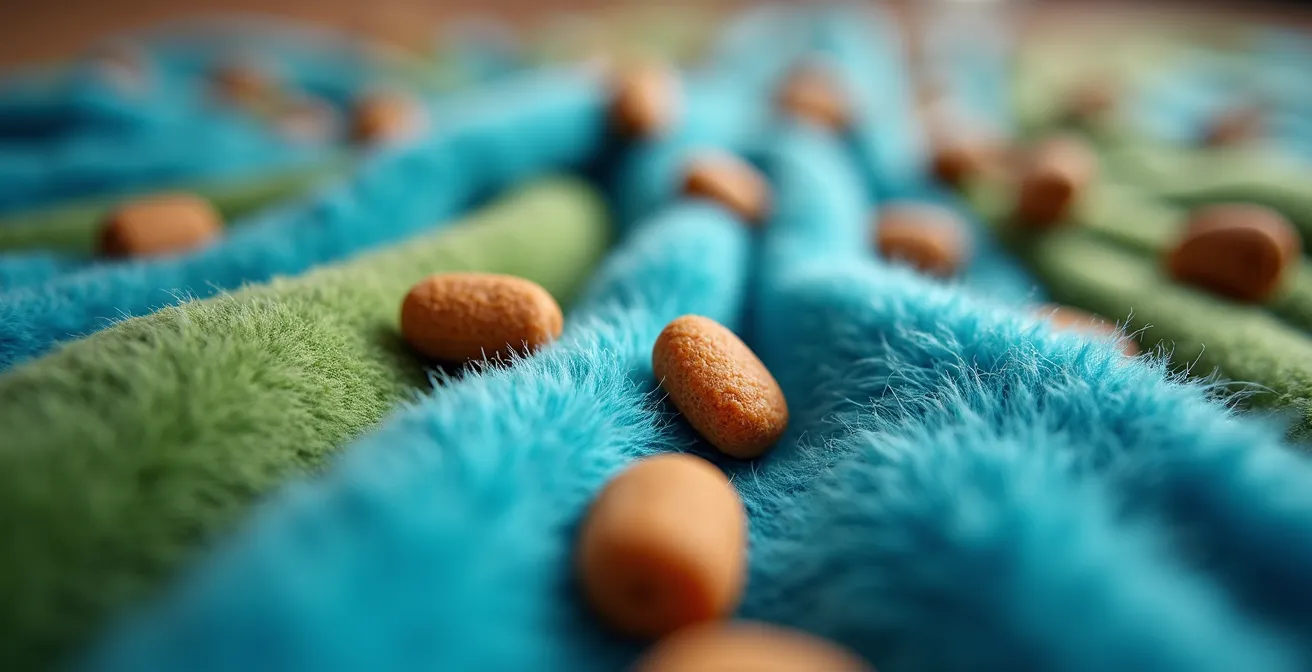
The beauty of a snuffle mat, as seen in the intricate detail above, is its ability to offer varying levels of difficulty. You can start by sprinkling kibble on top and gradually make it more challenging by hiding it deeper within the fleece strips. This activity is not just for dogs; cats also benefit immensely from food puzzles and foraging mats. In fact, studies show that providing engaging activities can reduce other unwanted instinctual behaviors. For example, a UK study found that providing a high-animal-protein diet and engaging in just 5-10 minutes of daily object play significantly moderated predatory behavior in outdoor cats, suggesting that a satisfied hunter is a less active one. The same principle applies to foraging—a mentally engaged animal is a more balanced one.
Why a lack of mental stimulation causes brain atrophy in indoor pets?
We often think of the negative effects of confinement in purely behavioral terms: boredom, destruction, anxiety. But the consequences are far more profound and physically damaging. From an evolutionary biologist’s standpoint, the brain is a ‘use it or lose it’ organ. For an animal living in a complex, ever-changing wild environment, the brain is constantly processing new sights, sounds, and smells, solving problems, and navigating social dynamics. This rich stimulation builds and maintains neural pathways. When we place an animal in a static, unchanging indoor environment, we are starving their brain of the input it was designed to receive. This leads to a measurable, physical degradation of the brain itself.
This is not a metaphor. A lack of novel stimulation, particularly in key brain regions like the hippocampus which is responsible for learning and memory, leads to a reduction in neural connections. As veterinary surgeon Dr. Pippa Elliott explains, the mechanism is starkly physiological.
A static, unchanging environment fails to stimulate the hippocampus, leading to measurable reduction in neural connections and synaptic pruning.
– Dr. Pippa Elliott, BVMS MRCVS, International Open Academy – Animal Psychology Course
This brain atrophy can manifest as cognitive dysfunction syndrome (similar to dementia in humans) later in life, but the effects start much earlier. An under-stimulated environment is also a chronically stressful one, especially in multi-pet households. When resources (like space, attention, or safe spots) are perceived as scarce, tension skyrockets. In fact, a 2024 survey in the *Journal of Feline Medicine and Surgery* found that an astonishing 87.7% of multi-cat households reported visible signs of intercat tension. This chronic stress accelerates the negative neurological effects. Therefore, providing enrichment isn’t just about ‘keeping them busy’; it is a non-negotiable requirement for maintaining brain health.
Why stopping every 5 feet is mental algebra for your dog?
For many owners, the ideal dog walk is a brisk, linear march with the dog trotting dutifully at their side. When the dog stops to sniff a single blade of grass for what feels like an eternity, we often get impatient and pull them along, urging them to ‘get on with it.’ This action reveals a fundamental misunderstanding of a dog’s primary sense: smell. For a dog, a walk is not about physical exercise; it’s about gathering information. Their nose is a sophisticated data-gathering tool, and the world is a rich tapestry of olfactory information. That lamppost is not just a lamppost; it’s a community message board.
When your dog is sniffing, they are not just ‘smelling.’ They are performing complex olfactory data processing. They are downloading information about which other dogs have been there, their gender, their reproductive status, their stress level, and what they ate. It is a form of mental algebra, and it is incredibly taxing and satisfying for their brain. Forcing them to walk without sniffing is like forcing a human to walk through an art gallery blindfolded. You are denying them the very purpose of the experience.
Case Study: The ‘Sniffari’ vs. The Structured Walk
Research into dog walking patterns, highlighted by canine behavior consultants, shows that mental stimulation is paramount. A 20-minute ‘sniffari’—a walk where the dog is allowed to lead the way and sniff to their heart’s content—can be more psychologically tiring and fulfilling than a full hour of structured heeling. As detailed in analyses of canine information processing, this is because the dog’s brain is working intensely to decode complex pheromonal messages left by other animals. This olfactory exploration is a critical ethological need that directly contributes to their psychological well-being.
The next time you take your dog for a walk, try to reframe its purpose. Instead of a mission to get from Point A to Point B, think of it as taking your dog to the library. Let them ‘read’ the messages. By allowing them this freedom, you are providing a crucial form of mental enrichment that builds confidence and reduces anxiety far more effectively than simply tiring them out physically. A tired dog is good, but a fulfilled dog is better.
Key Takeaways
- Your pet’s ‘bad behaviors’ are not acts of defiance but expressions of vital, species-specific instincts.
- Suppressing these instincts creates a ‘behavioral vacuum’ that leads to chronic stress, anxiety, and even physical brain changes.
- The solution is not suppression but redirection. Provide appropriate outlets like digging pits, varied scratching posts, and foraging toys to satisfy these needs.
How to Spot Signs of Chronic Depression in Indoor Cats?
When we fail to meet the ethological needs of our indoor pets, the cumulative effect of that chronic, low-grade stress and boredom can manifest as something we rarely attribute to animals: depression. In cats, this condition, often called anhedonia, is particularly insidious because its signs are frequently misinterpreted as positive traits. A depressed cat is often described by its owner as ‘calm,’ ‘lazy,’ or ‘finally settled down.’ In reality, the cat has simply given up. It has entered a state of behavioral shutdown because its environment is so profoundly unenriched that it no longer elicits any response.
The signs are subtle. It’s not about dramatic crying or acting out. It’s about what the cat *stops* doing. A cat that no longer shows interest in its favorite toy, stops greeting you at the door, or sleeps more than usual may be suffering. Other signs include changes in appetite, a decline in grooming (an unkempt or matted coat), or social withdrawal. These signs overlap significantly with physical illness, so a veterinary check-up is always the first step to rule out medical causes. However, when no physical ailment is found, chronic environmental stress is often the culprit.
This stress is particularly prevalent in homes with multiple cats where the environment hasn’t been properly managed to account for their territorial nature. One of the most common triggers for intercat tension and subsequent shutdown is the introduction of a new feline. Indeed, 2024 research identified that 73.3% of tension in multi-cat homes began with this exact event. The established cat’s world is turned upside down, and if it lacks sufficient resources and safe spaces, it can easily slip into a state of chronic depression. Recognizing that a ‘calm’ cat might actually be a ‘depressed’ cat is the first step toward providing the rich, stimulating environment it needs to thrive, not just survive.
Frequently Asked Questions about Pet Behavior and Psychological Distress
What is anhedonia in cats and why is it often missed?
Anhedonia is the loss of interest in previously enjoyable activities. In cats, this manifests as disinterest in favorite toys, window perches, or treat time. It’s often missed because owners may interpret it as the cat being ‘calm’ or ‘well-behaved’.
How can I differentiate between sickness behavior and depression?
The physiological responses to chronic psychological stress and physical illness are nearly identical in cats. Both cause lethargy, social withdrawal, and grooming changes. Always rule out medical causes with a vet first, as depression is a diagnosis of exclusion.
What’s the difference between ‘behavioral shutdown’ and ‘acting out’?
While some depressed cats act out with aggression or over-vocalization, many simply shut down. This shutdown is often misinterpreted as being lazy or calm, causing the condition to go unnoticed for years. Look for subtle changes in routine activities.