Punishing a dog’s growl doesn’t create obedience; it systematically dismantles their only remaining warning system, making an unprovoked bite far more likely.
- A growl is not defiance. It’s the final, audible signal that a dog’s “stress budget” is depleted and their brain is shifting from thinking to reacting.
- Effective, safe management requires creating distance and actively decompressing your dog’s stress, not confronting the warning signal itself.
Recommendation: Shift your focus from correcting the growl to proactively identifying the silent stress signals that precede it. Your goal is to manage your dog’s environment, not their voice.
You’ve been there. A guest reaches to pet your dog, or a child gets too close to their food bowl, and you hear it: a low, rumbling growl that freezes the air. Your first instinct, born from a desire to control the situation, is to scold the dog. “No!” “Quiet!” “Bad dog!” It feels like the responsible thing to do. In my years as a rehabilitation trainer for reactive dogs, I can tell you with absolute certainty: it is the most dangerous mistake you can make.
The common advice is that a growl is communication, a warning sign. This is true, but it’s a surface-level understanding. Punishing a growl does not fix the underlying fear or discomfort. It only teaches the dog that this specific warning signal is unacceptable and results in punishment. The dog, still feeling overwhelmed, learns to suppress the growl. The next time they are pushed past their limit, they will skip the warning you’ve trained out of them and go straight to the only option left: a bite.
This article will reframe your entire understanding of this critical moment. We will move beyond the idea of a growl as simple communication and treat it as what it is: the last audible data point before a neurological shutdown. You will learn to see it not as an act of defiance to be corrected, but as a distress signal to be heeded. We’ll explore the science of trigger stacking, how to build true safety for your dog, and what responsible management tools actually look like. Your job is not to silence the alarm, but to hear it and address the fire.
To better understand the subtle cues that come before a growl, this video offers a visual guide to a dog’s body language. It’s an essential primer for learning to see what your dog is feeling long before you hear it.
To effectively prevent bites and manage reactivity, it’s crucial to understand the distinct components that contribute to a dog’s stress. The following sections break down the concepts of trigger stacking, creating safe zones, choosing the right equipment, and recognizing your dog’s limits to give you a complete and actionable strategy.
Summary: The Rehabilitation Trainer’s Framework for Understanding and Preventing Dog Bites
- Why “unprovoked” biting is almost always a reaction to a trigger stacking event?
- How to build a “decompression zone” for a fearful dog when guests visit?
- Muzzle vs Head Halter: Which is the responsible choice for a reactive walker?
- The “Threshold” Mistake: Pushing your dog too close to the scary object
- How to execute an emergency U-turn when an off-leash dog approaches?
- The Hugging Mistake: Why embracing a dog often triggers a freeze response
- How to use “treat and retreat” to bond with a dog that flinches at touch?
- Walking a Fear Reactive Dog in the City: Strategies to Avoid Triggers
Why “unprovoked” biting is almost always a reaction to a trigger stacking event?
A bite that seems to come “out of nowhere” is one of an owner’s greatest fears, but in reality, it is almost never unprovoked. It is the final, explosive result of a process called trigger stacking. Think of your dog’s capacity for stress as a budget or a bucket. Each stressful event, no matter how minor, is a withdrawal or adds a little more water. A single trigger, like a stranger approaching, might be manageable. But a bite often occurs when multiple triggers stack up in a short period, causing the budget to be overdrawn and the bucket to overflow.
The problem is that we, as humans, often fail to recognize what constitutes a stressor for our dogs. A vet visit from two days ago can leave cortisol levels elevated. A thunderstorm overnight disrupts sleep. A skipped morning walk due to rain removes a vital outlet. Then a visitor enters the home, and a child tries to pet the dog while it’s eating. None of these events alone would cause a bite, but together they create a perfect storm. The dog’s ability to cope is completely eroded, and the final, seemingly innocent interaction becomes the last straw. This is why recent statistics are so sobering, showing that of the 4.5 million dog bites that occur annually, 885,000 require medical attention—many of which are the result of this cumulative stress.
Case Study: The Overdrawn Stress Budget
A senior dog with arthritis is a prime example of this phenomenon. Over a 48-hour period, he experienced a vet visit (elevating stress hormones), a thunderstorm (disrupting sleep), a skipped walk, and a new visitor in his home. When a child approached him while he was eating, he delivered a defensive bite. As one training university notes, each minor stressor acted as a ‘withdrawal’ from the dog’s stress budget. The final interaction exceeded his threshold, and it took over 72 hours of a quiet environment for his system to recover. The bite wasn’t about the child; it was about the accumulated, unmanaged stress.
To prevent trigger stacking, you must become a detective of your dog’s daily life. Proactively look for and mitigate these small stressors before they have a chance to accumulate. Your role shifts from reacting to an outburst to managing the underlying conditions that create one.
How to build a “decompression zone” for a fearful dog when guests visit?
When you know guests are coming, one of the most protective things you can do for a fearful or reactive dog is to remove them from the situation entirely. This isn’t punishment; it’s proactive management. Creating a “decompression zone” or a sensory sanctuary gives your dog a place to feel safe and avoid the stress of social pressure. This zone is not just a room with the door closed; it’s an environment engineered for calm.
The goal is to reduce sensory input and provide calming, predictable activities. This space should be far from the front door and the main gathering area to muffle noise and activity. It must be a place your dog already associates with positive things, not a place they are only sent when “bad” things (like visitors) happen. Start using this space for quiet time and special treats well before you need it for an event.
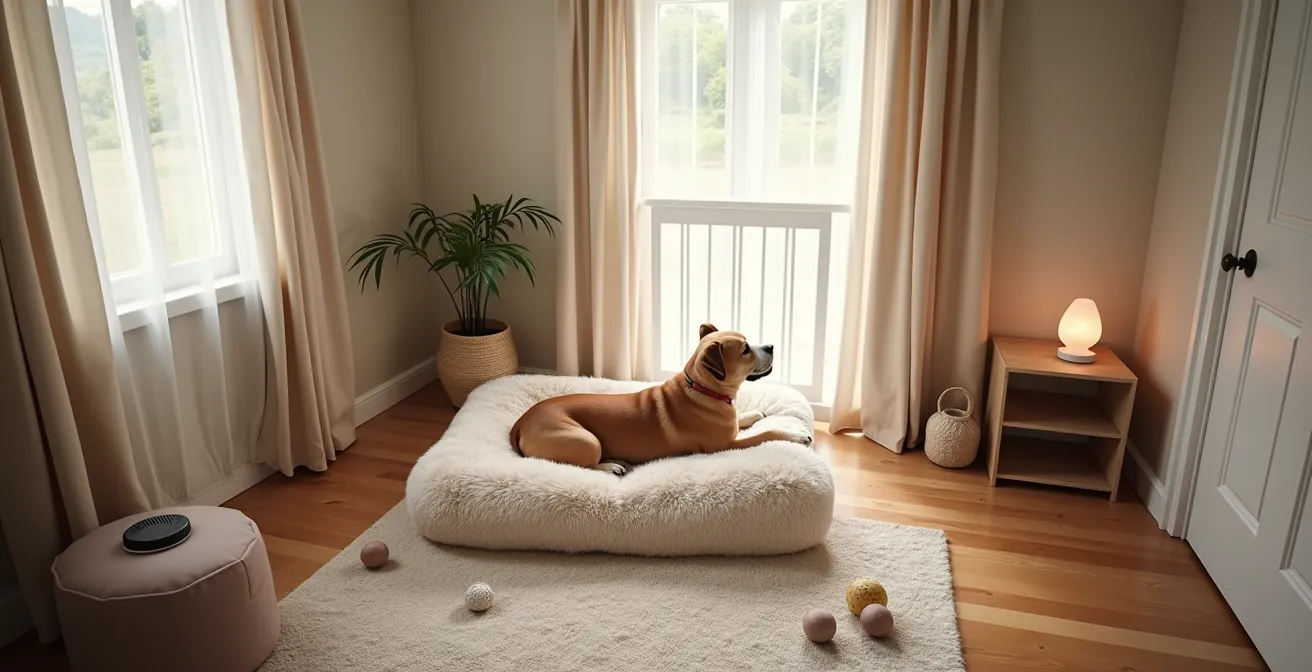
As you can see, this is about more than just isolation. It’s about creating a rich, calming experience that allows your dog’s nervous system to down-regulate. You are giving them an alternative to being on high alert, allowing their “stress budget” to replenish instead of being further depleted. A dog calmly enjoying a frozen Kong in a quiet room is a management success story.
Here’s how to set up an effective sensory sanctuary:
- Choose a quiet room away from main entry points and high-traffic areas.
- Install a white noise machine or play calming canine-specific music to buffer startling sounds.
- Set up a pheromone diffuser (like Adaptil) at least 48 hours before you need it to allow it to permeate the space.
- Provide high-value, long-lasting enrichment, such as a frozen Kong, a lick mat, or a puzzle feeder, to encourage calming behaviors and release endorphins.
- Create visual barriers by covering windows or the crate if your dog is visually reactive.
- Place comfortable bedding with one of your worn clothing items to provide scent comfort.
- Ensure the dog has easy access to fresh water and that the room is a comfortable temperature.
Muzzle vs Head Halter: Which is the responsible choice for a reactive walker?
If we punish a dog’s warning signals without putting in the training to make them feel better about the situation, then what we will end up with is a dog who no longer gives those warning signals, but still feels uncomfortable.
– Happy Hound University, Why We Never Punish Growling
Choosing the right walking equipment for a reactive dog is a matter of safety and ethics. The two most common tools considered are head halters and basket muzzles, but they serve fundamentally different purposes. A head halter is a “power steering” tool; it provides directional control for strong pullers. A basket muzzle is a safety net; its primary function is to prevent a bite from making contact. For a dog with a bite risk, the responsible choice is unequivocally a properly conditioned basket muzzle.
A head halter can often increase stress. The pressure on the face and muzzle can be aversive, adding another negative stimulus to an already stressful walk. It physically prevents the dog from turning its head to react, but it does nothing to change the dog’s emotional state. In contrast, a well-fitted basket muzzle, once positively conditioned, is simply a piece of safety equipment. The dog can still pant, drink, and even take treats through it. It allows the dog to exist in the world safely while you work on the underlying emotional issues through training like counter-conditioning and desensitization.
The public perception of muzzles is often negative, but this is a human problem, not a dog problem. A colorful, custom-made basket muzzle can help signal that you are a responsible owner, not someone with a “bad dog.” The priority must always be safety—for your dog, for yourself, and for the public. A muzzle provides that safety net, allowing training to happen without the constant fear of a catastrophic mistake. As one training resource makes clear in their comparison of management tools, the functions are distinct.
| Factor | Basket Muzzle | Head Halter |
|---|---|---|
| Primary Function | Safety net – prevents bites | Power steering – controls direction |
| Stress Level | Low once conditioned | Can increase stress from face pressure |
| Panting/Drinking | Fully possible | Possible but may restrict |
| Training Time | 2-4 weeks for positive association | 1-2 weeks for basic acceptance |
| Public Perception | Often negative (use colorful designs) | Generally more accepted |
| Best For | Fear-based reactivity, bite prevention | Pulling issues, directional control |
The “Threshold” Mistake: Pushing your dog too close to the scary object
One of the most common and damaging mistakes I see owners make is misunderstanding a dog’s “threshold.” Your dog’s threshold is the point at which they can notice a trigger (like another dog or a person) but remain calm and able to think. This is the “learning zone” where training can happen. Pushing them past this point—getting too close to the scary object—is counterproductive and dangerous. When a dog goes “over threshold,” their brain function fundamentally changes.
As one expert resource explains, the dog’s brain gets hijacked. When dogs become so reactive that they stop responding to cues or taking treats, they’ve shifted from the thinking brain (prefrontal cortex) to the reactive brain (amygdala). In this state, they are incapable of learning. They are purely in a survival mode of fight, flight, or freeze. Continuing to expose them to the trigger at this proximity doesn’t “teach them it’s okay”; it floods their system with stress hormones and reinforces the idea that the trigger predicts a terrifying, overwhelming experience.
The key to successful rehabilitation is learning to recognize the subtle signals your dog shows *before* they reach threshold. A growl is a late-stage signal. The whispers of discomfort come much earlier: a closed mouth, a shift in weight, a flick of the tongue, or “whale eye.” Your job is to see these whispers and create distance immediately, before they become a shout. Staying “sub-threshold” is the only way to build new, positive associations with triggers.
Your Checklist for Reading Pre-Threshold Signals
- Mouth State: Watch for a suddenly closed mouth when it was previously open and relaxed. This is a primary sign of tension.
- Eye Changes: Look for “whale eye,” where the whites of the eyes become visible as the dog watches a trigger without turning its head.
- Body Weight Shifts: Notice any subtle shifts in weight away from the trigger, even if the paws don’t move.
- Coat Condition: Check for sudden “stress flakes” or dandruff appearing on a dark coat, or even minor hair shedding.
- Mouth and Nose: Monitor for lip licking or nose licking when no food is present. This is a classic calming signal indicating discomfort.
How to execute an emergency U-turn when an off-leash dog approaches?
For any owner of a reactive dog, the sight of an off-leash dog bounding towards you is a moment of pure panic. This is not a training scenario; it is an emergency. Your only goal is to create space and get your dog out of there safely. Having a pre-practiced emergency escape plan is not optional—it’s a critical part of your management toolkit. The reality is that not all owners are responsible, and data from the postal service reveals that off-leash dogs are a major factor in attacks, highlighting the unpredictability you face on every walk.
The “Emergency U-Turn” is your primary move. Practice this in a calm environment: use a happy, upbeat tone, say “This way!”, and lure your dog in a 180-degree turn with a high-value treat. The goal is to make the turn a fun, fast, and rewarding game. When you see an off-leash dog, you can deploy this move instantly, turning and moving away briskly before your dog has a chance to fixate and react.
However, a U-turn isn’t always enough. You need multiple strategies to deploy depending on the situation. The key is to be proactive and decisive. Hesitation is your enemy. You are your dog’s advocate and protector; it’s your job to get them out of harm’s way, even if it feels socially awkward.
Here are several emergency escape techniques you must have in your arsenal:
- Execute a ‘Treat Scatter’: Your first and best defense. Throw a handful of high-value, smelly treats on the ground in the path of the approaching dog. This can often distract them long enough for you to escape.
- Deploy a Portable Barrier: Quickly open a small umbrella or a pop-up laundry hamper between your dog and the other dog. This visual block can interrupt the charge.
- Use Body Blocking: Confidently step in between your dog and the approaching one, using your body as a shield while you continue to move away.
- Advocate Loudly: Use your voice. Yell, “My dog is not friendly!” or “Please get your dog!” Be assertive and clear.
- Move Behind an Obstacle: Duck behind a parked car, a large tree, or a dumpster to break the line of sight.
- If Cornered, Drop the Leash: This is a last resort, but if an interaction is unavoidable and you are cornered, dropping the leash can prevent tangling and allow your dog to use flight if necessary, while reducing the tension you are sending down the lead.
The Hugging Mistake: Why embracing a dog often triggers a freeze response
Humans express affection through hugging; it’s a primary way we show love and comfort. For canines, however, being physically embraced and restrained is often interpreted as a threat. From an evolutionary standpoint, being held down or pinned is an act of aggression and signals extreme vulnerability. When a dog “freezes” during a hug, showing a stiff body, closed mouth, and wide eyes, this is not a sign of placid acceptance. It is a high-stress behavioral response that often precedes a defensive snap.
This “freeze” is a well-documented stress signal. Studies show that even in seemingly calm dogs, this isn’t acceptance but rather a high-stress response that may precede fight-or-flight reactions. Cortisol, the stress hormone, can spike during this kind of restraint-based affection. The dog is tolerating the interaction, not enjoying it. They are holding their breath, waiting for it to be over. A growl or snap in this context is the dog finally communicating, “I have been telling you I’m uncomfortable, and you haven’t listened.”
To interact with a dog safely and respectfully, you must learn to ask for their consent. Instead of forcing affection on them, invite it and see how they respond. This builds trust and gives the dog agency—a sense of control over their own body and interactions, which is fundamental to building confidence in a fearful dog.
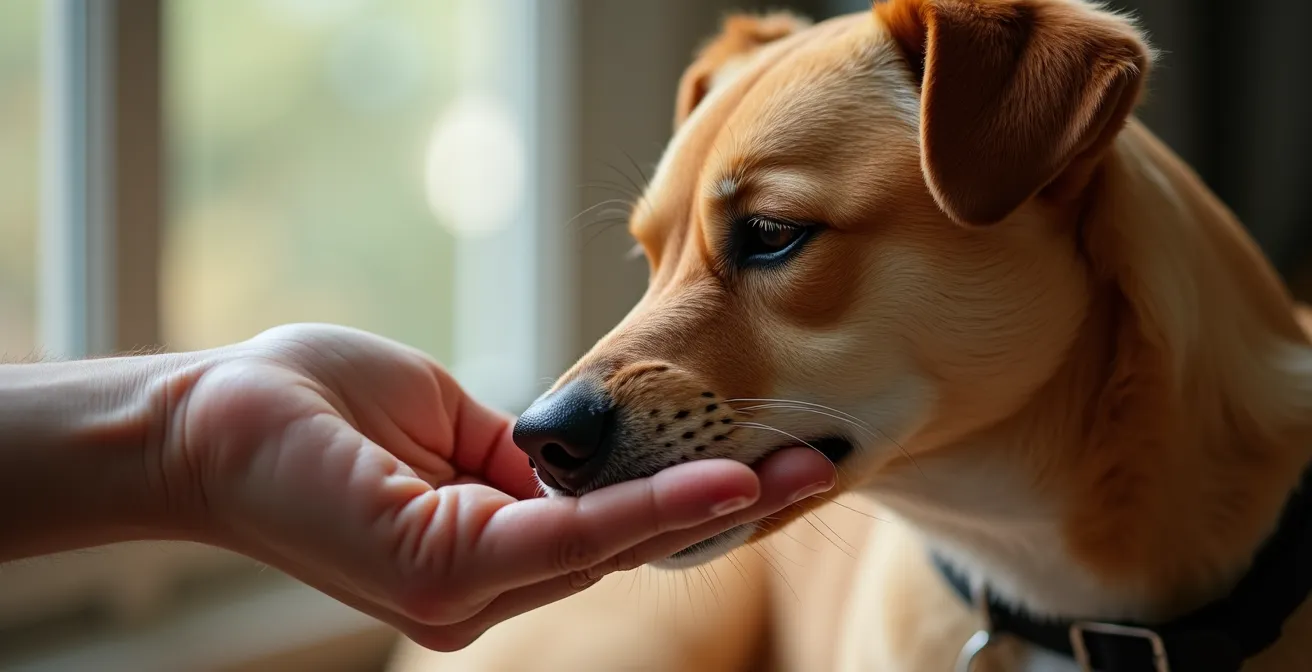
The best way to do this is with “The Canine Consent Test.” It’s a simple, powerful protocol that changes the dynamic from a one-way interaction to a two-way conversation.
- Pet the dog gently on the chest or shoulder for exactly 3 seconds. Avoid the top of the head.
- Completely remove your hand and lean back slightly. Pause and observe.
- If the dog leans in, nudges your hand, or paws at you: This is clear consent. They are asking for more. You may continue.
- If the dog turns away, licks their nose, yawns, shakes off, or remains perfectly still: This is a “no.” They are not comfortable. Respect their choice and stop the interaction.
- Repeat this test frequently to continuously check in. A “yes” now doesn’t mean a “yes” in five minutes.
How to use “treat and retreat” to bond with a dog that flinches at touch?
For a dog that is fearful of human hands and flinches at touch, building trust can feel like an impossible task. Reaching for them, even with the best intentions, reinforces their fear that hands predict something scary. The “Treat and Retreat” game is a powerful counter-conditioning exercise that flips this dynamic on its head. It teaches the dog that your approach doesn’t predict being grabbed, but rather that it makes a delicious treat appear and then—crucially—that you will move away, relieving the pressure.
This game is powerful because it gives the dog agency. The dog learns that its calm presence makes the scary thing (the human’s hand) retreat, which builds confidence and control.
– Sandy Paws Positive Dog Training, Building Trust with Fearful Dogs
The power of this game lies in giving the dog control. They learn that they can make you retreat simply by taking a treat. This sense of agency is the antidote to fear. You are no longer someone who imposes themselves on the dog; you are a predictable and safe bringer of good things who respects their space. The retreat is just as important as the treat.
This process must be done slowly, always staying at a level where the dog is comfortable and successful. Watching their body language is key; if you see any signs of stress like lip licking, yawning, or a tense body, you have moved too fast. Go back to the previous, successful level for several sessions before trying to advance again.
Here is a progressive protocol for the Treat and Retreat game:
- Level 1: From a distance where the dog is relaxed, toss a high-value treat on the floor about 3 feet away from them. As soon as they move to get it, take one large step back.
- Level 2: Place a treat on the floor 2 feet away. As the dog approaches to take it, lean your body back to create space.
- Level 3: Offer a treat from your open, flat palm at arm’s length. The moment they take it, pull your hand back and step away.
- Level 4: Offer the treat from your palm. As they take it, briefly (1 second) touch their shoulder with your other hand, then immediately retreat.
- Level 5: Offer the treat while applying a gentle, 2-second touch or stroke on their shoulder or chest, then retreat and assess their comfort level.
Key Takeaways
- A growl is not aggression to be punished; it is critical data about your dog’s stress level to be acted upon by creating distance.
- “Trigger stacking” is the most common cause of “unprovoked” bites. Your job is to manage your dog’s daily stress budget.
- Safety tools like basket muzzles are not a sign of failure. They are responsible management that enables safe training to occur.
Walking a Fear Reactive Dog in the City: Strategies to Avoid Triggers
Walking a reactive dog in a dense urban environment can feel like navigating a minefield. Every corner could hide a trigger: a person appearing suddenly, a dog barking from a balcony, the screech of a bus. For these dogs, a “normal” walk is not enriching; it is a constant barrage of stressors that depletes their stress budget. The most effective strategy is not to force your dog to cope, but to proactively manage the environment to avoid triggers altogether.
This begins with reconnaissance. Walk your neighborhood *without* your dog at different times of day to map out your environment. Your goal is to identify safe zones and red zones. Wide streets with good visibility are your friends. Narrow sidewalks next to busy doorways are your enemies. This “Urban Environment Mapping” allows you to create a rotation of safe walking routes that minimize the chance of surprise encounters.
Here is how to create a strategic map of your neighborhood:
- Identify escape routes: Note wide driveways, alleys, and empty parking lots you can duck into for an emergency U-turn.
- Mark ‘red zones’: Pinpoint high-traffic areas to avoid, such as dog parks, schoolyards during dismissal, and restaurants with outdoor seating.
- Document quiet times: The best times for a walk are often very early in the morning (5-7am) or late at night (9-11pm) when there is less activity.
- Find alternative locations: Think outside the box. Industrial parks or office complexes are often deserted on weekends. Some cemeteries allow leashed dogs and offer quiet, wide paths.
Finally, reconsider the goal of the walk. For a fearful dog, a short, 20-minute “sniffy walk” where they are allowed to lead the way and gather information with their nose can be far more therapeutic than a long, structured heel. As one case study found, a 20-minute ‘sniffy walk’ focused entirely on allowing the dog to investigate scents proved more beneficial for reducing reactivity than a 1-hour structured heel walk. The mental enrichment lowers overall stress, making them more resilient. By controlling the environment and the goal of the walk, you set your dog up for success.
Your role is not that of a disciplinarian, but a protector. You are your dog’s guide and advocate in a world that they often find confusing and overwhelming. Start today by observing their quiet signals, creating space, managing their environment, and becoming the safe harbor they need to feel secure. This is the path to true trust and a safer life for everyone.