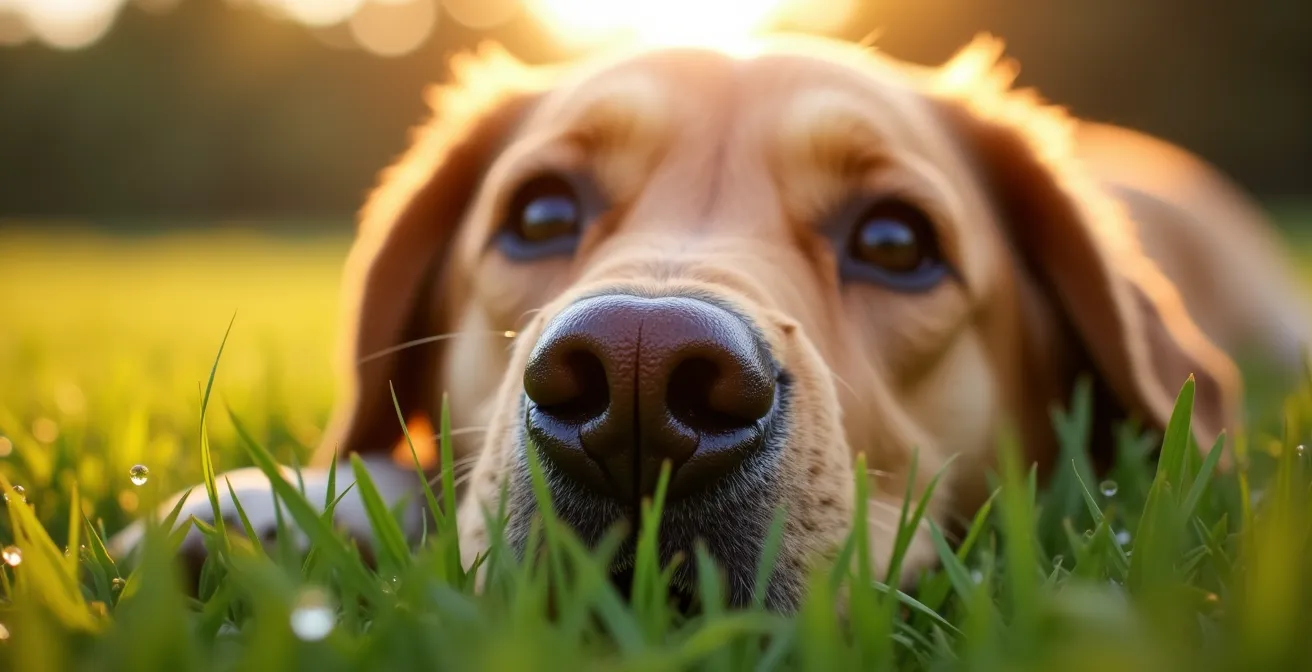
The endless cycle of running your dog only to find them still hyper isn’t a failure of effort, but a fundamental misunderstanding of canine energy.
- Canine exhaustion is primarily a cognitive state, not just a physical one. True tiredness comes from mental work.
- A short scent walk forces a dog’s brain to process a massive stream of sensory data, creating more “brain burn” than a long, monotonous run.
Recommendation: This week, swap one high-impact run for a slow, 20-minute meandering scent walk and observe the profound difference in your dog’s calmness.
You’ve done everything by the book. You’ve taken your energetic dog on long runs, played endless games of fetch, and visited the dog park until closing. Yet, after a brief nap, they’re back to bouncing off the walls, a furry ball of unspent energy. This frustrating cycle leads many well-intentioned owners to believe they simply aren’t doing enough. The common wisdom, “a tired dog is a good dog,” pushes us to focus exclusively on physical mileage, measuring success in kilometers covered rather than in quality of experience.
But what if we’ve been measuring exercise with the wrong metric? What if the key to a truly calm and fulfilled dog isn’t found in physical endurance, but in sensory engagement? The transformative truth is that a dog’s brain is far more powerful—and energy-hungry—than their legs. The solution isn’t necessarily a longer run, but a smarter, slower, and more scent-focused walk that provides a deep neurological workout.
This guide deconstructs the science behind the “scent walk” or “sniffari.” We will explore why this seemingly passive activity is a form of intense mental labor for your dog. We will cover the practical techniques for making these walks successful and demonstrate how prioritizing sensory data over distance can fundamentally change your relationship with your dog and finally bring peace to your household.
By understanding the concepts within this article, you will gain a new perspective on canine exercise and enrichment. The following sections break down the science, the practical skills, and the strategic applications of the scent walk.
Summary: Why a 20-Minute Scent Walk Tires Your Dog More Than a 1-Hour Run
- Why stopping every 5 feet is mental algebra for your dog?
- Why 15 minutes of sniffing burns as many calories as a 1-hour walk?
- The “Heel” Myth: Why strict heeling devalues the decompression walk?
- How to handle a 15ft leash without tripping or getting tangled?
- New Neighborhood vs Same Park: Which offers better sensory data?
- How to exercise an arthritic dog without causing a flare-up the next day?
- When to do a sniff walk: Pre-guests arrival to ensure a calm dog?
Why stopping every 5 feet is mental algebra for your dog?
To a human, a walk is a linear journey from point A to point B. To a dog, a walk is an immersive dive into a world of information. When your dog stops abruptly to sniff a single blade of grass, they aren’t being stubborn; they are downloading and processing a massive amount of sensory data. Their world is not primarily visual, but olfactory. With an incredible 200-300 million scent receptors compared to our paltry 6 million, a dog’s nose is a sophisticated biological sensor. Each sniff pulls in a complex story about which dogs have been there, their gender, their health, their emotional state, and how long ago they passed by.
This is not a passive activity. It is active cognitive labor. Your dog’s brain must rapidly identify, categorize, and interpret these layers of scent. It’s the canine equivalent of solving complex algebra problems. They are piecing together a timeline, building a social map, and making predictions. This is why a dog might be a “drive-by sniffer,” taking quick samples of many scents, or a “deep investigator,” focusing intensely on one spot to unravel a particularly complex narrative. The constant analysis creates significant cognitive load, which is far more tiring than the repetitive physical motion of running.
By constantly pulling them away, we interrupt this crucial mental process. Allowing them to stop and “read the news” isn’t a luxury; it’s a fundamental need for their mental well-being. Each pause is a moment of intense brain activity, contributing directly to their overall “tiredness” budget for the day. This mental expenditure is the secret to achieving a state of calm fulfillment that physical exercise alone can rarely provide.
Why 15 minutes of sniffing burns as many calories as a 1-hour walk?
The idea that a short, slow walk could be as tiring as a long run seems counterintuitive, but it hinges on a different definition of “tiring.” We tend to think only in terms of physical calorie burn, but the brain is an incredibly energy-intensive organ. While a run burns physical fuel, a scent walk burns cognitive fuel. This mental energy expenditure is what leads to a calm, settled state in a dog, which is often what owners are truly seeking when they say they want a “tired” dog.
Canine enrichment experts have observed this phenomenon for years, and it’s a game-changer for owners of high-energy breeds. In fact, many experts confirm that 20 minutes of sniffing is as enriching and tiring for a dog as a full hour of walking or running. This isn’t about burning fat; it’s about satisfying the brain’s deep-seated need to perform its primary function: interpreting the olfactory landscape.
As the dog’s brain works overtime to process scents, their respiration rate increases, and their heart rate can fluctuate, all contributing to energy use. AKC Certified Dog Trainer Staci Lemke, CPDT-KA, highlights this powerful effect:
Sniffing is a great form of canine mental stimulation, and it increases their respiration rate, so it’s a tiring activity.
– Staci Lemke, CPDT-KA, AKC Certified Dog Trainer
This explains why a dog might be physically capable of running another mile but is mentally “done” and deeply relaxed after a 20-minute sniffari. They have engaged in a fulfilling and demanding cognitive task, leading to a state of calm satisfaction that mere physical exhaustion cannot replicate.
The “Heel” Myth: Why strict heeling devalues the decompression walk?
The “heel” command is a valuable tool for safety and control in crowded or potentially dangerous situations. However, when misapplied as the default mode for an entire walk, it systematically strips the experience of all its enrichment value. A dog walking in a perfect, constant heel is not a partner on a journey; they are a passenger, mentally disengaged and simply following orders. Their focus is not on the environment but on maintaining their position relative to your leg. This turns a potentially rich cognitive workout into a mindless physical drill.
This type of walk is often called a “structured walk,” but a more accurate term for a scent-focused walk is a “decompression walk.” The goal is not structure and obedience, but mental release and autonomy. By allowing the dog to make choices—where to sniff, how long to linger, which direction to explore next—we empower them. This sense of agency is not just a nice-to-have; it’s a critical component of animal welfare.
This principle is supported by scientific research into animal behavior. A landmark study by researchers Duranton & Horowitz in Applied Animal Behaviour Science highlights that behaving naturally and making active choices are two key factors in an animal’s well-being. A dog in a strict heel is denied both. They cannot engage in the natural behavior of scent investigation, and they are making no choices of their own.
Therefore, a decompression walk requires a paradigm shift from the owner: your role is not to be a commander, but a facilitator. You are there to ensure safety while giving your dog the freedom to be a dog. This means letting go of the obsession with a perfect heel and embracing the meandering, stop-and-start nature of true canine exploration.
How to handle a 15ft leash without tripping or getting tangled?
The key to a successful decompression walk is giving your dog the freedom to explore, and that requires the right equipment. A standard 6ft leash is too restrictive, tethering the dog’s nose to the owner’s pace. A 15-to-30ft long line is the ideal tool, creating a radius of exploration that allows the dog to investigate scents without pulling the owner along. However, managing this much line can be intimidating and clumsy at first. The goal is to keep the leash from tangling, tripping you, or getting caught on obstacles.
The secret is to think of yourself not as an anchor, but as an active line manager. Your job is to smoothly gather and release slack as your dog moves, ensuring the line stays off the ground. This takes practice, but mastering a few professional techniques can make the process graceful and effective. The image below shows an owner giving their dog space to explore while maintaining a safe and organized connection.
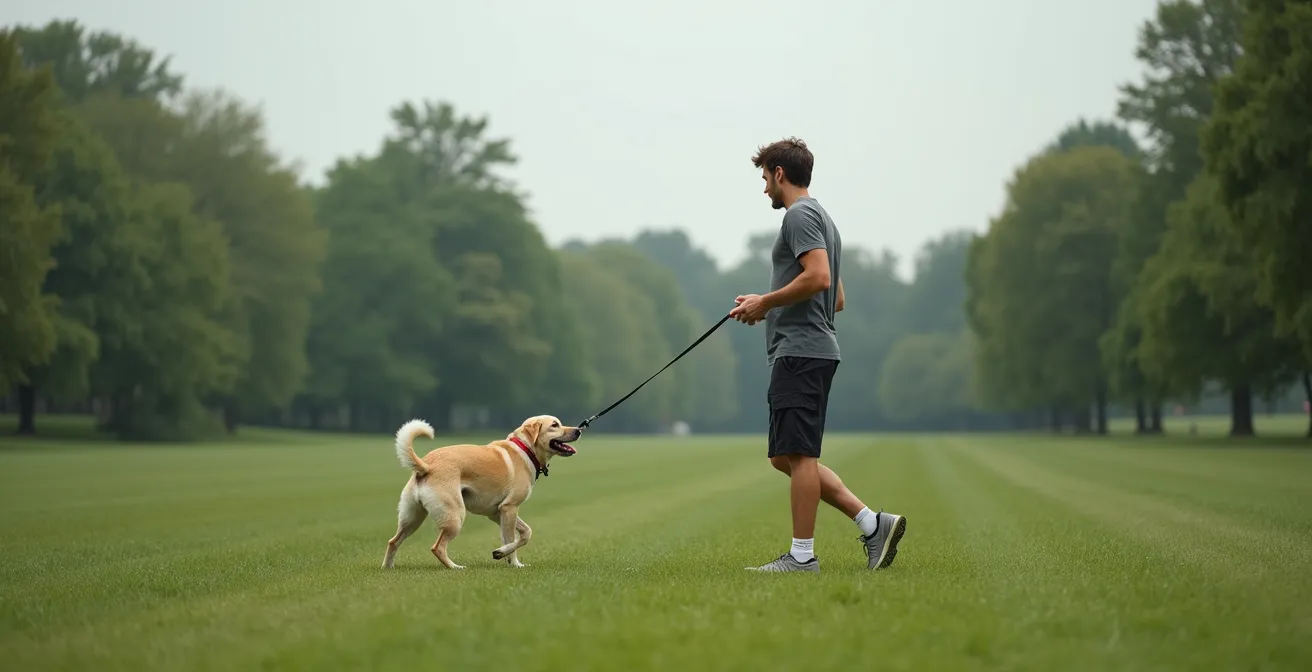
Moving from a short leash to a long line is a skill. To avoid frustration, it’s essential to learn the proper mechanics. The following checklist, based on techniques used by professional trainers, will help you manage a long line with confidence.
Your Action Plan: Mastering the Long Leash
- Use the ‘accordion method’: Constantly reel in and let out slack with one hand, gathering loops in your other hand, rather than letting the line drag on the ground.
- Keep the leash off the ground: This is the golden rule to prevent the line from tangling around your legs, your dog’s legs, or environmental obstacles like branches and posts.
- Choose Biothane material over nylon: As recommended by guides on scent walks, Biothane is a rubber-like material that doesn’t snag on brush, absorb water, or get heavy when wet.
- Position yourself based on the nose: Predict your dog’s next move by watching their nose direction, not just their current body position. This allows you to reposition yourself proactively.
- Practice in open areas first: Before navigating a trail with trees and benches, get comfortable with the accordion method in an open field or quiet park to build muscle memory.
New Neighborhood vs Same Park: Which offers better sensory data?
Once you’ve embraced the scent walk, a new question arises: where should you go? Is it better to explore a brand-new environment every day or to stick to a familiar route? The answer is that both have unique and valuable benefits, and the best choice depends on your dog’s individual personality and your enrichment goals for that day. A new neighborhood offers breadth of information, while a familiar park offers depth.
A walk through a new neighborhood is like speed-reading the headlines of a dozen different newspapers. The scents are novel and diverse, providing a high volume of new sensory data. For a confident, curious dog, this can be incredibly exciting and stimulating. They’ll encounter traces of entirely new dogs, people, and wildlife, creating a broad but relatively shallow information stream. This is excellent for building confidence and providing a jolt of novelty.
Conversely, a walk through the same park is like reading a detailed, multi-chapter novel. The environment is familiar, but the story is constantly changing. Your dog can detect subtle shifts: which dog passed by this morning versus yesterday, whether a female in heat was here two hours ago, or if a raccoon visited the trash can overnight. This requires complex pattern recognition and provides a rich, layered historical context. For anxious or reactive dogs, this predictability is comforting and allows for deep investigation without the stress of total novelty.
The Animal Humane Society provides a helpful framework for understanding these differences. The following table summarizes the trade-offs between the two types of environments.
| Aspect | New Neighborhood | Same Park |
|---|---|---|
| Scent Variety | Novel, broad data | Deep, layered narrative |
| Mental Stimulation | High initial excitement | Complex pattern recognition |
| Stress Level | Higher for anxious dogs | Lower, predictable environment |
| Information Type | Shallow but diverse | Rich historical context |
How to exercise an arthritic dog without causing a flare-up the next day?
For senior dogs or those with mobility issues like arthritis, the old model of exercise becomes not just ineffective, but actively harmful. High-impact activities like running, jumping, or even long, forced-march walks can cause significant pain and inflammation, leading to a “flare-up” the next day. Owners are often caught in a difficult bind: they want to provide enrichment and exercise, but they are afraid of causing their beloved companion pain. The scent walk is the perfect solution to this dilemma.
A self-paced scent walk is the ultimate low-impact, high-enrichment activity. Because the dog is in control, they can dictate the pace and duration of movement. They can choose to spend five minutes sniffing in one spot, taking the pressure off their sore joints entirely. The focus shifts from physical endurance to mental engagement, which is exactly what these dogs need. They still get the cognitive burnout and satisfaction of a “walk” without any of the physical strain.
This approach allows them to fulfill their instinctual needs to explore and investigate their environment in a safe and comfortable way. For dogs who are even more limited in their mobility, the principles of scent work can be brought indoors.
Case Study: Self-Paced Sniffing for Senior Dogs
The Animal Humane Society consistently sees senior pets with achy joints benefit enormously from short, slow-paced walks that prioritize sniff breaks. This model provides essential mental enrichment without the physical toll of traditional exercise. By allowing these dogs to control their own pace and rest as needed, they remain engaged and happy while avoiding the pain and stiffness associated with forced, high-impact movement.
You can create indoor “sniffaris” by hiding treats in a snuffle mat or around a single room. Setting up stationary scent stations in the backyard with different smells (like a drop of vanilla extract on a leaf or a bit of shed fur from another pet) can provide a full cognitive workout without requiring more than a few steps of movement. This adaptive approach ensures that every dog, regardless of physical ability, can experience the profound benefits of scent enrichment.
When to do a sniff walk: Pre-guests arrival to ensure a calm dog?
Just as important as the “how” and “where” of scent walks is the “when.” By timing your decompression walks strategically, you can use them as a powerful tool to manage your dog’s emotional state and behavior. Instead of viewing the walk as a simple potty break, think of it as a proactive intervention to regulate their nervous system. This is particularly effective for managing excitability or anxiety around specific events.
One of the most effective applications is conducting a 30-minute scent walk about an hour before guests arrive. For dogs who get over-excited or anxious with visitors, this isn’t just exercise; it’s a cognitive off-load. By fulfilling their deep need to sniff and process information, you are mentally tiring them out. Studies show that the act of sniffing releases dopamine, the “feel-good” neurotransmitter, and can lower a dog’s heart rate. This proactively puts them into a calmer, more relaxed state of mind before the doorbell ever rings, making them less likely to react with frantic energy.
This same principle applies to other stressful situations. A short scent walk immediately after a vet visit or grooming appointment can act as a “post-stress debrief,” allowing the dog to decompress and regulate their nervous system by focusing on a calming, natural behavior. Similarly, a 10-minute “pre-training primer” can help a distracted dog focus better during a training session by first satisfying their need to check out the environment. An evening walk becomes a way to process the day’s social information, and an early morning walk connects them with fresh scents from nocturnal wildlife. By being intentional with your timing, the scent walk transforms from a routine into a targeted wellness tool.
Key Takeaways
- A dog’s exhaustion is primarily cognitive; mental work like sniffing is more effective for creating calm than purely physical exercise.
- True enrichment requires giving your dog agency. Ditch the strict “heel” on decompression walks and let them lead with their nose.
- The right gear is essential. A 15ft+ long line is the key to unlocking a dog’s natural exploratory behavior safely and effectively.
When to walk: The 5 AM club vs late night strategies
For the dedicated scent walk enthusiast, optimizing the “when” goes even deeper, down to the very physics of scent itself. The quality and availability of olfactory data in the environment are not constant; they are dramatically affected by time of day, weather, and temperature. By understanding these variables, you can choose a time that offers the richest possible olfactory landscape for your dog.
The two prime times for a high-quality sniffari are early morning and late evening. The reason is simple: scent molecules travel and linger better in cool, humid air. During the heat of a sunny afternoon, rising warm air and low humidity cause scent particles to disperse and evaporate quickly. However, environmental science shows that cool, damp conditions, typical of dawn and post-dusk, hold scent molecules closer to the ground, making them more available and potent for a dog’s nose. This is why many hunting dogs work best in the early morning.
The “5 AM Club” walk offers access to undisturbed “scent trails” left by nocturnal wildlife like raccoons, foxes, or deer. The air is cool, the ground is often dewy, and the sensory data is fresh and potent. This is a tracker’s paradise. In contrast, a late-night walk (8-10 PM) offers a different kind of richness. While wildlife scents may be present, this is the prime time to download the dense social information from the day’s activities. The scents of all the dogs who were walked in the neighborhood, the mail carrier’s path, and the neighbor’s barbecue all settle in the cool evening air, creating a complex tapestry of social news for your dog to interpret.
Ultimately, the best strategy is to vary your routine. An early morning walk provides a thrilling connection to the wild, while a late evening walk provides a deep dive into the neighborhood’s social fabric. Both offer a far richer cognitive experience than a walk in the hot, scent-poor conditions of midday.
Your journey to a calmer, more fulfilled dog doesn’t start with a longer run, but with a shorter, slower, more intentional walk. The change you’ll see won’t just be a less hyper dog, but a more connected and communicative partner. Try swapping just one run for one scent walk this week and watch the transformation begin.