In summary:
- Walking a reactive dog in a city isn’t about avoidance, but about becoming a skilled, tactical handler.
- Understanding “trigger stacking” and managing your dog’s cumulative stress is more important than the distance you walk.
- Mastering game-like escape maneuvers like the emergency U-turn builds confidence for both you and your dog.
- Using the urban environment, specialized gear, and strategic timing are key to reducing stressful encounters.
- A growl is communication, not disobedience. Punishing it removes the warning and increases the risk of a bite.
The feeling is all too familiar for urban owners of reactive dogs. Your hand tightens on the leash as you round a corner. Your eyes scan the street, not for its beauty, but for threats: another dog, a running child, a skateboarder. Every walk is a mission fraught with tension, and the common advice to “just avoid triggers” feels like a hollow platitude in the chaotic, unpredictable landscape of a city. You can’t control every variable, and the constant vigilance is exhausting.
Many guides focus on standard counter-conditioning, a valuable tool but one that’s difficult to implement when a trigger appears suddenly from a blind alley. They tell you to stay calm, but don’t give you the tools to actually feel in control. The result is often a cycle of reaction, frustration, and a growing dread of the very activity that should be a source of joy for you and your dog. This leaves both of you more stressed, not less.
But what if the goal wasn’t to create an impossible, trigger-free bubble? What if, instead, you could become a street-smart, tactical handler? This guide reframes the challenge. It’s not about hoping for empty streets; it’s about mastering proactive escape maneuvers, understanding the neurochemistry of stress, and learning to use the urban environment as an ally, not an enemy. We’ll move beyond simple avoidance and into the realm of skilled, confident navigation.
This article will provide you with a set of tactical strategies to manage your dog’s reactivity in the real world. We will break down the science of stress, teach you practical drills, evaluate essential gear, and shift your entire mindset from one of fear to one of empowerment. You’ll learn how to turn a panicked retreat into a planned maneuver and how to listen to what your dog is truly telling you.
Summary: A Tactical Guide to Walking Your Reactive Dog in the City
- Why “trigger stacking” means your dog reacts to a leaf after seeing a truck?
- How to train an emergency U-turn that feels like a game?
- Thundershirt vs Calming Cap: Which reduces visual stimuli effectively?
- The “Just One More Block” Mistake: Why over-walking makes reactivity worse?
- When to walk: The 5 AM club vs late night strategies
- How to execute an emergency U-turn when an off-leash dog approaches?
- How to use window film to stop barrier frustration in reactive dogs?
- Why Punishing a Growl Increases the Risk of a Bite Without Warning?
Why “trigger stacking” means your dog reacts to a leaf after seeing a truck?
You’ve experienced it: after a tense walk past a construction site and a near-miss with a bicycle, your dog suddenly has a massive reaction to a plastic bag blowing in the wind. This isn’t random; it’s “trigger stacking.” Think of your dog’s capacity for stress as a bucket. Each stressful event—a loud truck, a stranger getting too close, even your own tension traveling down the leash—adds a little water to the bucket. None of these events alone might cause an overflow, but their cumulative effect fills the bucket to the brim. The final, seemingly minor trigger (the leaf or the bag) is just the last drop that causes the bucket to spill over into a reactive episode.
The stress hormone cortisol is the key chemical player here. Each reactive event causes a spike, and it can take up to 72 hours for those hormone levels to return to baseline. If your dog has stressful encounters every day, their cortisol levels never have a chance to reset. They start each walk with their stress bucket already half-full, making them more likely to react and shortening the fuse for the next explosion. This is a physiological response, not a behavioral choice. In fact, compelling research from Bristol University demonstrates that dogs can even absorb stress from their owners, showing more pessimistic responses after smelling human stress odors.
Understanding this concept is the first step to proactive management. It shifts the focus from blaming the dog for the final reaction to managing their overall stress load. This means recognizing “invisible triggers” like traffic noise or subway vibrations and scheduling “zero days” with no walks after a particularly stressful day to allow for a full cortisol reset. Your goal is to start every walk with as empty a bucket as possible.
How to train an emergency U-turn that feels like a game?
The emergency U-turn is the single most important tactical maneuver in your urban toolkit. This isn’t about yanking your dog in the opposite direction in a panic; it’s a slick, practiced drill that feels like a fun game. When you see a trigger in the distance, you cheerfully say your cue (like “This way!” or “Let’s go!”), turn 180 degrees, and reward your dog with a shower of high-value treats as they follow you. The goal is for your dog to associate the cue and the turn with an exciting “treat party,” not with the appearance of something scary.
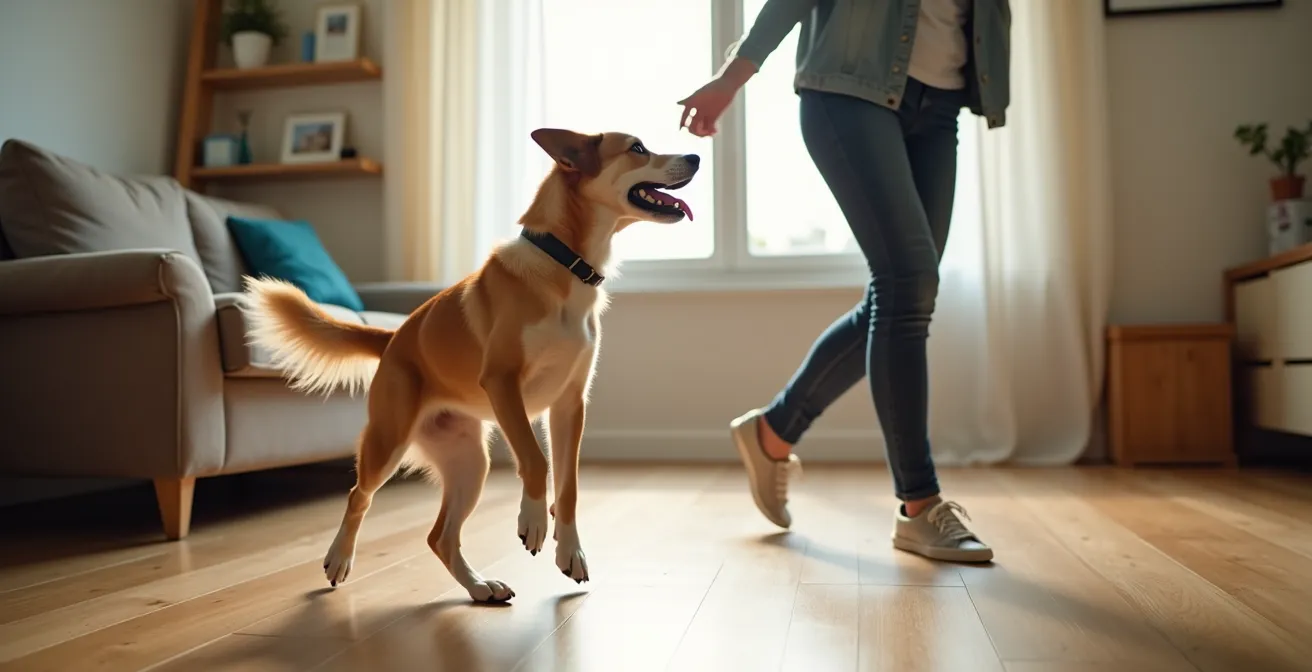
To achieve this, you must practice relentlessly in low-stress environments, starting in your living room. Make it fast, fun, and incredibly rewarding. Once the maneuver is fluid indoors, take it to your quietest outdoor space during an off-peak time. Practice it when there are no triggers around. Your dog should learn that the “This Way!” game can happen at any time and always results in something wonderful. This builds a strong, positive conditioned response that will override the instinct to fixate on a distant trigger.
Beyond the basic U-turn, your urban environment demands a few variations. The “Side-Step Shimmy” involves quickly ducking into a building alcove or doorway when a narrow sidewalk prevents a full turn. The “Treat Scatter” is another essential move: as you turn, you toss a handful of treats on the ground behind your dog. This creates a rewarding treasure hunt that immediately gets their nose to the ground and their brain focused on sniffing, a naturally calming activity. As you move away, you can continue to drop treats to keep them engaged with you. Reward any time your dog voluntarily checks in with you after the turn is complete—this reinforces that you are the source of safety and fun.
Case Study: Patricia McConnell’s U-Turn Success
Renowned animal behaviorist Patricia McConnell successfully used this exact technique to rehabilitate her own dog, Willie, from severe dog reactivity. Her key advice is to practice it “like a fun game with no other dogs around, (Wheee! Lots of treats for turning fast!)” before ever attempting to use it in a real-world scenario. This pre-emptive, positive training is what makes the maneuver reliable when you actually need it.
Thundershirt vs Calming Cap: Which reduces visual stimuli effectively?
Part of your tactical approach involves managing your dog’s sensory input. While you can’t control the whole city, you can control what your dog directly sees and feels. Tools like anxiety vests and calming caps are not magic wands, but they can be effective pieces of gear when used correctly. The key is to understand their different mechanisms. A ThunderShirt, for example, applies gentle, constant pressure to the dog’s torso. This is a form of Deep Pressure Therapy, which has a calming effect on the nervous system for many dogs, similar to swaddling an infant.
A Calming Cap (or ThunderCap), on the other hand, works by reducing visual stimuli. It’s a sheer fabric hood that fits over the dog’s head, diminishing the intensity and detail of their sight without blinding them. This is particularly useful for dogs who are triggered by specific visual cues from a distance, like the shape of another dog or the rapid movement of a cyclist. By filtering the visual information, it can prevent the dog from fixating and allow the handler to manage the situation before the dog goes over threshold. It’s crucial, however, that the dog is gradually and positively desensitized to wearing the cap first.
For dogs whose reactivity is triggered by the cacophony of the city, noise-reducing earmuffs like Mutt Muffs can be a game-changer. These tools help to lower the overall volume of the environment, which in turn helps to keep the stress bucket from filling too quickly. The following table breaks down these options to help you choose the right tool for your dog’s specific needs. An analysis of these tools shows that a ThunderShirt, for example, is reported to be effective in up to 80% of cases for general anxiety.
| Tool Type | Primary Function | Best For | Effectiveness | Usage Notes |
|---|---|---|---|---|
| ThunderShirt | Deep pressure therapy via compression | General anxiety, thunderstorms, separation anxiety | 80% reported improvement | Use preemptively before known stressors |
| Calming Cap/ThunderCap | Reduces visual stimuli through mesh fabric | Visual triggers, reactive dogs in busy environments | Variable effectiveness | Must be gradually desensitized first |
| Mutt Muffs | Noise reduction earmuffs | Sound-triggered reactivity in urban settings | Reduces noise by 20-25 dB | Critical for dogs triggered by city sounds |
The “Just One More Block” Mistake: Why over-walking makes reactivity worse?
There’s a pervasive myth that a tired dog is a good dog, leading many well-intentioned owners to push for longer and longer walks, even with a reactive dog. This is the “just one more block” mistake, and it’s a primary way we inadvertently fill our dogs’ stress buckets to overflowing. As Pawsitive Futures Dog Training notes, “Each time your dog has a reactive response, cortisol levels spike, their heart rate elevates, and adrenaline goes pumping through their body.” Forcing your dog to endure one more block of potential triggers when they are already near their limit is a recipe for disaster. It doesn’t tire them out in a healthy way; it marinates them in stress hormones, making future reactivity more likely.
The solution is to radically redefine what a “successful walk” means. It’s not about distance covered; it’s about calm minutes achieved. A successful walk might be just 10 minutes long, ending on a positive note before your dog has even had a chance to get stressed. This is far more beneficial than a 45-minute walk that includes three reactive episodes. Learn to distinguish between different types of walks. A “Sniffari” or decompression walk should be short (under 10 minutes), in a safe and quiet area, where your dog is allowed to simply sniff and be a dog. These are for stress relief. “Training Missions” are separate, focused sessions where you work on skills like your U-turn.
When neighborhood walks are too stressful, you need alternatives. Ten minutes of indoor mental work, like puzzle toys or nose work games, can be just as tiring for a dog as a 30-minute physical walk. Using apps like Sniffspot to rent private, fenced-in yards can provide a safe outlet for off-leash exercise without any trigger exposure. The ultimate goal is to protect your dog’s mental state and ensure their stress bucket has a chance to empty, which makes real-world training more effective in the long run.
When to walk: The 5 AM club vs late night strategies
In an urban environment, timing is everything. Becoming a student of your neighborhood’s rhythms is a core tactical skill. The world at 5 AM is vastly different from the world at 5 PM. Joining the “5 AM club” or becoming a late-night walker can dramatically reduce the number of triggers you encounter. During these off-peak hours, there are fewer dogs out, less traffic, and a general quiet that can be incredibly calming for a nervous dog. As dog training professionals at Upstate Canine Academy advise, owners should “take quieter routes or consider walking during off-peak hours” as a foundational strategy while working on reactivity.
Your mission is to become a neighborhood intelligence agent. Actively map out your local rush hours. This includes more than just commuter traffic. Note the school drop-off and pick-up times (roughly 7-9 AM and 3-4 PM), the peak dog walker hours (often 5-7 PM), and even the weekly garbage truck schedule. Use weather to your advantage; a drizzly afternoon is often far quieter than a bright, sunny morning. This isn’t about hiding, it’s about making smart, strategic choices to set your dog up for success.
Expand your definition of “walkable areas.” On weekends, quiet industrial parks or office complexes can become your private walking grounds. College campuses and even cemeteries during off-hours often offer wide open spaces with excellent visibility, allowing you to spot potential triggers from hundreds of feet away. The final, and perhaps most important, factor is to balance your dog’s needs with your own. A sleep-deprived, tense handler is a major trigger for a sensitive dog. Choose a sustainable schedule that doesn’t burn you out. A calm, confident handler is the best asset a reactive dog can have.
How to execute an emergency U-turn when an off-leash dog approaches?
This is the scenario that strikes fear into the heart of every reactive dog owner: you’re on a narrow sidewalk, and an off-leash dog comes bounding towards you, its owner yelling “He’s friendly!”. Your practiced U-turn is your first line of defense, but sometimes you need a more robust protocol. Your primary goal is to create space and time to escape. First, try to stop the approaching dog. Plant your feet, put up a hand in a “stop” signal, and use a firm, loud “SIT!” or “STOP!” command. Many dogs, even strangers, will respond to a basic command delivered with authority.
If the dog keeps coming, it’s time to deploy the “Treat Bomb.” This involves scattering a large handful of very smelly, high-value treats directly in the path of the approaching dog. This is not rewarding the other dog; it is a defensive maneuver designed to create a “scent minefield” that will hopefully stop them in their tracks to hoover up the food, buying you precious seconds to execute your U-turn and retreat. As you move away, you can also position your body as a “human shield,” stepping confidently between your dog and the other dog to create a physical barrier.
For an extra layer of non-violent defense, some handlers carry a small, pop-up umbrella. Opening it suddenly creates a surprising visual barrier that can startle and deter an approaching dog without causing any harm. After any such incident, your walk is over. Immediately head home. Once in a safe space, scatter some treats on the floor for your dog to sniff out. This helps them decompress and end the experience on a more positive note. It’s also a moment to reflect on your own leash handling. As experts from Aggressive Dog Training Specialists warn, leash handling is crucial, as poor skills can increase reactivity and lead to dangerous situations.
How to use window film to stop barrier frustration in reactive dogs?
Managing reactivity isn’t just an outdoor job. For many dogs, the home is not a sanctuary but a source of constant stress. Every person, dog, or squirrel that passes by the front window can trigger barking, lunging, and a spike in cortisol. This is known as barrier frustration, and it means your dog’s stress bucket is filling up before you even clip on the leash. One of the most effective and affordable tools for managing this is decorative window film. It obscures the view, preventing your dog from constantly monitoring and reacting to the outside world.
The type of film you choose depends on your dog and your home’s layout. For ground-floor apartments or windows facing a busy sidewalk, a completely obscured frosted or rice-paper film is often best. It blocks the trigger entirely while still letting in natural light. For dogs who might be made more anxious by a total loss of visibility, a one-way mirror film can be a good compromise, allowing them to see out while preventing people from seeing in (though this is less effective at night when indoor lights are on). For a less severe case, patterned film can break up the shape of triggers enough to prevent a reaction.
You don’t necessarily have to cover the entire window. A “bottom-half application” is often sufficient to block the sightline of most dogs while preserving the view for the humans in the house. This environmental management is critical, especially when considering that up to 50% of companion dogs suffer from noise sensitivities, and a visual trigger is often paired with a startling sound. By creating a calmer home environment, you ensure your dog has a place to truly rest and their stress bucket can actually empty.
| Film Type | Visibility Level | Best Application | Pros | Cons |
|---|---|---|---|---|
| Frosted Film | Completely obscured | Ground floor windows facing sidewalks | Total visual barrier | Reduces natural light |
| One-Way Mirror Film | See out, not in | Dogs who need environmental awareness | Maintains dog’s ability to survey | Less effective at night with indoor lights |
| Patterned Film | Partially obscured | Breaking up trigger shapes | Decorative, allows light | May not block all triggers |
| Bottom-Half Application | Lower portion blocked | Standard height dogs | Preserves light, blocks dog’s sightline | Taller dogs may still see over |
Key Takeaways
- Stress is Cumulative: Manage the “stress bucket,” not just the single trigger. A reaction is often the result of many small stressors stacking up.
- Maneuvers are Skills: Reframe escape tactics like the U-turn as a fun, practiced game. A confident retreat is a strategic victory, not a failure.
- A Growl is Information: Treat a growl as a “thank you” for the warning. Punishing it erases the warning signal, creating a dog that may bite without notice.
Why Punishing a Growl Increases the Risk of a Bite Without Warning?
Of all the mistakes a handler can make with a fearful or reactive dog, punishing a growl is perhaps the most dangerous. In our human world, a growl feels threatening and disobedient. In the canine world, it is vital communication. A growl is your dog’s way of saying, “I am incredibly uncomfortable with this situation. Please create distance. I am trying very hard not to escalate.” It is a warning, a plea for help, and a sign that your dog is over their threshold. When you punish that growl—with a leash pop, a scolding, or any other aversive method—you are not teaching the dog to be less afraid. You are teaching them that their warning signals are not safe to use.
The result is a dog who learns to suppress their warnings. They may stop growling, but the underlying fear or anxiety hasn’t gone away. You have simply taken the batteries out of the smoke detector. This creates a much more dangerous animal: a dog that may now go directly from a subtle stress signal (like a lip lick or “whale eye”) to a bite, with no audible warning in between. You have inadvertently trained your dog to bite without warning. This is why a positive-reinforcement approach is not just “nicer,” but significantly safer.
As the American Animal Hospital Association states with no ambiguity, you must never punish a dog for being afraid. This is a critical principle for building a relationship based on trust.
Studies show that animals subjected to aversive training techniques are less likely to learn and punishment causes long-lasting mental trauma. Never punish your dog, especially when she’s scared, because you will increase her fear.
– American Animal Hospital Association, How can I safely walk my reactive dog?
Instead of punishing the growl, you must honor it. The moment you hear it, your job is to create distance from the trigger immediately. This teaches your dog two crucial things: first, that their communication works, and second, that you are their protector who will listen to them and keep them safe. Each time you do this, you make a deposit in your “trust account,” strengthening your bond and building a more confident, resilient dog.
Action plan: The “Thank You and Retreat” Protocol
- Reframe your mindset: When you hear a growl, your first internal thought must be ‘Thank you for the warning,’ not ‘Stop that.’
- Create immediate distance: Honor the growl by calmly but quickly executing a U-turn or side-step to move away from the trigger. Do not punish.
- Build the Trust Account: Acknowledge that by respecting their warning, you are proving that you are a reliable and safe handler. This is a deposit in your relationship bank.
- Document the context: After the fact, make a mental or physical note of what exactly triggered the growl (distance, type of trigger, environment) to better predict and manage future situations.
- Reward alternative communications: Lavishly reward calmer warning signals your dog offers *before* a growl, such as looking away from a trigger or moving to stand behind you.
By shifting your mindset from one of control and correction to one of tactical management and communication, you can transform your relationship with your reactive dog. It’s a journey that requires patience, observation, and skill, but it is one that replaces dread with confidence. Start by implementing just one of these strategies today to begin building a safer, calmer future on your city walks.