
The common belief that post-operative recovery is a period of passive waiting is not just wrong—it’s dangerous. The only way to ensure a safe, smooth healing process is through active, strategic management.
- Complications like wound opening are not random accidents; they are preventable outcomes of failed supervision.
- A bored, confined pet is a risk. Redirecting their energy into mental games is safer and more effective than simply trying to “keep them quiet.”
Recommendation: Shift your mindset from a worried observer to a proactive recovery manager. This guide provides the tactical playbook to do just that, turning a stressful two weeks into a controlled and successful healing period.
Listen to me. The next two weeks will be challenging. You’re going to see your beloved pet confused, frustrated, and uncomfortable. Your instinct will be to soothe them, maybe bend the rules a little. I’m here, as your post-op recovery nurse, to tell you: you cannot. Your veterinarian performed a successful surgery; the success of the recovery is now entirely in your hands. Many owners think recovery is about using the “cone of shame” and simply waiting for time to pass. They focus on vague advice like “keep them quiet” and hope for the best.
This is a recipe for a late-night emergency visit. The key to a successful recovery without relying on heavy sedatives isn’t about hope; it’s about proactive management. It’s about understanding the *why* behind every rule, anticipating problems before they happen, and strategically redirecting your pet’s physical and mental energy. It’s about transforming a prison cell into a healing sanctuary and knowing the precise visual cues that separate normal healing from a brewing infection.
This guide is your shift report. We will not be dealing in generalities. We will cover the stark reality of wound licking, how to set up a confinement area that promotes calm, how to choose the right equipment to prevent self-trauma, and why brain games are your most powerful tool. We will also cover the precise timing of pain medication, the science behind calming pheromones, and the critical pre-surgery mistakes you must never make again. Your job for the next 14 days starts now.
Summary: The Nurse’s Guide to a 2-Week Post-Op Recovery Without Sedatives
- Why licking the wound causes dehiscence (opening) in less than 5 minutes?
- How to set up a confinement area that isn’t a jail cell?
- Inflatable Donut vs Surgical Suit: Which prevents licking without bumping into walls?
- The “Zoomies” Risk: Why brain games are safer than physical play during recovery?
- When to send a photo to the vet: Signs of infection vs normal crusting
- When to give nerve pain medication relative to activity for best effect?
- Why facial pheromones make a carrier feel safe during travel?
- The Pre-Surgery Error: Why you must stop fish oil 2 weeks before dental work?
Why licking the wound causes dehiscence (opening) in less than 5 minutes?
Let’s be perfectly clear: your pet’s tongue is the single greatest threat to their recovery. A common myth is that animal saliva is antibacterial. It is not. It is a soup of bacteria. A few minutes of unsupervised licking is not a minor setback; it is a catastrophic failure that can undo the surgeon’s work completely. The primary danger is wound dehiscence—the separation of the incision edges—which is the most common post-surgical complication and it can happen with alarming speed.
The rough, sand-papery texture of a cat’s or dog’s tongue is designed to remove material, and it does not discriminate between dead fur and delicate, healing tissue. When they lick, they are not “cleaning” the area. They are actively causing trauma and introducing infection. This action can and will:
- Introduce infection: The mouth is full of bacteria. Licking directly deposits these pathogens into the sterile surgical site.
- Damage sutures: The physical force of licking can easily loosen, break, or pull out stitches, causing the wound to open immediately.
- Create physical trauma: The tongue’s abrasive surface scrapes away the fragile new cells that are trying to bridge the incision gap, delaying healing and increasing scarring.
Do not underestimate the speed at which this happens. A determined pet can open a fresh incision in less than five minutes. This is not a risk you can “keep an eye on.” It requires a 100% effective physical barrier, 24 hours a day, without exception. This is the first and most important rule of proactive management. Your vigilance is the first line of defense.
How to set up a confinement area that isn’t a jail cell?
Confinement is non-negotiable. No running, jumping, or using stairs. However, a stark crate in the corner of the room will only increase stress and anxiety, which can hinder healing. Your goal is not to create a jail cell, but a “healing sanctuary.” This is a calm, comfortable, and enriching space where your pet feels secure, not punished. This proactive environmental setup is key to keeping them calm without needing sedatives.
The ideal recovery space, as recommended by veterinary professionals, should be in a quiet, draft-free room with a stable temperature between 68°F–75°F (20°C–24°C). It needs to have soft, clean bedding, and be positioned away from household chaos and stairs, but still within your line of sight for easy supervision. This is not isolation; it is controlled comfort.
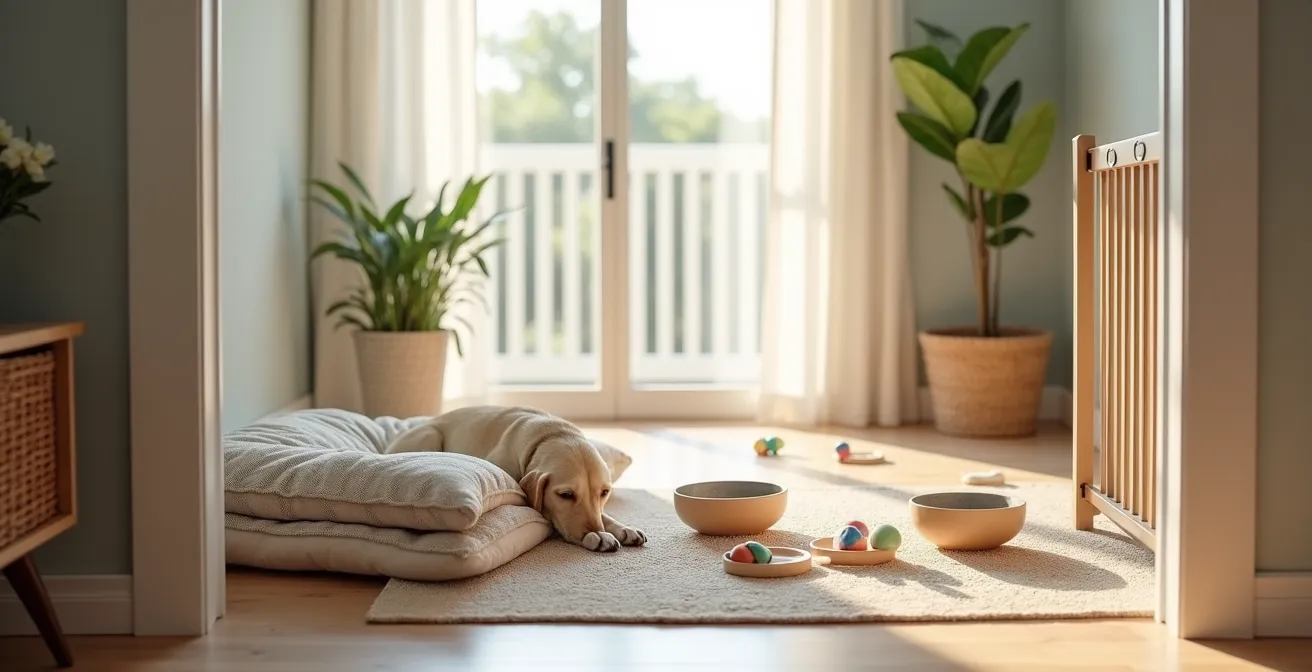
As you can see in this ideal setup, the environment is designed for calm and safety. Your sanctuary should include several key elements. Use baby gates instead of a closed door to provide a boundary without causing feelings of isolation. Provide an orthopedic bed to support their joints and ensure easy access to water. Most importantly, make this space special. Introduce puzzle toys and long-lasting treats that are only available in the recovery area. This builds a positive association with the space, turning it into a place of reward, not restriction.
Inflatable Donut vs Surgical Suit: Which prevents licking without bumping into walls?
The traditional plastic E-collar, or “cone of shame,” is effective but often miserable for the pet. They bump into walls, struggle to eat and drink, and their peripheral vision is cut off, which can be terrifying for an already anxious animal. Thankfully, we have better options. Your choice between an inflatable donut collar and a surgical recovery suit depends entirely on the location of the incision. This is a strategic decision, not one based on aesthetics.
As Greencross Vets Australia highlights, these alternatives can be a game-changer for a pet’s comfort and your sanity. For many, a surgical suit is a far superior choice for abdominal wounds.
For many dogs, a surgical recovery suit or pet recovery suit can be a comfortable and effective alternative to a cone. These bodysuits cover the wound, preventing licking while allowing for more freedom of movement.
– Greencross Vets Australia, Dog & Cat After Surgery Care Guide
The decision requires careful thought, as each device has specific applications and limitations. An inflatable donut is excellent for upper body, head, or neck wounds but will do nothing to stop a pet from reaching a back leg or their abdomen. Conversely, a surgical suit is perfect for torso incisions but offers no protection for limbs or paws. A detailed comparison is essential for making the right choice.
| Device Type | Best For | Advantages | Limitations |
|---|---|---|---|
| Inflatable Donut | Neck/shoulder wounds, short-snouted breeds | Better peripheral vision, more comfortable sleeping | Won’t prevent access to limb wounds |
| Surgical Recovery Suit | Abdominal/chest incisions | Full freedom of movement, covers wound directly | Doesn’t protect extremities, some pets can escape |
| Traditional E-Collar | All wound locations | Most foolproof protection | Restricts vision, causes stress for anxious pets |
Choose the tool that provides foolproof protection for the specific wound location. If you are ever in doubt, the traditional E-collar, while cumbersome, remains the gold standard for a reason. Do not sacrifice safety for comfort.
The “Zoomies” Risk: Why brain games are safer than physical play during recovery?
A few days into recovery, your pet will start to feel better. They will get bored. This is the most dangerous phase for a sudden burst of activity—the “zoomies.” A single moment of running or jumping can tear internal and external sutures, leading to a severe setback. Your job isn’t just to “keep them quiet”; that’s impossible. Your job is to redirect their energy. Mental stimulation is your most valuable tool here.
This isn’t just a distraction; it’s a biological hack. As veterinary experts at PetMD confirm, 10-15 minutes of puzzle toys can tire a dog as much as a 30-45 minute walk. Sniffing, problem-solving, and concentrating are exhausting activities that satisfy your pet’s need for stimulation without putting any physical strain on their healing body. This is how you manage a high-energy dog without sedatives.
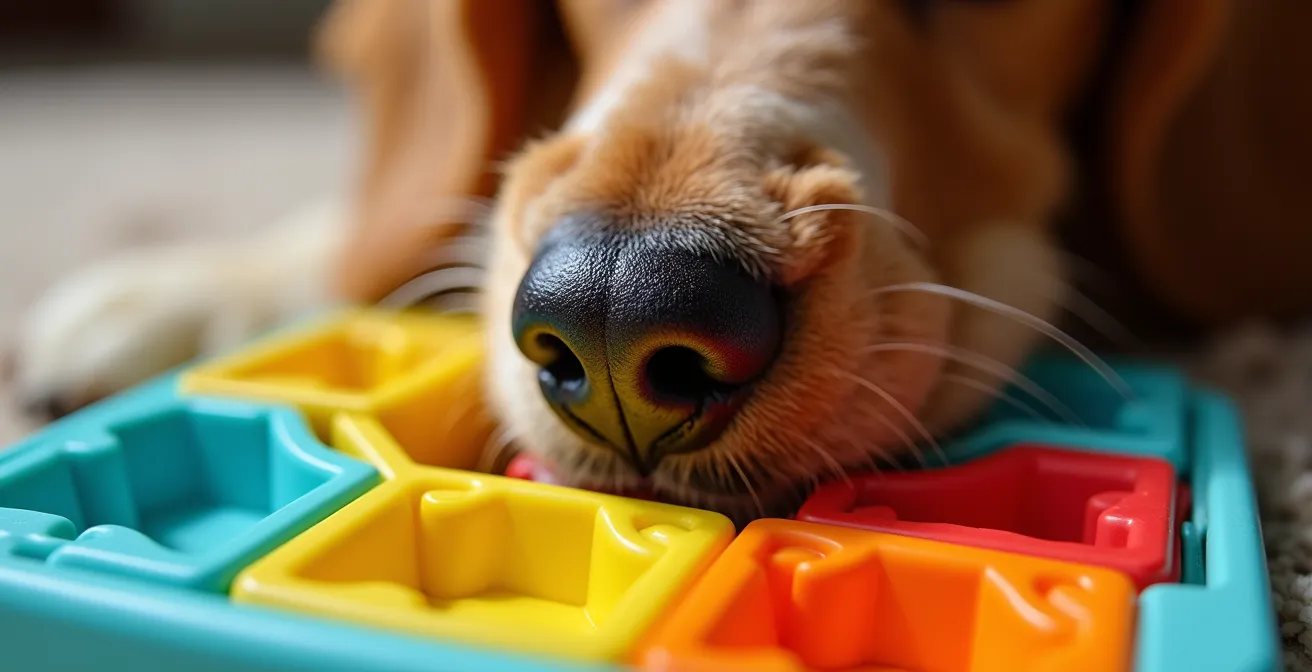
You must integrate these brain games into your daily routine. Rotate different types of puzzle feeders to keep things novel and challenging. Use slow feeders for every meal, turning a 30-second gobble-fest into a 10-minute mental workout. This strategy of energy redirection is the cornerstone of a peaceful recovery. It channels their frustration into a productive, safe outlet.
Your Action Plan: Safe Mental Enrichment Activities
- Nose Work Games: Hide high-value treats in a muffin tin and cover the holes with tennis balls or toys. Your pet must use their nose to find the reward.
- Command Training: Practice stationary commands like ‘stay’, ‘watch me’, or ‘touch’ (touching your hand with their nose) from a lying or sitting position.
- Long-Lasting Toys: Use a Kong or similar durable toy filled with their food, mixed with a little peanut butter or yogurt, and then freeze it. This can provide up to an hour of focused engagement.
- Puzzle Feeder Rotation: Invest in 2-3 different types of puzzle feeders and rotate them daily to prevent boredom and maintain the challenge.
- Scent Exploration: Introduce new, safe scents (like a small dab of lavender or chamomile extract on a cloth) in their confinement area for them to investigate without needing to move.
When to send a photo to the vet: Signs of infection vs normal crusting
You will be instructed to monitor the incision, but what are you actually looking for? Staring at it with a worried expression is not monitoring. Objective surveillance is required. This means knowing the difference between the normal stages of healing and the early warning signs of an infection. Normal healing involves some redness, minor swelling, and the formation of dry scabs. It should not involve excessive discharge, a foul odor, or increasing heat and pain.
This is a critical tip from a place of experience, as highlighted by Indian Peaks Veterinary Hospital. It’s one of the most effective ways to partner with your vet for a successful recovery.
Taking daily photos of the incision with good lighting can help you objectively track changes over time and provide valuable information to your veterinarian if concerns arise.
– Indian Peaks Veterinary Hospital, Pet Surgery Recovery: A Comprehensive Guide
Take a clear, well-lit photo of the incision every morning at the same time. This creates a visual diary. If you become concerned, you can send these photos to your veterinarian, allowing them to assess the situation remotely and tell you if a visit is necessary. This simple action replaces subjective worry (“I think it looks redder”) with objective evidence (“Here is the photo from today versus yesterday”).
This table outlines what to expect during a normal healing process versus the red flags that warrant an immediate call or photo sent to your vet, based on guidance from veterinary sources like VCA Animal Hospitals.
| Timeframe | Normal Healing | Warning Signs |
|---|---|---|
| Day 1-3 | Slight redness, minimal clear drainage, mild swelling | Excessive bleeding, yellow/green discharge, severe swelling |
| Day 4-7 | Dry scabs forming, bruising may appear, edges together | Wound edges separating, foul odor, increasing redness |
| Day 7-14 | Healing ridge (firm swelling under incision), scabs falling off | Persistent drainage, hot to touch, wound dehiscence |
Trust your gut, but verify with data. If you see any of the warning signs, do not wait. Contact your vet immediately.
When to give nerve pain medication relative to activity for best effect?
Pain management is not just about giving pills on a schedule. It is about strategic dosing to stay ahead of the pain, especially nerve pain which can be intense after procedures like an ACL repair. The goal is to prevent the “wind-up” pain phenomenon, where the nervous system becomes hypersensitive, making pain much harder to control. Giving medication *before* the pain spikes is crucial.
You must be tactical. The most predictable moment of activity and potential pain is during potty breaks, when your pet has to stand up, walk, and posture. This is your key window for pre-emptive pain management. For the best effect, MedVet specialists recommend administering pain medication 30-60 minutes before this anticipated activity. This allows the medication to reach peak effectiveness just as your pet needs it most, providing a cushion of comfort that prevents them from associating movement with pain.
Do not be fooled if your pet seems comfortable lying down. Many pets hide their pain well, and skipping a dose can lead to a severe rebound of discomfort. Consistency is mandatory. To execute this strategy effectively:
- Keep a pain diary: Log the time of each dose, the activity level, and a simple pain score (e.g., 1-5, where 5 is severe). This helps you and your vet track progress.
- Set phone alarms: Do not rely on memory. The schedule must be strict.
- Administer pre-activity: Time doses to be 30-60 minutes before their scheduled, leashed potty breaks.
- Never skip a dose: Maintain the prescribed schedule, even if they appear pain-free. It is far easier to prevent pain than to chase it down.
This proactive approach to analgesia is a core component of a smooth recovery. It keeps your pet more comfortable, reduces their anxiety about moving, and helps ensure they get the restorative rest they need to heal.
Why facial pheromones make a carrier feel safe during travel?
The trip home from the vet is often the most stressful part of the entire surgical day. Your pet is disoriented, in pain, and in a moving vehicle. This is where we can use biochemistry to our advantage. Synthetic facial pheromones, like Feliway for cats and Adaptil for dogs, are not a gimmick. They are a powerful tool for reducing acute stress, and their use extends perfectly to creating a calm recovery space at home.
These products mimic the natural calming pheromones produced by a mother to make her offspring feel safe and secure. It’s a primal signal that taps directly into the brain’s emotional center, the amygdala. Essentially, it intercepts the panic response before it fully develops. By spraying a blanket or the carrier with these pheromones 15-20 minutes before your pet gets in, you are changing the emotional context of the environment from “scary and unfamiliar” to “safe and known.”
Case Study: Pheromone Effectiveness in Reducing Post-Surgical Anxiety
Clinical observations show that synthetic pheromones chemically mimic a mother’s calming signals, creating a primal sense of safety. These compounds directly connect to the amygdala, intercepting panic responses before they develop. Using a pheromone diffuser in the recovery room or spraying bedding can make an unfamiliar, sterile recovery space feel secure, significantly reducing stress behaviors like excessive vocalization or restlessness, and promoting the deep rest necessary for healing.
Think of pheromones as an “invisible comfort object.” They make a strange environment smell familiar. Using a plug-in diffuser in your designated “healing sanctuary” continues this calming effect throughout the recovery period. It’s a silent, passive way to reduce their baseline anxiety level, making them less likely to become agitated and test the boundaries of their confinement. This is a simple, effective piece of proactive management.
Key Takeaways
- Proactive management over passive waiting is the only rule of recovery. Your actions directly prevent complications.
- Mental exercise is a non-negotiable tool. It is as effective as physical exercise for tiring your pet and far safer.
- Objective monitoring with daily photos provides your vet with valuable data and replaces subjective worry with clear evidence.
The Pre-Surgery Error: Why you must stop fish oil 2 weeks before dental work?
Our final point is a critical lesson in proactive management that begins long before surgery day. Many well-intentioned owners give their pets supplements like fish oil for its anti-inflammatory benefits. However, this same property makes it dangerous before a procedure. Fish oil, along with Vitamin E and certain herbal supplements, has an anticoagulant effect—it thins the blood and impairs its ability to clot.
Giving these supplements right up until surgery, especially for a procedure like dental work that involves significant bleeding, is a serious error. It increases the risk of excessive bleeding during and after the procedure, which can complicate the surgery and prolong recovery. This is not a minor detail. As a strict rule, MSPCA-Angell veterinary surgeons require a 2 weeks minimum cessation period for fish oil and similar supplements before any scheduled procedure. You must inform your veterinarian of every single medication, treat, and supplement your pet receives.
This is the ultimate example of why your role as a proactive manager is so vital. What is beneficial in one context (daily health) can be dangerous in another (pre-operative care). You must be the keeper of this information and the enforcer of the veterinarian’s pre-op instructions. This includes a full review of all supplements.
For any future procedures, you must discuss this checklist with your vet:
- Fish oil/Omega-3s: Stop at least 2 weeks before surgery.
- Vitamin E: Discontinue 1 week prior.
- Garlic or Ginger supplements: Cease 2 weeks before.
- Ginkgo biloba: Stop 2 weeks before the procedure.
Your journey through this two-week recovery will test your resolve, but it is a finite period. By applying the strict, resourceful, and proactive strategies we’ve covered, you are not just helping your pet survive recovery; you are actively managing it for the best possible outcome.
Your responsibility now is to take this knowledge and apply it without deviation. Prepare your healing sanctuary, acquire the correct equipment, and plan your mental enrichment strategy today. A successful recovery is made of a thousand correct decisions, and it starts now.