
Your pet’s chronic anxiety is likely not a training failure but a rational response to a hidden sensory assault within your home.
- Seemingly harmless items like pest repellers, scented candles, and even flooring create a constant state of low-level stress.
- True environmental enrichment isn’t about adding more toys; it’s about systematically removing these invisible sensory triggers.
Recommendation: Instead of focusing solely on behavior, conduct a “sensory audit” of your home to identify and neutralize the root causes of your pet’s distress.
As a pet owner, it’s a deeply frustrating experience. You’ve invested in training, provided love and stability, and bought all the recommended toys, yet your dog remains perpetually on edge or your cat is inexplicably destructive. You’ve addressed separation anxiety and social triggers, following every piece of conventional advice. But what if the problem isn’t your pet’s behavior, but their environment? What if your home, intended as a sanctuary, is bombarding their senses with invisible stressors they cannot escape?
This is the core premise of animal environmental psychology. It posits that many persistent behavioral issues are not character flaws but symptoms of a sensory assault. We often focus on the obvious—loud bangs or new visitors—while ignoring the chronic, low-level static of our daily lives. The hum of an electronic device, the scent of an air freshener, the feel of a slippery floor; these are not trivial details to an animal with senses far more acute than our own. They are a constant, draining presence.
The solution, therefore, is not more training or another puzzle feeder. It is a paradigm shift: from managing behavior to curating a serene sensory landscape. This article will guide you through a comprehensive sensory audit of your home. We will move beyond the platitudes and reveal the hidden triggers in your lighting, acoustics, and daily routines. By learning to see—and hear, and smell—the world through your pet’s senses, you can finally address the root cause of their anxiety and transform your home into the true haven it was always meant to be.
To help you navigate this process, we will explore eight critical areas where your home might be inadvertently causing stress, providing practical solutions for each. This guide is your first step toward environmental and sensory detoxification for your beloved companion.
Summary : An Environmental Psychologist’s Guide to a Pet-Friendly Home
- Why your plug-in pest repeller might be torture for your dog’s hearing?
- How to use window film to stop barrier frustration in reactive dogs?
- Hardwood vs Carpet: Why slippery floors cause chronic stress in senior dogs?
- The Scented Candle Mistake: Why strong fragrances trigger behavioral issues in cats?
- When to introduce a new schedule before the kids go back to school?
- Why your dog’s bed placement might violate the ‘thermal comfort’ freedom?
- How to position a diffuser in the room for maximum airflow and effect?
- How to Design an Enrichment Strategy for High-Energy Breeds in Small Apartments?
Why your plug-in pest repeller might be torture for your dog’s hearing?
One of the most insidious household stressors is the one you cannot perceive at all: ultrasonic sound. Plug-in pest repellers are marketed as a silent, pet-safe solution for humans, but for your dog, they can be a source of constant, high-frequency torment. The core of the problem lies in the vast difference between our hearing and theirs. These devices operate in a frequency range designed to be inaudible to us but directly within your dog’s auditory field.
According to research, ultrasonic repellers operate between 20-65 kHz, while studies show that dogs can hear frequencies up to 45-65 kHz. This means a device you can’t hear at all may be emitting a piercing, non-stop siren for your pet. Imagine being trapped in a room with a smoke alarm that never turns off—this is the acoustic landscape you may be unknowingly creating. This chronic acoustic stress can manifest as unexplained anxiety, avoidance of certain rooms, or other distress signals that are often misdiagnosed as behavioral problems.
A veterinary consultation highlighted a case where a Gerberean Shepsky, a mix with large, sensitive ears, showed significant restlessness and avoidance behaviors after a pest repeller was installed. The constant 24/7 exposure created a state of chronic stress, which only resolved once the device was removed. If you use these devices, it is critical to watch for subtle signs of discomfort. Common indicators of ultrasonic stress include:
- Persistent head tilting or confusedly looking around the room
- Frequent pawing at ears or head shaking
- Sudden avoidance of rooms where the devices are plugged in
- Unexplained whining or low-level vocalizations
- Running away or backing away from the sound’s source
How to use window film to stop barrier frustration in reactive dogs?
For many dogs, the world outside the window is a source of intense stimulation and frustration. Every passing squirrel, pedestrian, or another dog can trigger a cycle of barking, lunging, and agitation known as barrier frustration. While you might think your dog is “protecting the house,” they are often caught in a loop of hyper-arousal that contributes significantly to their daily stress load. You can’t control the world outside, but you can manage how your dog perceives it.
A simple yet profoundly effective tool for this is translucent window film. Unlike closing the blinds, which plunges a room into darkness and completely isolates your pet, window film offers a brilliant compromise. It blurs the details of the outside world, turning distinct, arousing triggers into indistinct shapes and movements. This allows natural light to fill the room, maintaining a pleasant atmosphere, while “muting” the visual triggers that cause the reaction. The dog can still perceive light and general motion but is no longer triggered by the specific sight of a mail carrier or a cat crossing the street.
This paragraph introduces the concept of managing visual triggers. The illustration below shows how a simple film can transform a window from a source of stress into a calm feature of the room.
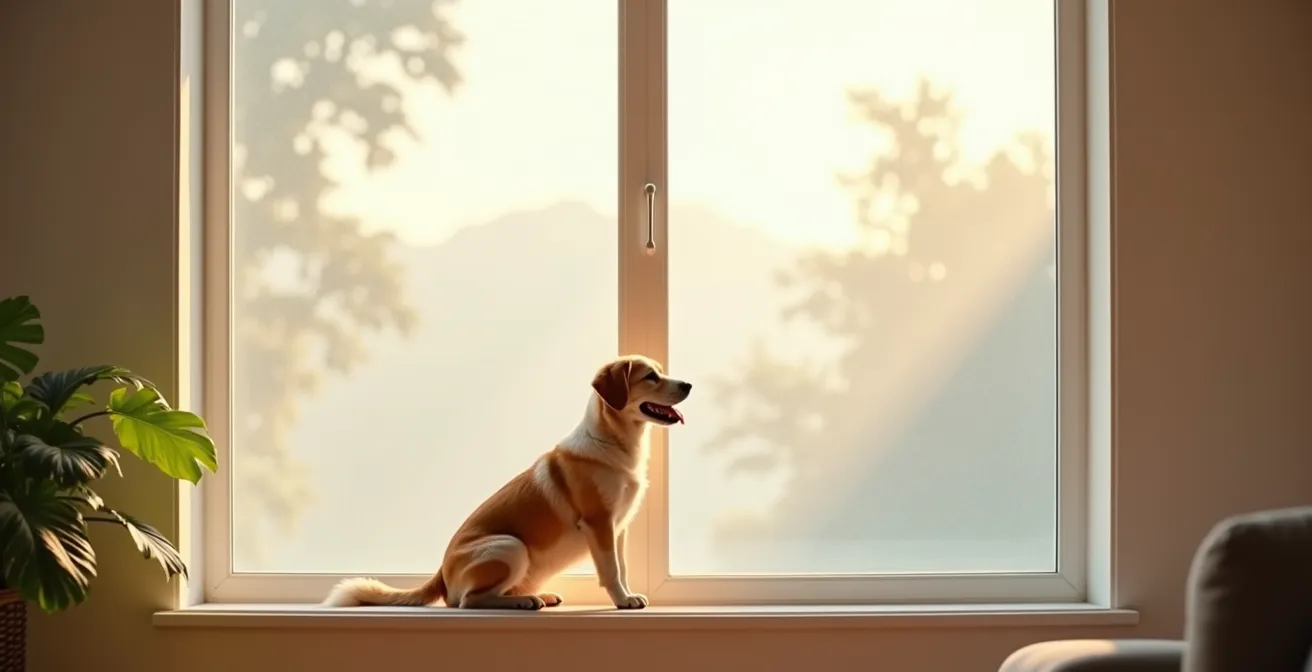
As this image demonstrates, the goal isn’t to block the view entirely but to obscure it just enough to break the cycle of reactivity. For optimal results, a strategic installation is key. Don’t just cover the entire window; focus on your dog’s line of sight while preserving your own view and maximizing light. A thoughtful approach includes:
- Choosing semi-transparent or patterned films over completely opaque ones to blur motion without total isolation.
- Installing the film primarily at your dog’s eye level, leaving upper portions clear for natural light.
- Combining the window treatment with sound-dampening curtains for a dual-pronged approach to sensory management.
- Testing different film densities, starting with a lighter opacity and increasing it only if necessary.
Hardwood vs Carpet: Why slippery floors cause chronic stress in senior dogs?
The aesthetic appeal of modern flooring like hardwood, laminate, or polished tile comes at a hidden cost to our pets, especially seniors. While we appreciate the clean look, our dogs experience these surfaces as a treacherous, low-traction landscape. For a young, agile dog, this might be a minor inconvenience. But for a senior dog dealing with arthritis, muscle weakness, or decreased proprioception (the sense of body position), these floors are a source of chronic physical and psychological stress.
Every step is an act of careful balance. The constant, subtle muscle tension required to prevent slipping leads to physical fatigue and exacerbates joint pain. More profoundly, the fear of falling creates a pervasive state of anxiety. A dog that is afraid to move freely around its own home is not a happy dog. This fear can lead to a more sedentary lifestyle, muscle atrophy, and a reluctance to engage in activities they once loved. The problem is not just tactile; it’s also acoustic. Hard surfaces amplify every sound—claws clicking, items dropping—adding another layer to the sensory assault.
A comparative analysis of common flooring types reveals just how significant the impact can be on a pet’s well-being. This is clearly demonstrated in a recent breakdown of flooring characteristics.
| Flooring Type | Acoustic Properties | Traction Level | Stress Impact |
|---|---|---|---|
| Hardwood | Amplifies sounds (footsteps, dropped items) | Poor – slippery surface | High stress from noise + fall risk |
| Carpet | Dampens ambient sounds | Good – provides grip | Lower stress but potential static buildup |
| Rubber mats | Moderate sound dampening | Excellent – non-slip | Minimal stress, ideal for senior dogs |
Addressing this is essential for a senior pet’s quality of life. You don’t need to re-carpet your entire home. Strategic placement of non-slip runners, yoga mats, or interlocking rubber tiles in high-traffic areas and around beds and food bowls can create “islands of safety.” This allows your dog to navigate their home with confidence, dramatically reducing both their physical strain and their ambient anxiety.
The Scented Candle Mistake: Why strong fragrances trigger behavioral issues in cats?
For humans, a scented candle or plug-in air freshener creates an ambiance of calm or cleanliness. For a cat, it can be the equivalent of a chemical bulldozer, systematically destroying their sense of security and identity. A cat’s world is primarily an olfactory one. They navigate, communicate, and establish their territory through a complex language of subtle scents, primarily through facial pheromones left when they rub against furniture and people. These markers are their “I am home, and I am safe” signals.
When you introduce a strong, artificial fragrance into this delicate olfactory landscape, you are not just adding a new smell; you are overpowering and erasing their own. This sensory obliteration can be deeply unsettling. As animal behaviorist Dr. Susan Wagner explains, this leads directly to insecurity and compensatory behaviors.
Strong artificial scents act as a ‘chemical bulldozer,’ erasing the cat’s own subtle facial pheromone markings – their ‘I live here’ signs – leading to insecurity and over-marking behaviors like spraying.
– Dr. Susan Wagner, Through a Dog’s Ear
Suddenly, the cat’s environment is alien. Their own scent-based “property lines” have vanished. In a desperate attempt to reclaim their territory and feel secure again, they may resort to far more potent marking methods, such as spraying urine. What we perceive as a “bad behavior” is, from the cat’s perspective, a logical and desperate attempt to be heard in a world that has become screamingly loud with synthetic lavender or vanilla.
To create a cat-friendly scent environment, the goal is subtraction, not addition. Remove the overwhelming artificial fragrances and allow your cat’s natural, subtle scents to define the space. For a fresher home, consider these safer alternatives:
- Replace synthetic air fresheners with pet-specific hydrosols (gentle floral waters).
- Avoid candles with VOCs (Volatile Organic Compounds) that overwhelm the Jacobson’s organ.
- Use unscented or naturally derived cleaning products.
- Allow cats to re-mark their territory after cleaning by not over-sanitizing their favorite spots.
- If introducing a new scent, do so gradually and observe your cat for any signs of stress.
When to introduce a new schedule before the kids go back to school?
Beyond the physical environment, a pet’s sense of security is deeply rooted in predictability and routine. The leisurely, spontaneous days of summer can be a wonderful time for family bonding, but the abrupt shift back to a rigid school schedule can be a major source of stress for pets. Suddenly, the house is empty and quiet for long stretches, feeding times change, and walks are rushed. This sudden void can trigger separation anxiety and other stress-related behaviors.
The key to mitigating this schedule-induced stress is a gradual transition, not a sudden shock. Your pet cannot read a calendar; they rely on consistent cues to understand their day. By slowly adjusting their routine in the weeks leading up to the change, you allow their internal clock to recalibrate without panic. Behavioral research confirms the efficacy of this approach; one study found that as many as 87% of dogs show reduced anxiety when given a 2-week adjustment period for major schedule changes. This proactive management prevents the development of anxiety rather than trying to treat it after it has already taken hold.
A “taper” approach is most effective. Instead of making all the changes on the first day of school, implement them incrementally. Here is a sample two-week transition plan:
- Two Weeks Out: Begin adjusting wake-up times by 15 minutes earlier every two days to match the future school-day schedule.
- Two Weeks Out: Start short, 15-minute “alone time” sessions during what will be school hours, providing a high-value chew or toy.
- One Week Out: Gradually increase these alone time sessions to 30-45 minutes and introduce engaging puzzle toys to create a positive association.
- One Week Out: Shift feeding times by 15-minute increments each day until they align with the new, permanent schedule.
- Day Before School: Do a full “dress rehearsal” of the complete morning routine, including leaving the house for a short period.
- First Day of School: Leave calming classical music or a species-specific soundscape playing to help ease the transition from a full house to a quiet one.
Why your dog’s bed placement might violate the ‘thermal comfort’ freedom?
We often choose a dog bed’s location based on our own convenience or aesthetics: out of the way, in a corner, or where it fits the room’s layout. However, from an animal’s perspective, the “perfect spot” is a complex calculation of security, vantage point, and, crucially, thermal comfort. One of the fundamental freedoms in animal welfare is the freedom from thermal discomfort. A bed placed in a drafty hallway, directly over an air conditioning vent, or too close to a radiator can force a pet to endure being consistently too cold or too hot, creating a state of chronic, low-level physical stress.
These “micro-climates” within our homes are often invisible to us. A spot that feels fine to a standing human can be several degrees colder on the floor. A sunny patch might become an unbearable hot spot by the afternoon. A dog that is constantly getting up and moving, circling, or seems unable to settle might not be “fidgety”—it might be trying to find a place of thermal neutrality. This choice is vital for their ability to rest and recover properly.
Beyond temperature, the ideal location must also satisfy two primal instincts: the need for prospect and refuge. “Refuge” means having a protected back, like being against a solid wall or in a corner, which provides a sense of security from being ambushed. “Prospect” means having a clear line of sight to the room’s entrances, allowing them to monitor their environment without being fully exposed. A bed in the middle of a room or in a high-traffic hallway fails on both counts. To find the optimal location, you need to conduct a sensory audit of the specific spot.
Your Home’s Sensory Hotspot Audit
- Map Invisible Drafts: Light an incense stick and hold it near the floor in potential bed locations. Watch the smoke to identify subtle air currents from doors, windows, or vents.
- Check Temperature Variance: Use an infrared thermometer (or simply your hand) to check the floor temperature at different times of day to identify hot spots from sun or cold zones from tile.
- Test for Vibrations: Place a glass of water on the floor near appliances like refrigerators or washing machines. If the water ripples, the floor is vibrating, which can be highly disturbing to a resting animal.
- Ensure Refuge: The location must have a “protected” aspect. The bed should be placed with at least one, preferably two, sides against a solid wall or sturdy piece of furniture.
- Provide Prospect: From the bed, your pet should have a clear sightline to the main doorways of the room, allowing them to relax while still feeling in control of their territory.
How to position a diffuser in the room for maximum airflow and effect?
While synthetic fragrances are a clear problem, many well-intentioned owners turn to essential oil diffusers as a “natural” alternative for calming their pets. The logic seems sound, but the execution is fraught with risk. The issue is not just *what* you diffuse—many essential oils are toxic to pets—but also *how* and *where* you diffuse it. An improperly placed diffuser can turn a therapeutic tool into another source of sensory overload or even poisoning.
The cardinal rule of diffusion in a pet household is that it must always be an optional experience. Your pet must be able to easily move away from the scent if they find it overwhelming. Placing a diffuser in a small, enclosed room or right next to their bed traps them in an olfactory cloud they cannot escape. This is not calming; it’s suffocating. Furthermore, the micro-droplets of oil settle on surfaces, including your pet’s fur. When they groom themselves, they ingest these concentrated oils, which can lead to toxicity. In fact, veterinary toxicology data reveals that over 60% of essential oil poisoning cases in pets occur from this type of surface contamination, not from direct inhalation.
Proper placement is therefore a matter of safety, not just efficacy. The goal is gentle, ambient scenting, not concentrated exposure. To use a diffuser responsibly, you must manage airflow and provide clear escape routes. Follow these pet-safe guidelines for placement:
- Place the diffuser in a large, open area where your pet can easily leave the room. Never use it in a crate or small, closed-off space.
- Position it near an air return vent (where air is pulled in) rather than a supply vent (where air blows out) for a more gentle, whole-room distribution.
- Keep the diffuser at least 4 feet above your pet’s bed and, most importantly, away from their food and water bowls to prevent contamination.
- Utilize timer settings to limit exposure to short, 30-minute intervals, a few times a day, rather than continuous diffusion.
- Always test a new scent with the door open, giving your pet the clear option to leave if they are uncomfortable.
- Wipe down surrounding surfaces weekly to prevent the buildup of oily residue.
Key Takeaways
- A pet’s chronic anxiety is often a direct result of an overwhelming sensory environment, not a behavioral flaw.
- A home “sensory audit” should assess invisible triggers across sound, sight, touch, and scent.
- The most effective solutions often involve removing negative stimuli (like ultrasonic noise or strong scents) rather than adding more stimulation.
How to Design an Enrichment Strategy for High-Energy Breeds in Small Apartments?
Owners of high-energy breeds in small living spaces often fall into the “more is more” trap of enrichment. Believing their dog’s energy is the problem, they bombard them with a constant stream of new toys, intense physical exercise, and complex puzzles. While well-intentioned, this approach can backfire, creating a state of hyper-arousal and an inability to ever truly settle down. The goal of enrichment is not to exhaust your pet, but to provide satisfying, species-appropriate outlets that lead to a state of calm fulfillment.
True enrichment for a high-energy dog in a small space focuses on mental and sensory decompression, not just physical output. Activities that engage their most powerful sense—their nose—are far more tiring and satisfying than another frantic game of fetch in a small hallway. A 10-minute “nose work” session, where a dog has to find hidden treats, can be more effective at reducing stress than a 30-minute run. This is because it allows them to engage in a natural, cognitive behavior that requires focus and problem-solving, leading to mental satisfaction.
This concept of sensory-focused activity over repetitive exercise is a cornerstone of modern behavioral science. Dr. Lori Kogan of Colorado State’s College of Veterinary Medicine highlights the danger of over-stimulation:
A constant barrage of new toys and puzzles can create anxiety and an inability to settle. Mental decompression through sensory-focused activities like nose work is far more effective at reducing stress than repetitive physical exercise.
– Dr. Lori Kogan, Colorado State College of Veterinary Medicine Study
A successful strategy relies on novelty and rotation, preventing boredom without creating anxiety. Instead of having a basket full of toys available at all times, create a “toy library” and rotate a few select items weekly. Structure and predictability are also key, even for enrichment. A weekly schedule that balances different types of sensory engagement can provide the stimulation your dog craves within a secure framework.
- Scent Work Days (Mon/Wed/Fri): Hide treats in cardboard tubes, snuffle mats, or around the apartment to encourage natural foraging behavior.
- Puzzle Days (Tues/Thurs): Use one or two puzzle feeders, rotating which ones you use each week to maintain novelty.
- Sensory Days (Weekend): Introduce new, calming soundscapes (like classical music or nature sounds) or let them explore pet-safe herbs like basil or mint.
- Daily Quiet Time: Critically, schedule and train 20 minutes of “quiet time” each day, where the dog learns to relax on their mat without any stimulation, preventing enrichment overload.
Your journey to a calmer pet and a more peaceful home begins not with more commands, but with a more compassionate and observant perspective. Start your home’s sensory audit today. Remove one hidden stressor, observe the change, and continue to build a world that respects the profound sensitivity of the animals we are so lucky to share our lives with.