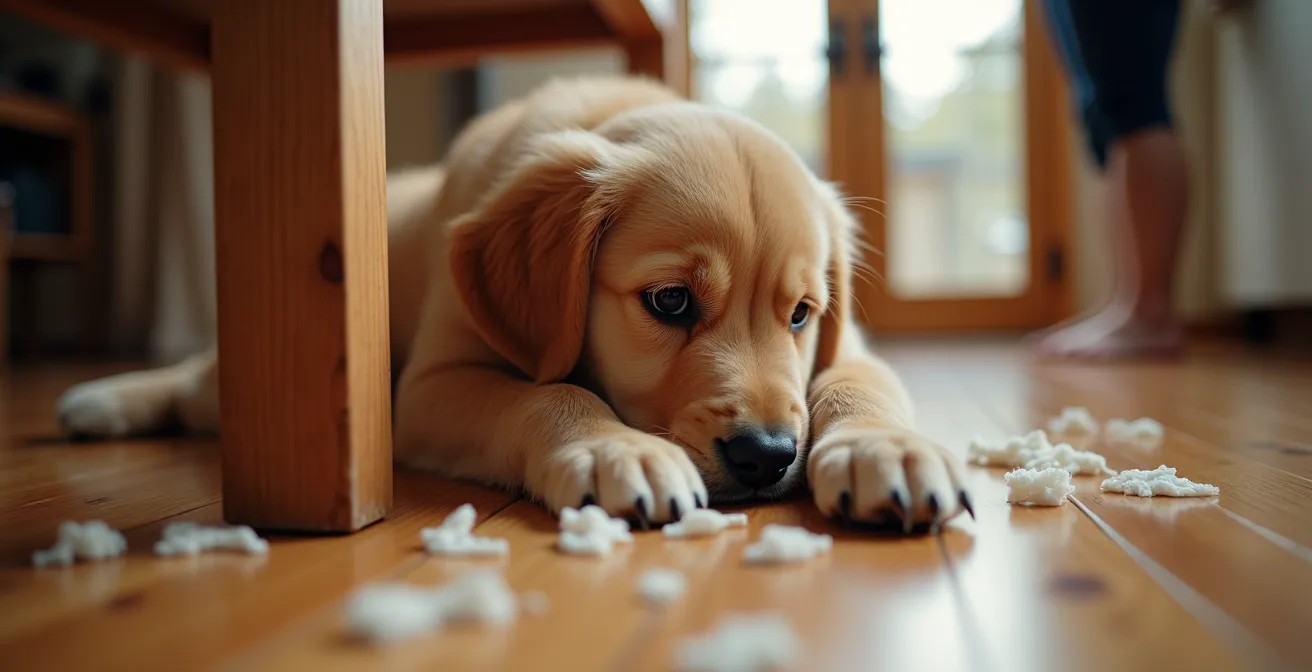
Destructive chewing is a solvable management problem, not a sign of a “bad dog.”
- The core issue is almost always an unmet need for mental stimulation, physical release, or anxiety management.
- Effective solutions focus on redirecting the natural urge to chew onto safe, appropriate outlets through a structured plan.
Recommendation: Shift your focus from punishing the bad behavior to proactively engineering your dog’s environment and routine to make the right choice the easiest choice.
Coming home to find the leg of a cherished chair gnawed into splinters is more than frustrating; it feels like a personal betrayal. For many dog owners, this cycle of destruction and dismay becomes a daily source of stress. The immediate reaction is often to look for quick fixes—a spray, a scolding, a different type of toy. You might have already tried crating your dog for longer periods or taking them for an extra-long walk, only to find the destructive behavior persists.
These common solutions treat the symptom, not the cause. They are based on the assumption that the dog is being “bad” or “disobedient.” But what if the chewing isn’t an act of defiance, but a form of communication? What if that shredded couch cushion is your dog’s desperate attempt to tell you something important about their physical or emotional state? The true key to solving destructive chewing isn’t about finding a magic punishment to stop it; it’s about becoming a household manager who can diagnose the underlying need and engineer a system to meet it.
This guide will move beyond the generic advice. We will explore how to perform a proper behavioral diagnosis to understand the “why” behind the chewing. We’ll delve into the science of chew toy safety, the strategic timing of enrichment, and the critical importance of mental stimulation. By the end, you will have the tools to build a comprehensive enrichment strategy that redirects your dog’s natural instincts, creating a calmer dog and a more peaceful home.
To help you navigate this process, this article is structured to build your knowledge step-by-step. Below is a summary of the key areas we will cover, from understanding the root cause to designing a complete enrichment plan.
Summary: A Management Guide to Destructive Chewing
- Why your dog destroys the couch: Boredom, Anxiety, or Teething?
- Kong vs Nylabone: Which holds up to a Power Chewer without cracking teeth?
- Bitter Apple vs Vinegar: Which deterrent actually works on wood furniture?
- The Rope Toy Danger: Why linear foreign bodies are a surgical emergency
- When to give a high-value chew to maximize passive settling time?
- The Hard Chew Toy Mistake That Breaks Premolars in Aggressive Chewers
- Why a lack of mental stimulation causes brain atrophy in indoor pets?
- How to Design an Enrichment Strategy for High-Energy Breeds in Small Apartments?
Why your dog destroys the couch: Boredom, Anxiety, or Teething?
Before you can solve the problem of destructive chewing, you must first perform a behavioral diagnosis. The behavior may look the same—a shredded pillow or a chewed baseboard—but the root cause can vary dramatically. Treating boredom-related chewing with an anxiety solution will fail, and vice-versa. The three most common culprits are boredom, separation anxiety, and teething.
Teething is the easiest to identify. It typically occurs in puppies under six months of age. The chewing is a natural response to the discomfort of new teeth erupting. The solution is straightforward: provide a variety of safe, puppy-specific chew toys and manage the environment to prevent access to furniture.
Boredom is a leading cause of destructive behavior in adult dogs, especially intelligent, high-energy breeds. A dog left alone for hours with nothing to do will invent its own job, and “de-stuffing the couch” can be a very rewarding task. This type of chewing is often accompanied by other signs of under-stimulation, like excessive barking or digging.
Separation anxiety is a more complex panic disorder. The destruction is not a result of boredom but of genuine distress. It’s often accompanied by other signs like excessive vocalization (howling, barking), pacing, or house soiling, which occur exclusively when the dog is left alone. In severe cases, dogs with separation anxiety can cause self-injury like broken teeth or cut paws in their attempts to escape or self-soothe. Understanding this distinction is the critical first step in developing an effective plan.
Kong vs Nylabone: Which holds up to a Power Chewer without cracking teeth?
Once you’ve committed to redirecting your dog’s chewing, the next step is building a safe and effective “chew hierarchy.” This means selecting toys that can withstand your dog’s chew style without posing a dental risk. Two of the biggest names in the industry are Kong and Nylabone, but they serve very different types of chewers. Understanding the difference is key to preventing both wasted money and veterinary emergencies.
Kong toys, made of durable rubber, are ideal for “grip and rip” chewers who like to hold a toy between their paws and tear at it. Their primary advantage is the ability to be stuffed with food, turning a simple chew session into an engaging, problem-solving puzzle. Nylabone toys, made of hard nylon, are designed for steady gnawers who prefer to scrape and grind away at a surface over time. They are incredibly durable but offer no interactive component.
The most critical factor is dental safety. As a general rule, you should be able to make an indentation in a chew toy with your thumbnail. If the toy is too hard to mark, it’s likely too hard for your dog’s teeth. This “thumbnail test” is a simple but effective way to assess risk.
| Feature | Kong | Nylabone |
|---|---|---|
| Material | Rubber (various densities) | Nylon polymer |
| Best For | Grip & Rip chewers | Steady gnawers |
| Dental Safety | Softer, less risk of fractures | Harder, requires monitoring |
| Interactive Use | Can be stuffed with treats | Static chewing only |
| Durability | Varies by rubber density | Very durable for gnawing |
While Nylabone’s durability is appealing, its hardness poses a greater risk of tooth fractures, especially for aggressive chewers. Kongs, particularly the black “Extreme” line, offer a safer balance of durability and give. Ultimately, the right choice depends on a careful assessment of your dog’s individual chewing style and power.
Bitter Apple vs Vinegar: Which deterrent actually works on wood furniture?
In the world of environmental engineering for your dog, deterrents can play a useful role. Their purpose is not to punish, but to make inappropriate chewing on items like furniture legs less pleasant, thereby making the appropriate chew toys more attractive by comparison. The two most common recommendations are commercial bitter apple sprays and household apple cider vinegar. But which one is actually effective?
The answer depends entirely on the individual dog. Some dogs are strongly repelled by the bitter compounds in commercial sprays. For them, it’s a highly effective tool. However, a surprising number of dogs are either indifferent to the taste or, in some cases, seem to enjoy it. Apple cider vinegar works on a different principle: its strong, sour taste and smell are aversive to most dogs.
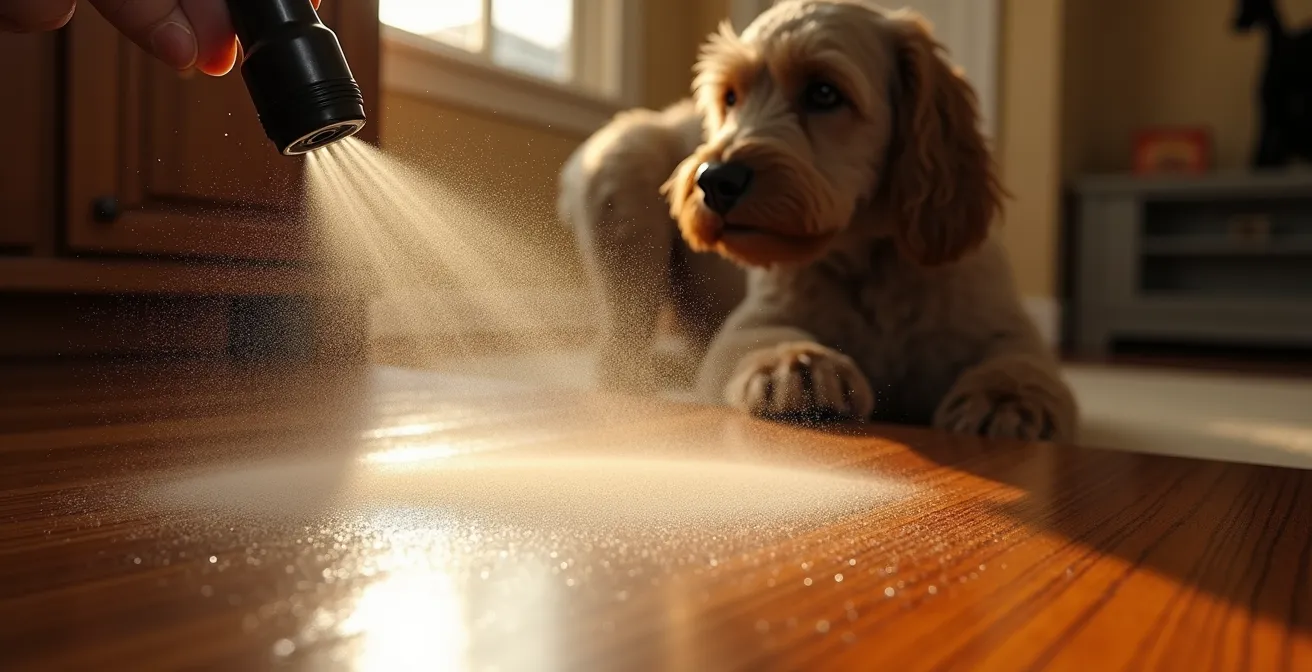
A test of various home remedies found that apple cider vinegar was often more consistently effective, especially on porous surfaces like unfinished wood, because the scent lingers longer. The key takeaway is that there is no universal solution. You may need to experiment to find what your specific dog dislikes. The goal is to create a negative association with the furniture, but this only works if the dog has a highly positive alternative (like a food-stuffed toy) available nearby.
Action Plan: Deterrent Application Protocol
- Test deterrent on a hidden furniture area first to check for damage or discoloration.
- Apply deterrent daily for at least 3-4 weeks to establish a consistent aversion.
- Present the deterrent on a cotton ball to your dog first for an initial smell/taste association before applying to furniture.
- Reapply after cleaning or wiping down surfaces, as the deterrent’s effectiveness diminishes over time.
- Monitor your dog’s reaction closely and be prepared to switch products if no aversion develops.
Remember, a deterrent is only one small part of a larger management plan. It is useless without the simultaneous and more important step of providing plenty of “yes” options for your dog to chew on.
The Rope Toy Danger: Why linear foreign bodies are a surgical emergency
Rope toys are a staple in many dog toy baskets. They are inexpensive, great for tug-of-war, and many dogs love to shred them. However, this shredding behavior is precisely what makes them one of the most dangerous toys for unsupervised chewing. When a dog ingests the long strings from a rope toy, it can lead to a life-threatening condition known as a linear foreign body.
Unlike a single object that might pass through the digestive system or cause a simple blockage, a long string is far more sinister. One end can get lodged in the stomach while the rest of the string continues to move into the intestines. As the intestines try to move the string along through their normal wave-like contractions (peristalsis), they can end up “climbing” the string, much like gathering fabric on a thread. This action can cause the intestine to bunch up and can even lead to the string sawing through the intestinal wall, causing a fatal infection.
This is a true surgical emergency that is complex and expensive to repair. For this reason, rope toys should never be left with a dog unsupervised. They are for interactive play only—a game of tug between you and your dog. Once the game is over, the toy should be put away immediately. If your dog is a shredder, you must provide safer outlets for that instinct.
Safe Alternatives for Dogs Who Love to Shred
- Destruction Boxes: Supervise your dog as they shred safe materials like cardboard egg cartons, paper towel tubes, or delivery boxes (with all tape and labels removed). You can hide treats inside to make it more rewarding.
- Shreddable Paper Toys: Many companies now make toys specifically designed from pressed paper or cardboard that are safe for shredding.
– Forage Mats: These allow dogs to use their nose and “shred” through fabric to find food, satisfying the instinct in a safe manner.
The key is to manage the environment and the toys. By understanding the risks, you can make informed choices to keep your dog safe while still satisfying their natural behaviors.
When to give a high-value chew to maximize passive settling time?
One of the most powerful tools in your management toolkit is the high-value chew, such as a frozen Kong stuffed with peanut butter or a long-lasting bully stick. However, its effectiveness is not just about *what* you give, but *when* you give it. Strategic timing can transform a simple treat into a powerful behavior modification tool, especially for dogs with mild separation or departure anxiety.
Many owners make the mistake of giving the high-value chew at the last second as they are walking out the door. For an anxious dog, this can be too late; their stress levels are already rising. The goal is to pre-empt the anxiety. A 2024 study on separation distress highlights the effectiveness of giving the high-value item 5-10 minutes before your departure. This timing is crucial. It allows the dog to become fully engaged and settled with the chew *before* they even notice you are preparing to leave.

This technique helps re-wire the dog’s brain. Instead of your departure routine (picking up keys, putting on a coat) triggering anxiety, it becomes a predictor of something wonderful. The dog learns to associate your leaving with the beginning of a rewarding, calming activity. This fosters a state of passive settling, teaching the dog to be calm and content in your absence. The study also notes the importance of having lower-value chews available for after the main item is finished, to help transition the dog into a longer period of quiet time.
By shifting the timing of your enrichment, you move from simply distracting your dog to proactively shaping a more positive emotional response to being alone. It’s a small change in your routine that can have a profound impact on your dog’s well-being.
The Hard Chew Toy Mistake That Breaks Premolars in Aggressive Chewers
In the quest to find a chew toy that lasts, owners of “power chewers” often gravitate towards the hardest objects available: antlers, cooked bones, and ultra-durable hard nylon toys. While this seems logical, it’s a common and costly mistake. These items are a leading cause of painful and expensive slab fractures of the premolar and molar teeth.
The fourth upper premolar, a large shearing tooth, is particularly vulnerable. Its shape and the immense force a dog can generate with its jaws create a perfect storm for fracture when biting down on an unyielding object. Many owners don’t realize a tooth is broken until it becomes infected or they notice their dog is suddenly reluctant to chew on one side of their mouth. The treatment often involves complex extraction surgery.
So, how do you know if a toy is too hard? Veterinary dental specialists offer a simple, brilliant rule of thumb, perfectly summarized by experts featured in the American Kennel Club:
If you wouldn’t want to be hit hard in the kneecap with it, don’t give it to your dog.
– Veterinary Dental Specialists, American Kennel Club Expert Advice
This “kneecap rule” instantly helps you filter out dangerous options. If an object is rock-hard and has no give, it has the potential to break a tooth. This is why materials like dense rubber (like a Kong Extreme) are much safer. They are durable enough to withstand chewing but have just enough flexibility to prevent the tooth-on-rock impact that causes fractures. Always prioritize your dog’s dental health over a toy’s indestructibility.
Why a lack of mental stimulation causes brain atrophy in indoor pets?
We often focus on the physical consequences of a sedentary lifestyle for our pets, but the mental consequences can be just as severe. When a dog, particularly an intelligent one, lives in a barren environment with little to do, their brain can suffer. This isn’t just about being “bored”—it’s a biological process. A lack of mental stimulation and problem-solving opportunities can lead to a measurable decline in cognitive function, sometimes referred to as a form of brain atrophy.
A brain that isn’t challenged doesn’t grow. In fact, scientific research has demonstrated that enrichment can physically grow new brain cells and strengthen neural pathways related to self-control and calmness. Conversely, dogs in unenriched environments show a decline in their ability to solve problems and regulate their impulses. This cognitive decline manifests as behavioral problems. The dog isn’t just chewing your furniture; their brain is actively seeking the stimulation it craves and is not receiving through appropriate channels. Behavioral research has found that up to 40% of dogs engage in excessive barking due to this exact combination of boredom and lack of mental input.
This is why simply increasing physical exercise isn’t always the answer. A long run may tire a dog’s body, but it does little to work their brain. The solution lies in providing daily “cognitive load” through activities that encourage thinking, problem-solving, and the use of their senses. Puzzle feeders, nose work games, and learning new tricks are not just fun activities; they are essential brain maintenance. They build a more resilient, calmer, and better-behaved dog from the inside out.
Key Takeaways
- Destructive chewing is a natural behavior that needs to be managed and redirected, not a moral failing that needs to be punished.
- A safe environment is built on a “chew hierarchy,” prioritizing toys that are tough but have enough ‘give’ to protect dental health.
- The solution is a holistic enrichment strategy that provides daily outlets for physical, mental, and instinctual needs (like chewing and shredding).
How to Design an Enrichment Strategy for High-Energy Breeds in Small Apartments?
Living with a high-energy dog in a small space like an apartment presents a unique management challenge. You can’t rely on a big backyard to absorb their energy. This is where a structured, multi-faceted enrichment strategy becomes your most valuable asset. The goal is to provide a high level of cognitive and sensory stimulation within the confines of your home, leading to a mentally tired and physically content dog.
A great way to structure this is using an “Enrichment Pyramid” framework. This ensures you are providing a balanced diet of activities daily, weekly, and on special occasions. This isn’t just theory; a study on apartment-dwelling dogs showed a 60% reduction in destructive behaviors when a similar strategy was implemented. The study also found that short, intense training bursts were more effective for mental exhaustion than long, monotonous walks.
Here is a framework you can adapt for your dog:
- Foundation (Daily): Provide basic opportunities for natural behaviors. This includes meals fed from puzzle toys instead of a bowl, and having safe, appropriate chew toys always available.
- Physical (Daily): Schedule 2-3 short (5-10 minute) sessions of high-intensity training. This could be practicing fast recalls down a hallway, playing tug, or doing “doggy push-ups” (sit-to-down repetitions).
- Cognitive (Weekly): Introduce one new puzzle or teach one new trick each week. This novelty is crucial for keeping the brain engaged and preventing habituation.
- Sensory (Ongoing): Create dedicated stations. A “sniffle mat” in one corner for nose work, playing calming dog-specific music, or setting up a comfortable window perch for visual stimulation.
By layering these activities throughout the day, you create a rich, engaging world for your dog. You meet their innate needs to work, think, and play, dramatically reducing the likelihood that they will need to find their own, more destructive, forms of entertainment.
By understanding that chewing is a natural need and by creating a structured management plan, you can build a more harmonious relationship with your dog. Start today by choosing one small change—feeding dinner from a puzzle toy or scheduling a five-minute training session—and begin the process of engineering an environment where your dog can thrive.