In summary:
- Scent work is a high-intensity mental workout that can tire a dog more effectively than a long walk.
- You can start at home with simple items like tea bags or safely prepared essential oils.
- The handler’s job is to stay quiet and trust the dog, avoiding common mistakes like unintentional “cueing.”
- Rewarding your dog directly at the scent source is key to building their confidence and understanding.
That boundless energy is one of the things you love most about your dog. But when a long walk or a run in the park isn’t an option due to weather, injury, or just a hectic schedule, that same energy can turn into chewed-up furniture and endless pacing. Many owners turn to puzzle toys or extra chewies, but these often only provide a temporary distraction. They don’t truly address the core need of a working brain to have a job to do.
What if there was a way to tap into your dog’s most powerful natural tool—their nose—to provide a deep, satisfying, and genuinely tiring workout without ever leaving your living room? This isn’t just about hiding treats and hoping for the best. We’re talking about a structured activity that engages their mind on a profound level, a concept that feels less like a game and more like high-intensity cognitive exercise.
Forget the idea that tiring out your dog requires physical exhaustion. The real secret lies in engaging their brain in complex olfactory processing. This guide will show you how to move beyond generic enrichment and start using scent work as a targeted tool to burn mental energy. We’ll explore the science behind why sniffing is so powerful, how to set up your first searches safely, and the critical handler skills you need to master to turn your hyperactive companion into a calm, contented, and cognitively fulfilled dog.
This article will guide you through the essential foundations of at-home scent work. Below is a summary of the key topics we will cover to help you and your dog get started on this exciting journey.
Summary: Your Guide to At-Home Scent Work
- Why 15 minutes of sniffing burns as many calories as a 1-hour walk?
- How to use tea bags or essential oils safely for beginner searches?
- Container Search vs Interior Search: Which is easier for a distractible dog?
- The “Cueing” Mistake: Why you must look away when your dog is searching?
- When to pay the dog: The importance of rewarding at source vs from hand?
- Why stopping every 5 feet is mental algebra for your dog?
- Food Puzzles vs Scent Games: Which Burns More Mental Energy for Working Breeds?
- Why a 20-Minute Scent Walk Is More Tiring Than a 1-Hour Run?
Why 15 minutes of sniffing burns as many calories as a 1-hour walk?
It sounds almost too good to be true, but the evidence is compelling: concentrated sniffing is an incredibly demanding activity for a dog’s brain. While we see it as just “sniffing,” for your dog, it’s a full-blown cognitive event. Their brain is firing on all cylinders, processing vast amounts of “invisible data” from the environment. This intense mental effort consumes a surprising amount of energy. It’s the difference between a person taking a light stroll and an air traffic controller safely landing a dozen planes at once—both are technically “working,” but the cognitive load is worlds apart.
This concept is known as energy equivalency. The mental energy expended during a focused scent work session provides a level of enrichment and fatigue comparable to much longer periods of physical activity. In fact, training experts confirm this phenomenon; one play expert notes that for a dog, just 20 minutes of sniffing is equivalent to an hour’s walk in terms of enrichment. This is because every sniff pulls in new information that must be categorized, analyzed, and prioritized.
Think of it this way: a physical run works the body, but a scent game works the primary operating system of the dog—their olfactory brain. For high-energy breeds, especially those bred for hunting or detection, this kind of work is not just fun; it’s a biological necessity. It fulfills a deep-seated instinct to seek and find, providing a level of satisfaction that simple physical exercise can’t match. This is why a short, 15-minute scent session can leave your dog more relaxed and content than an hour of repetitive fetch.
How to use tea bags or essential oils safely for beginner searches?
Getting started with scent work is simple, and you likely already have the perfect beginner odors in your pantry. For your dog’s very first sessions, there’s no need to buy special equipment. A few strongly scented, dog-safe herbal tea bags (like peppermint or chamomile) are a fantastic and safe starting point. The goal is to use a novel scent that is distinct from the everyday smells in your home.
As you progress, you might want to move on to the same target odors used in official nose work sports, such as birch, anise, and clove essential oils. However, safety is paramount. Essential oils are highly concentrated and must be handled and diluted correctly. Never apply them directly to any surface or let your dog come into direct contact with the oil. The goal is for your dog to find the *scent*, not the source.
This image shows a typical setup for safely preparing scents for a training session, ensuring no contamination of the environment or risk to the dog.
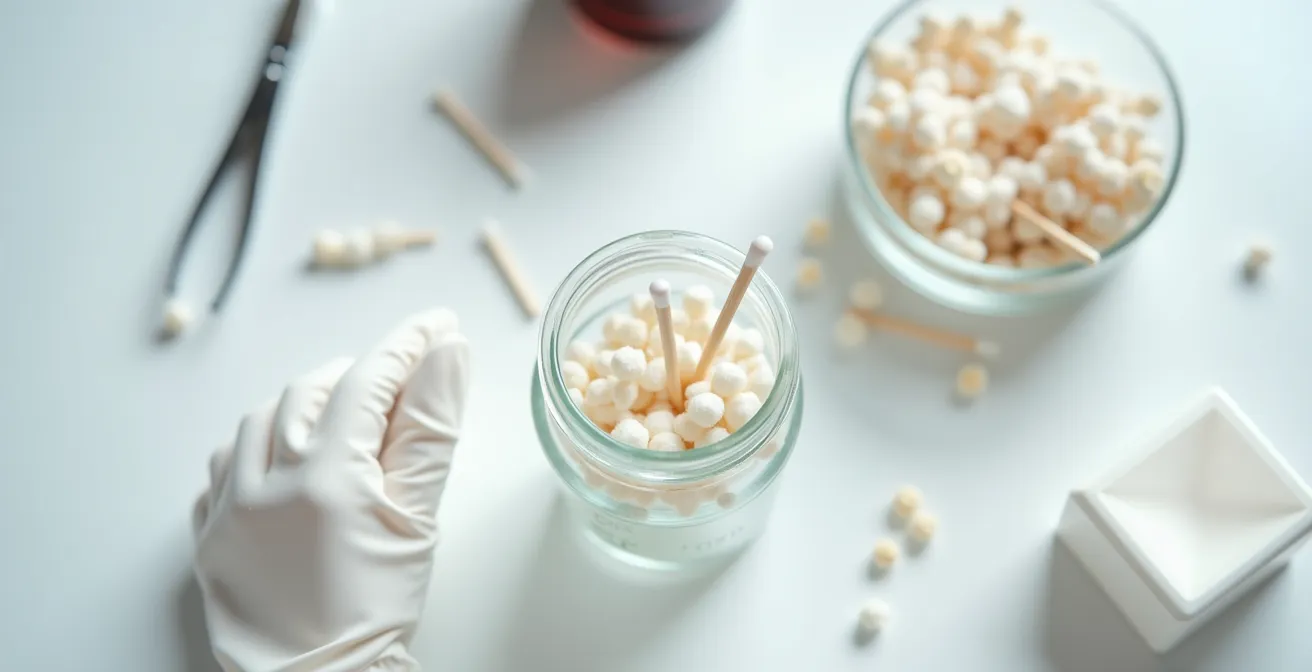
To prepare a scent source with essential oils, follow a strict protocol. According to the American Kennel Club’s guide to scent work, you should always wear disposable gloves in a separate, well-ventilated room away from your dog. Apply just one or two drops of oil to a cotton swab, place it in a small, ventilated container (like a small tin with holes punched in the lid), and then dispose of the gloves and any other contaminated materials immediately and securely. This prevents the target odor from contaminating the search area and ensures your dog is only hunting for the scent you’ve intentionally hidden.
Container Search vs Interior Search: Which is easier for a distractible dog?
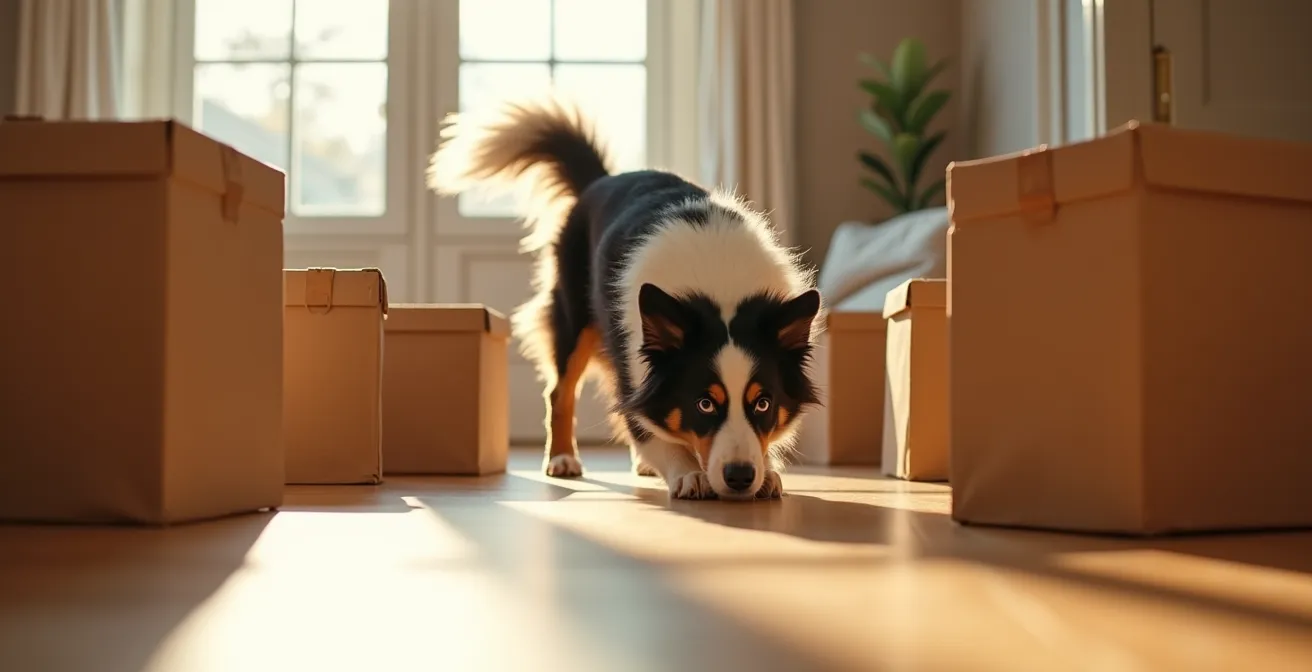
When you’re first starting, the environment you choose for the search is just as important as the scent itself. The two most common setups for at-home scent work are container searches and interior searches. For a dog that is easily distracted by sights and sounds, the container search is almost always the easier starting point. This type of search involves a set of identical containers, like cardboard boxes or small plastic tubs, with the scent hidden in just one.
The beauty of a container search is its structure. It creates a clear, defined “puzzle” for the dog to solve. The visual picture is simple and repetitive, which helps a distractible dog focus on the olfactory task at hand rather than being sidetracked by a piece of furniture, a window, or a toy across the room. The task is straightforward: “Check these boxes and find the one that smells different.” This controlled environment minimizes visual chaos and allows the dog’s nose to take the lead.
An interior search, where the scent is hidden somewhere in a room (e.g., on a chair leg, a bookshelf, or a baseboard), presents a much higher level of challenge. The environment is full of competing scents and visual distractions. For a beginner or a distractible dog, this can be overwhelming. They have to ignore the lingering smell of dinner, the cat’s favorite napping spot, and the shoes by the door, all while trying to pinpoint a novel target odor. While interior searches are a fantastic goal to work towards, starting with the simplicity of containers builds focus and confidence first.
This table, based on training principles from organizations like Best Friends Animal Society, breaks down the key differences to help you choose the right starting point for your dog.
| Aspect | Container Search | Interior Search |
|---|---|---|
| Structure | Highly structured with identical boxes | Variable environment with multiple surfaces |
| Visual Distractions | Minimal – focused on limited area | High – entire room with windows, furniture |
| Olfactory Complexity | Can be challenging if floor has old scents | Multiple competing scents from various sources |
| Best For | Dogs with visual distractibility | Dogs who can focus despite environmental stimuli |
| Training Progression | Leave the boxes open and easily accessible to make it easier for your dog to find the goodies | Start in sterile environments like bathrooms |
The “Cueing” Mistake: Why you must look away when your dog is searching?
As a handler, your most important job during a scent work search is to be a silent, neutral observer. This is much harder than it sounds. Without realizing it, we constantly give our dogs subtle clues with our bodies. A slight glance towards the correct box, a brief pause in our breathing as the dog gets close, or a subtle shift in our posture—these are all forms of unintentional cueing. Your dog is an expert at reading human body language, and they will quickly learn to search *you* for answers instead of using their nose.
This phenomenon is famously known as the “Clever Hans Effect.” As the IAABC Foundation Journal explains, it’s named after a horse that appeared to solve complex math problems but was actually just reacting to tiny, unconscious cues from his handler and the audience.
To appreciate the difficulty, consider Clever Hans, a horse who became famous for answering complex questions. He appeared to count the number of people in the audience, and do math, responding with the correct answer by tapping his hoof.
– IAABC Foundation Journal, How the Clever Hans Effect Leads to Errors in Canine Scent Detection
When handlers believe they know where a scent is, their body language can inadvertently influence their dog, leading to false alerts. In a professional context, this can have serious consequences. A revealing UC Davis study published in Animal Cognition found that handler beliefs were a significant source of errors, with 18 drug/explosive detection teams reporting over 200 false alerts when they were led to believe an odor was present in a location that was actually scent-free. To build a truly independent and confident search dog, you must learn to be “blind” and trust their nose completely. This means actively looking away from the search area, staring at a wall, or walking in a random pattern. Let your dog be the expert in the room.
Your Action Plan: Techniques to Avoid Handler Cueing
- The ‘Wall Stare’ Technique: Pick a spot on the opposite wall or ceiling and maintain your focus there throughout the entire search.
- The ‘Drunken Walk’ Method: Walk in a slow, random, looping pattern around the room, completely unrelated to the search area’s layout.
- Master Body Language Control: Consciously avoid stopping near the hidden scent, blocking the dog’s path, or pointing your shoulders, hips, and toes toward the odor’s location.
- Practice Blind Searches: The ultimate test. Have someone else hide the scent for you so you genuinely don’t know its location. This forces you to trust your dog completely.
When to pay the dog: The importance of rewarding at source vs from hand?
The moment your dog finds the scent is the most critical part of the training process. How you deliver the reward in that split second will shape your dog’s entire understanding of the game. A common beginner mistake is to call the dog back to them to give them a treat. While well-intentioned, this teaches the dog that the reward comes from the handler. What we want is for the dog to understand that the scent itself predicts the reward.
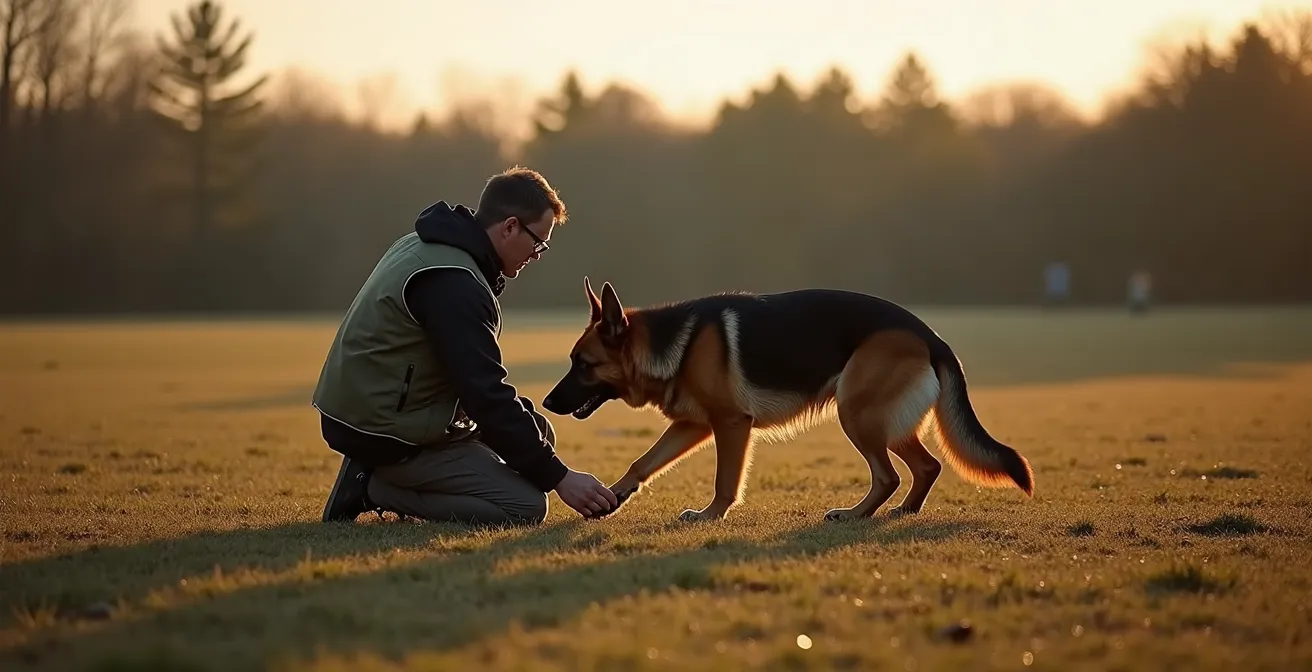
This is the principle of “rewarding at the source.” The goal is to make the location of the odor the most valuable and exciting spot in the room. When your dog indicates the correct container or location, you should immediately go to them and deliver a high-value treat right at their nose, as close to the scent source as possible. This creates a powerful, direct association: “My nose touching this spot makes delicious food appear right here!”
This handler is demonstrating the perfect technique, bringing the reward directly to the dog’s nose at the exact location of the find, reinforcing the value of the source.
This method builds a dog who is intensely focused on the search problem, not on the handler. They learn that their job is to pinpoint the origin of the odor, and that’s where the party happens. As training progresses, this helps build a stronger, more committed “alert” behavior, where the dog will stay at the source, waiting for their reward, rather than finding the scent and immediately looking back at you. As the AKC’s training protocol emphasizes, you must “be sure to feed the dog at the box.” This small detail makes a huge difference in building a confident and independent search dog.
Why stopping every 5 feet is mental algebra for your dog?
We often think of walks as linear—A to B physical exercise. But for a dog, a walk isn’t about distance; it’s about information. When you let your dog stop and sniff, you’re not just being indulgent; you are allowing them to engage in a complex cognitive process that is deeply fulfilling and surprisingly tiring. A dog’s nose is a scientific marvel. Depending on the breed, they possess up to 300 million scent receptors, compared to our meager six million. This gives them an olfactory picture of the world that is unimaginably rich and detailed.
Every time your dog stops to investigate a spot on the sidewalk, they are downloading and processing huge amounts of data. They can tell which dogs have been there, their gender, their health, their emotional state, and how long ago they passed by. It’s the canine equivalent of scrolling through a complex social media feed and reading all the updates. This act of decoding “pee-mail” is a form of mental algebra, requiring intense focus and brainpower.
This form of stimulation is incredibly powerful because it activates what experts at VCA Animal Hospitals call the brain’s “seeking system.”
We often think of physical exercise, like walks or games of fetch, as the main way to keep dogs healthy, but exercising the mind is also exercise, and will burn calories and tire out your dog… This form of stimulation activates their brain’s ‘seeking system,’ similar to how we seek updates on social media and news sites.
– VCA Animal Hospitals, Mental Stimulation for Dogs: Sniffing Walks
This system, a key part of the brain’s reward pathway, drives the instinct to explore and find resources. Allowing your dog to engage it on a walk by stopping frequently provides a deep sense of satisfaction and purpose. For a high-energy dog, this mental workout can be far more effective at achieving a state of calm than simply trying to run them into the ground.
Food Puzzles vs Scent Games: Which Burns More Mental Energy for Working Breeds?
Food puzzles and snuffle mats are fantastic enrichment tools, and they certainly have their place. They encourage problem-solving and can slow down a fast eater. However, when it comes to truly burning significant mental energy, especially for high-drive and working breeds, scent games operate on a completely different level of cognitive complexity. The two activities engage the brain in fundamentally different ways.
A food puzzle is primarily a test of physical manipulation and dexterity. The dog can see the food, and the challenge is to figure out how to push, pull, or flip a component to access it. It’s a tangible problem with a visible solution. Scent games, on the other hand, require abstract thinking. The dog is hunting for invisible data. They must create a mental map of the area, discriminate between countless background odors, and trace a faint scent cone back to its source. This process is far more akin to their natural hunting instincts and engages their brain’s powerful “seeking system” in a much more profound way.
For a Border Collie, a German Shepherd, or a Beagle, this type of olfactory work isn’t just a game; it’s the job they were bred for. It satisfies a deep-seated behavioral need that a food puzzle can’t quite reach. While a puzzle might keep them busy for 20 minutes, a 10-minute scent game can leave them more mentally fatigued because it demands a higher level of complex cognitive processing.
This table breaks down the core differences in the type of mental energy each activity requires, highlighting why scent games are often the superior choice for tiring out an active mind.
| Factor | Food Puzzles | Scent Games |
|---|---|---|
| Primary Skills Used | Fine motor skills and dexterity | Abstract thinking and invisible data processing |
| Cognitive Challenge | Physical manipulation and problem-solving | Hunting instinct and seeking system activation |
| Mental Fatigue Level | Moderate – primarily physical puzzle | High – complex cognitive processing |
| Best For Working Breeds | Supplementary enrichment | Primary mental exercise matching their drive |
| Duration for Tiredness | 20-30 minutes typical | Mental stimulation can help tire your dog out just as physical exercise does. A tired dog is a happy dog. |
Key takeaways
- Mental exercise is just as, if not more, tiring than physical exercise for a dog.
- Scent work taps into a dog’s natural “seeking system,” providing deep cognitive satisfaction.
- The handler’s role is to be a neutral observer, trusting the dog’s nose and rewarding directly at the source to build value and confidence.
Why a 20-Minute Scent Walk Is More Tiring Than a 1-Hour Run?
The idea that a short “sniffari” can be more exhausting than a long run seems counterintuitive, but it all comes down to the type of exhaustion we’re aiming for. A one-hour run primarily builds physical stamina. For a fit, high-energy dog, this can actually increase their physical endurance over time, meaning you need to run even longer to achieve the same tiring effect. It creates a cycle of ever-increasing physical demand. You are creating a canine athlete who is even harder to tire out.
A 20-minute scent walk, in contrast, focuses on creating cognitive fatigue. By allowing your dog the freedom to stop, investigate, and decode the complex world of scent around them, you are tasking their brain with a massive processing load. They aren’t just stretching their legs; they are solving puzzles, reading stories, and analyzing data with every sniff. This intense mental effort burns calories and leads to a calm, satisfied state of mind that physical exertion alone often fails to achieve.
This is why humane societies and trainers increasingly advocate for this approach. As the Baypath Humane Society notes that for many dogs, just 15 to 20 minutes of quality sniffing is the enrichment equivalent of an hour-long brisk walk. To maximize the mental workout on these walks, the key is to give up control. Use a long line (not a retractable leash, for safety) and let your dog be the guide. Let them choose the path, the pace, and how long they spend investigating a single blade of grass. Your job is simply to be the anchor and keep them safe while their brain does the heavy lifting.
You now have the knowledge to transform your dog’s downtime into a productive and deeply satisfying activity. By embracing their incredible sense of smell, you’re not just tiring them out; you’re providing them with a meaningful “job” that nurtures their mind and strengthens your bond. Start today with a few cardboard boxes and some tasty treats, and watch your dog’s confidence and focus blossom.