
Rehabilitating a street dog has nothing to do with obedience training and everything to do with dismantling their survival instincts.
- Forced “socialization” increases trauma; quiet decompression in a predictable environment is the key.
- Progress isn’t measured in tail wags, but in micro-milestones like taking a treat without flinching or choosing to lie down outside a crate.
Recommendation: Stop trying to ‘train’ your dog and start learning to speak their language of safety through consent, calming signals, and trigger deconstruction.
Bringing a street dog into your home is an act of profound kindness, but it often opens a Pandora’s box of behaviors that typical dog training advice fails to address. You expected a grateful companion; instead, you have a wild creature who is terrified of your ceiling, flinches at your touch, and views your front door not as an entrance, but as an escape hatch to the only life it has ever known. The internet tells you to be patient, to socialize, to use treats. But when your dog is living in a state of pure survival, these concepts are meaningless and can even be damaging.
This is not a failure on your part. You are trying to bridge the gap between two different worlds using a language your dog does not understand. The feral-minded dog—whether from the streets of a foreign country or a local alleyway—operates on a deeply ingrained system of triggers and survival responses. A raised hand isn’t a potential pet; it’s a threat. The click of a leash isn’t a promise of a walk; it’s the sound of a snare. Your home isn’t a sanctuary; it’s a trap.
The true path to rehabilitation isn’t about teaching a ‘sit’ or ‘stay’. It’s about systematically deconstructing the dog’s survival-based triggers and building a new language of safety from the ground up. This guide is built on a counter-intuitive principle: less is more. We will not be flooding your dog with experiences. We will be creating a world so small, so predictable, and so quiet that your dog can finally take a breath and begin to choose a new way of being. We will explore why their trauma manifests in specific ways, how to establish consent, and why the progress you should be looking for is so small you might not even notice it at first.
This article provides a roadmap to understanding the feral mind inside your domestic dog. It will guide you through the critical first steps of deconstructing fear and building a foundation of trust, one deliberate and patient action at a time.
Summary: How to Rehabilitate a Street Rescue Dog Who Has Never Lived Indoors?
- Why your rescue dog tries to bolt every time the front door opens?
- How to use “treat and retreat” to bond with a dog that flinches at touch?
- Puppy Mill Survivor vs Street Dog: How their trauma responses differ?
- The “Socialization” Error: Why taking a terrified rescue to a café is harmful?
- When to expect the first tail wag: Setting realistic timelines for shut-down dogs
- The “Just One More Block” Mistake: Why over-walking makes reactivity worse?
- How to make your keys and shoes boring triggers before you even open the door?
- How to use “slow blinks” to bond with a fearful rescue cat?
Why your rescue dog tries to bolt every time the front door opens?
For a dog that has only known survival outdoors, your front door is not a portal to your home; it is a barrier to their freedom and safety. Every instinct in their body screams that being confined is a death sentence. This isn’t disobedience; it’s a primal, life-preserving reflex. The desire to escape is one of the most common and dangerous behaviors, with recent data showing that nearly 85.9% of dogs show separation and attachment behaviors that can include frantic escape attempts. For a street dog, this isn’t just about separation anxiety; it’s about a deep-seated fear of being trapped.
The key to solving this is not to block the door or punish the attempt, but to make the door utterly boring. You must systematically dismantle the door’s power as a predictive trigger for either freedom or confinement. This means breaking the chain of events the dog has learned to associate with the door opening. The sound of keys, putting on shoes, grabbing a leash—these are all signals that the state of the world is about to change, triggering high alert.
The goal of trigger deconstruction is to sever these associations. You must practice the components of leaving dozens of times a day *without actually leaving*. Walk to the door and walk away. Pick up your keys and go sit on the sofa. Put your shoes on to watch TV. By scrambling the sequence, you make the triggers meaningless. The door ceases to be a dramatic event and becomes just another piece of furniture. Only when the door has lost its power can you begin to build a new, calm association with it.
How to use “treat and retreat” to bond with a dog that flinches at touch?
A dog that flinches at your touch is not rejecting you; they are protecting themselves. For a feral-minded dog, an outstretched hand is a threat until proven otherwise. Forcing interaction, even well-intentioned petting, reinforces their belief that humans are unpredictable and ignore their signals. The foundation of trust is not built through affection, but through respect for their autonomy. This is where the “Treat and Retreat” method becomes your most powerful tool. It’s a cornerstone of building a new language of safety.
The concept is simple: you offer a high-value treat and then you immediately remove all social pressure by turning away or taking a step back. You are not asking for anything in return. You are teaching the dog that your approach predicts something wonderful (the treat) followed by something safe (your retreat). This allows the dog to approach you on its own terms, which is a monumental shift from being a passive recipient of your actions to an active participant in the interaction. This process gives the dog control, the one thing they have never had.
Before any physical touch, you must establish consent. The 5-second consent test is non-negotiable. This is how you ask permission in a language the dog understands. The transformation of Luna, a 7-year-old rescue from North Macedonia, hinged on this principle. Initially frozen with fear, her foster family used patient “treat and retreat” and consent tests, allowing her to come out of her shell at her own pace. After months, she began seeking contact, proving the method’s power. It’s not about how quickly you can pet your dog; it’s about creating a dynamic where the dog asks to be petted.

This image captures the critical moment of choice. The dog is not being forced; it is initiating the approach. This is the first step in rebuilding a dog’s trust in humans, moving from fear to curiosity. The goal is for the dog to see your hand not as a threat, but as a predictable, safe source of good things. Once hand targeting is established, you can move to the consent test.
Your Action Plan: The 5-Second Consent Test
- Gently touch your dog for exactly 3 seconds on their chest or side. Never approach from above or reach over their head.
- Remove your hand completely and pull it back about six inches from their body. All social pressure is now off.
- Watch their body language for 5 seconds. Look for a clear signal they want more, such as leaning into where your hand was, nudging your hand, or taking a step towards you.
- If the dog moves away, looks away, or shows no interest, they are saying “no.” Respect this. Wait at least 30 minutes before trying another brief interaction.
- If the dog actively seeks more contact, you may continue for another 3-second interval only, then repeat the test. This reinforces that they are in control.
Puppy Mill Survivor vs Street Dog: How their trauma responses differ?
It’s a common mistake to lump all traumatized dogs together. However, the origin of a dog’s trauma profoundly shapes its fear response and rehabilitation path. Understanding whether your dog is a product of a puppy mill or the streets is critical for setting realistic expectations and employing the right strategies. A street dog’s fear is of confinement and loss of autonomy. A puppy mill dog’s fear is of novelty and open spaces. They are almost mirror images of each other.
A street dog is a resourceful problem-solver. They have learned to navigate a complex, dangerous world. Their rehabilitation often involves teaching them that the indoor world is safe, that silence is not a threat, and that resources are abundant. They may bond more quickly through food and structured interaction because they are accustomed to transactional relationships. Their primary challenge is overcoming hypervigilance and their instinct to escape perceived traps.
A puppy mill survivor, by contrast, has been raised in a sterile, unchanging, and confined environment. They have never learned to make choices. Open spaces can be terrifying. The sound of a bird, the feeling of grass, a new person—these are all overwhelming sensory inputs. They often exhibit learned helplessness, shutting down or freezing rather than trying to escape. Their rehabilitation is about building the world from the ground up, introducing every single new experience as a safe and positive one. They need to learn how to be a dog.
This comparison from the ASPCA’s work with severely fearful dogs highlights the fundamental differences in their primary fears and problem-solving abilities, which dictates the focus of their recovery.
| Aspect | Street Dog | Puppy Mill Survivor |
|---|---|---|
| Primary Fear | Confinement, silence, loss of territory | Open spaces, novelty, sudden changes |
| Human Interaction | Selective trust, food-motivated bonding | Generalized fear, learned helplessness |
| Environmental Response | Hypervigilant, escape-oriented | Shutdown, freeze response |
| Problem-Solving | High resourcefulness, independent | Learned helplessness, dependency |
| Rehabilitation Timeline | 3-6 months for basic trust | 6-12 months for environmental comfort |
Recognizing these distinct profiles, as detailed in this analysis of trauma responses, allows you to tailor your approach. For a street dog, you build safety within confinement. For a puppy mill dog, you build safety in the face of novelty.
The “Socialization” Error: Why taking a terrified rescue to a café is harmful?
One of the most pervasive and damaging pieces of advice given to owners of fearful dogs is to “socialize them.” This is often misinterpreted as exposing them to as many new people, places, and dogs as possible. For a feral-minded dog, taking them to a busy café or a dog park is not socialization; it’s a form of psychological torture called flooding. The dog doesn’t learn that the world is safe; it learns that its fear signals are ignored and that there is no escape. This leads to a state of learned helplessness, where the dog simply gives up.
This “calm” appearance is deceptive. A dog that is sitting rigidly under a café table, with wide, dilated pupils, a tightly closed mouth, and a stiff body, is not relaxed. It is shutdown. Its brain is so overwhelmed with stimuli that it has gone into a state of self-preservation, unable to process anything. As Dr. Emma Grigg, a veterinary behaviorist, explains, this is a profound stress state with lasting physiological consequences.
Flooding a fearful dog by exposing them to overwhelming stimuli doesn’t create habituation – it causes learned helplessness. The dog appears calm but is actually shut down, with dilated pupils, stiff body posture, and elevated cortisol that persists for 48-72 hours post-exposure.
– Dr. Emma Grigg, UC Davis School of Veterinary Medicine, Stress-Related Behaviors in Companion Dogs Study
True socialization for a fearful dog is about controlled decompression. It means creating positive experiences at a distance and intensity the dog can handle. It might start with simply sitting on your porch and watching the world from 100 feet away. The goal is to keep the dog “under threshold”—in a state where they are aware of the stimulus but not overwhelmed by it. It is your job to be your dog’s advocate and protector, which means removing them from a situation long before they shut down, not forcing them to endure it.
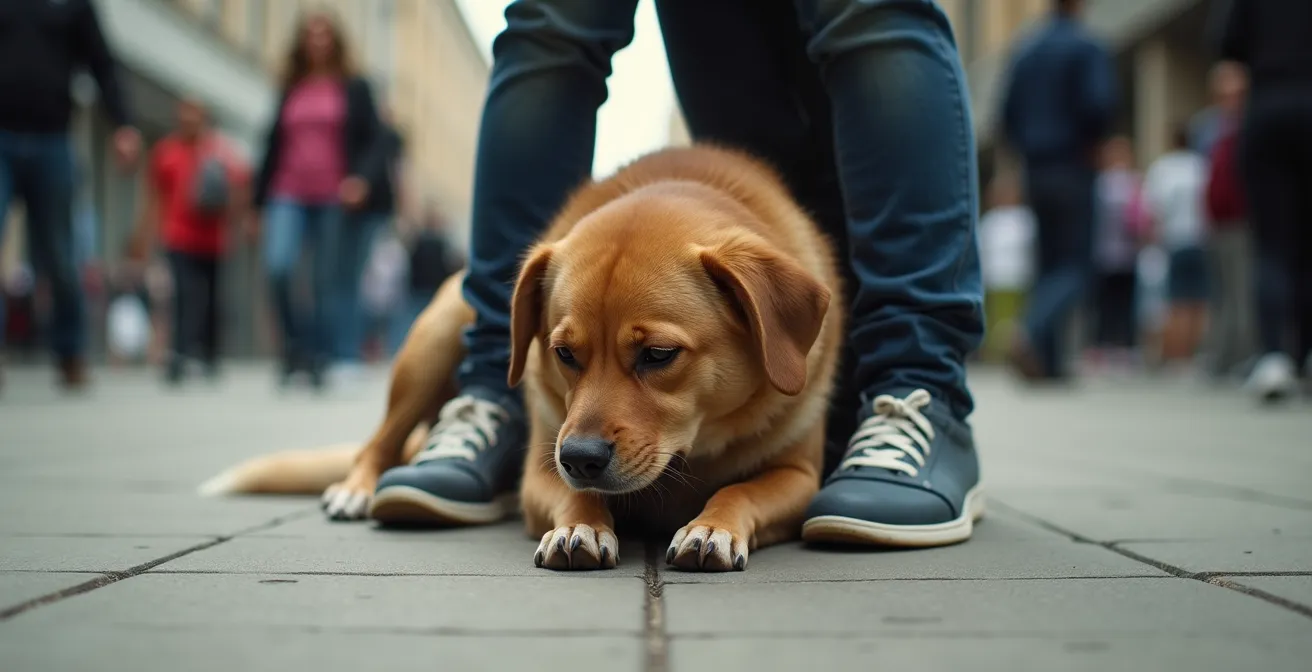
This dog is not calm. The tucked tail, whale eye, and tense body posture are clear signs of a dog that is over its threshold and in a state of shutdown. Recognizing these subtle signs is the most important skill you can develop as the guardian of a fearful dog. Your ability to differentiate between a calm dog and a shutdown dog is the difference between healing and retraumatizing.
When to expect the first tail wag: Setting realistic timelines for shut-down dogs
In our desire for connection, we often look for big, obvious signs of happiness: a wagging tail, a request for belly rubs, a playful bow. For a shutdown street dog, these milestones may be months away, if they happen at all in the traditional sense. Tying your sense of success to a tail wag is a recipe for frustration and burnout. Instead, you must learn to see and celebrate the micro-milestones. These are the tiny, almost imperceptible signs that your dog is starting to feel safe.
The popular “3-3-3 rule” (3 days to decompress, 3 weeks to learn the routine, 3 months to feel at home) provides a rough framework, but for a truly feral-minded dog, you must extend this timeline. A study tracking rescue dogs found that while initial tail wags might appear in the first few weeks, a genuinely happy, relaxed, full-body wag often doesn’t emerge for 6-8 weeks. For severely shut-down dogs, it could be 3-4 months before they display any relaxed tail movement. Your dog is not broken; they are operating on a different clock.
Success is not a tail wag. Success is your dog drinking water while you are in the same room for the first time. Success is your dog making fleeting eye contact. Success is the first time they choose to lie down on a dog bed instead of in their crate. Documenting these tiny victories is essential for your own morale. It reframes the journey from one of waiting for a breakthrough to one of appreciating a slow, steady build of trust. This perspective, as shared by one owner, is what makes the long journey sustainable.
Runi’s owner documented micro-milestones: ‘First time drinking water while I was in room (Day 4), First eye contact (Day 7), First time lying down outside crate (Day 12), First play bow attempt (Day 28), First zoomies in backyard (Day 45), First true relaxed smile for no reason (Day 73)’. The owner notes that focusing on these tiny victories prevented burnout during the slow rehabilitation process.
– Runi’s owner
Shifting your focus to these micro-milestones changes everything. It allows you to see the progress that is happening every day, right in front of you. The first tail wag will happen when it happens. The real magic is in the hundreds of tiny “firsts” that precede it.
The ‘Just One More Block’ Mistake: Why over-walking makes reactivity worse?
There’s a common belief that a tired dog is a good dog. For many dogs, this is true. But for a fearful street dog, a long walk is often a long ordeal. Pushing them to walk “just one more block” when they are already showing signs of stress is a critical mistake. This practice leads to a phenomenon called trigger stacking, where multiple small stressors accumulate until the dog’s nervous system is completely overloaded. A leaf blowing, a distant dog bark, a person approaching—each one adds a layer of stress until the dog explodes in a reactive display or collapses into a shutdown state.
The stress is not just psychological; it’s physiological. When a dog is trigger-stacked, its body is flooded with cortisol, the stress hormone. Research confirms this, with veterinary behavior research demonstrating that dogs exposed to three or more triggers on a single walk can show elevated cortisol levels for up to 72 hours. This means the stress from one “bad walk” on Monday can make your dog more reactive on Wednesday. You are not building resilience; you are creating a chronic state of anxiety.
The solution is the Decompression Walk. This is a short, 10-15 minute walk in a quiet, familiar location. The goal is not physical exercise, but mental relaxation. You use a long line (15 feet or more) to give the dog freedom of movement and choice. You let them sniff. Sniffing is a natural dog behavior that lowers the heart rate and acts as a calming mechanism. For 70% of the walk, your only job is to be the anchor on the end of the leash and let the dog’s nose lead the way. This type of walk allows the dog’s cortisol levels to decrease, making them more resilient and capable of handling stress in the future. Quality over quantity is the rule.
How to make your keys and shoes boring triggers before you even open the door?
For a dog with bolting tendencies or separation anxiety, your departure routine is a sequence of terrifying omens. The jingle of keys, the act of putting on shoes, the sight of a leash—these are not neutral events. They are the first chapters in a story that always ends with them being left behind or forced into the scary world outside. This predictive chain is what builds their anxiety to a fever pitch before you even touch the doorknob. To stop the panic at the door, you have to dismantle the panic that starts in the living room.
The technique is called non-associative desensitization, but you can just think of it as “making things boring.” Your mission is to perform these trigger actions so many times, in random orders, and without the consequence of leaving, that they lose all their predictive power. The goal is for the dog to see you pick up your keys and think absolutely nothing of it. It should be as meaningless as you scratching your nose. This requires hundreds of repetitions.
A case study of Barney, a rescue with severe door bolting, showed remarkable success with this method. His owners picked up their keys over 30 times a day for weeks without leaving. They wore their shoes while watching TV. They carried the leash to the kitchen. Within six weeks, Barney’s pre-departure anxiety, measured by a heart rate monitor, had decreased by 90%. This wasn’t magic; it was the systematic deconstruction of a trigger. You can implement this by creating a “scrambled routine.” Put on your shoes, make coffee, and then take your shoes off. Pick up your keys, walk to the bathroom, and put them down in a different spot. By severing the link between action and outcome, the action becomes just noise.
Key takeaways
- A “shutdown” dog is not calm; learn to spot the difference (dilated pupils, tight mouth) to prevent trauma.
- Rehabilitation is about deconstructing triggers (doors, keys, leashes) by making them boring, not forcing exposure.
- Your dog’s consent is not optional. Use the “Treat and Retreat” method and the 5-second consent test to build trust on their terms.
How to use “slow blinks” to bond with a fearful rescue cat?
The “slow blink” is widely known as a way to communicate trust and affection to a cat. It’s a powerful tool in feline communication. However, a common and critical mistake is to apply this same logic directly to a fearful dog. In the canine world, the language of safety is entirely different. While your intention is kind, trying to “slow blink” at a fearful dog can be ineffective at best and subtly confrontational at worst because it still involves direct or semi-direct eye contact.
A fearful dog interprets direct eye contact as a challenge or a threat. The true canine equivalent of a cat’s slow blink is a combination of signals that communicate the exact opposite of confrontation: you are not a threat. This involves using what dog behaviorists call calming signals. These are the gestures that dogs use with each other to diffuse tension and show peaceful intentions. Your ability to mimic this language is far more powerful than any attempt at direct connection.
As renowned dog trainer Susan Garrett points out, the key is to deliberately show you are not focused on the dog. This is the ultimate sign of respect in their world.
For dogs, the equivalent of a cat’s slow blink isn’t blinking – it’s the soft eye combined with looking away. Direct eye contact in dog language is confrontational. The most powerful calming signal you can give is to yawn, lick your lips slowly, and turn your head away while keeping your body sideways.
– Susan Garrett, Professional Dog Trainer, Dog Body Language and Communication Signals
Adopting these signals into your own body language is transformative. When you are near your fearful dog, don’t face them directly; present your side. Yawn widely and obviously. Lick your lips. Avoid staring, and instead use “soft eyes” by relaxing your eyelids and looking indirectly at them or past them. When you approach, do so in a gentle curve rather than a straight line. By speaking their language, you are telling them, “I see you are afraid, and I am not a threat.” This is infinitely more comforting than a well-intentioned but misunderstood stare.
By consistently applying these principles—deconstructing triggers, respecting consent, managing expectations, and speaking their language of safety—you create an environment where your street dog can finally shed their survivalist past and begin to trust in the safety of your home and your heart.