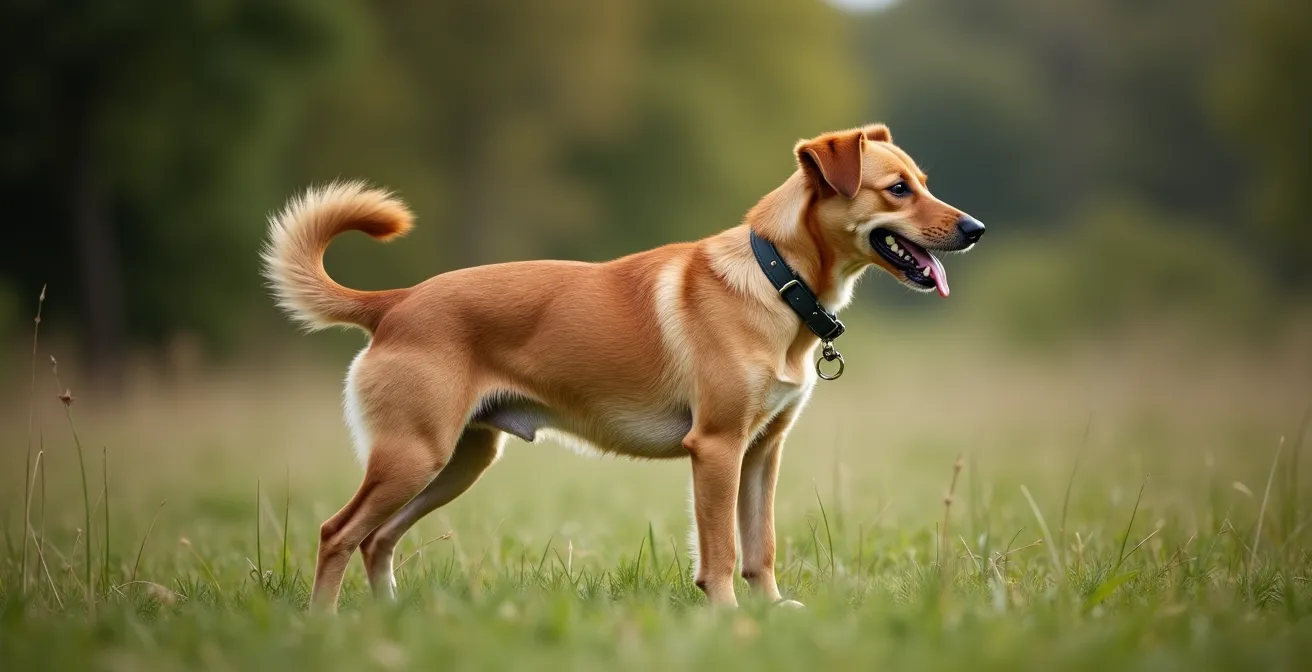
A wagging tail isn’t a reliable sign of friendliness; it’s a sign of emotional arousal, and misreading it is a primary cause of bites.
- A dog’s body language is a “signal chain” where a stiff body, pinned ears, and raised hackles are critical warnings that precede a bite.
- A “freeze”—when a dog becomes completely still over a resource—is the most dangerous signal, often the final moment before an attack.
Recommendation: Stop focusing on the tail as a single clue and learn to read the entire body as a complex sentence to ensure your safety.
The belief that a wagging tail equals a happy, friendly dog is one of the most dangerous myths in human-canine interaction. It’s a comforting oversimplification that leads countless well-intentioned people, including seasoned dog owners, to misinterpret a clear warning and suffer a preventable bite. The tail is merely an indicator of emotional arousal; it can be aroused by excitement, but it can just as easily be aroused by fear, conflict, or aggressive intent. A high, stiff, rapidly vibrating tail is not an invitation to approach; it’s often a sign of high-arousal and potential threat.
To truly understand a dog’s intentions, you must stop looking for single, isolated cues and start reading the entire body as a coherent sentence. This requires moving beyond the tail and learning to interpret the “signal chain”—the sequence of subtle and overt cues that reveal a dog’s true emotional state. We often only notice the end of this chain, the growl or the snap, but the conversation started long before that. Understanding the grammar of this language, from the shift in body weight to the angle of the ears, is not just an interesting skill; it is a critical safety measure.
This article will deconstruct that signal chain for you. We will move piece by piece through the dog’s body, not as a simple checklist, but as a series of interconnected signals that build upon one another. By learning to recognize the early, subtle warnings that most people miss, you will gain the ability to accurately predict intent and de-escalate a situation long before the tail’s deceptive wag leads to a dangerous encounter.
To navigate this complex but crucial topic, this guide breaks down the most misunderstood signals. Each section focuses on a specific part of the dog’s communication toolkit, explaining what it means and how it fits into the bigger picture of their intent.
Summary: Decoding the Full Spectrum of Canine Body Language
- Why a forward-leaning stance indicates assertion while leaning back means fear?
- How to tell if raised hackles mean excitement or defensive aggression?
- Pricked vs Pinned Ears: What the angle tells you about immediate intent?
- The “Play Bow” Context: When is it actually a meta-signal for a pause?
- What to do instantly when a dog goes completely still while guarding a toy?
- Why looking away is a polite gesture in dog language, not ignoring you?
- How to test for resource guarding potential using the “Trade Game” safely?
- Why Punishing a Growl Increases the Risk of a Bite Without Warning?
Why a forward-leaning stance indicates assertion while leaning back means fear?
Before you even look at a dog’s face or tail, their center of gravity tells you a story about their confidence and intent. Body posture is the foundational word in a dog’s communication sentence. A dog’s weight distribution is a direct reflection of their emotional state and their readiness to either engage or retreat. An even, neutral stance is the baseline for a relaxed dog, but any shift from this center point is a significant piece of information.
A forward-leaning stance, where the dog’s weight is shifted onto their front paws, is a signal of assertion and confidence. The dog is closing the distance and preparing to control the situation. This posture often comes with a stiffened body and a high head carriage. This isn’t necessarily aggressive on its own, but it’s a clear sign of a dog who is assessing a potential challenge and is ready to escalate if they feel it’s necessary. They are saying, “I am here, and I am not backing down.”
Conversely, a dog that is leaning back, with their weight shifted onto their rear legs, is expressing fear, anxiety, or appeasement. They are creating distance and making themselves smaller to appear less threatening. This posture is often accompanied by a lowered head, a curved back, and a tucked tail. This dog is communicating, “I am uncomfortable, and I want this interaction to end.” While a fearful dog might seem less dangerous, it’s crucial to remember that a cornered, fearful dog is one of the most likely to bite as a last resort. Ignoring these “I want to leave” signals is a grave mistake.
How to tell if raised hackles mean excitement or defensive aggression?
Raised hackles, or piloerection, are one of the most misunderstood signals in a dog’s vocabulary. This is an involuntary physiological response, much like goosebumps in humans, where the hair along the dog’s neck, shoulders, and back stands on end. Because it’s involuntary, it’s an honest signal of high arousal. However, “arousal” is a neutral term; it can be caused by intense excitement during play, deep-seated fear, or defensive aggression. The key to interpreting hackles lies entirely in the surrounding context of the other body signals.
The critical mistake is assuming raised hackles always mean aggression. A dog might raise its hackles when chasing a squirrel, greeting a beloved owner after a long absence, or during a vigorous game of tug. In these cases, the rest of the body language will be loose, bouncy, and relaxed. The mouth might be open and panting, and the tail will have a wide, sweeping wag. These are “excitement hackles,” a sign of pure, unadulterated arousal from a positive stimulus.
The danger signal appears when the raised hackles are combined with a stiff, frozen body. This is the hallmark of defensive aggression or fear. The dog feels threatened and is making itself look bigger to ward off the perceived danger. An article on canine communication explains that piloerection releases odor from glands contained in the dog’s hair follicles, further amplifying their presence to a potential threat. If you see raised hackles on a dog that is also leaning forward, staring intently, with a closed mouth and a stiffly held tail, you are witnessing a dog on the verge of a defensive or offensive action. This is a clear warning to stop, create space, and de-escalate.
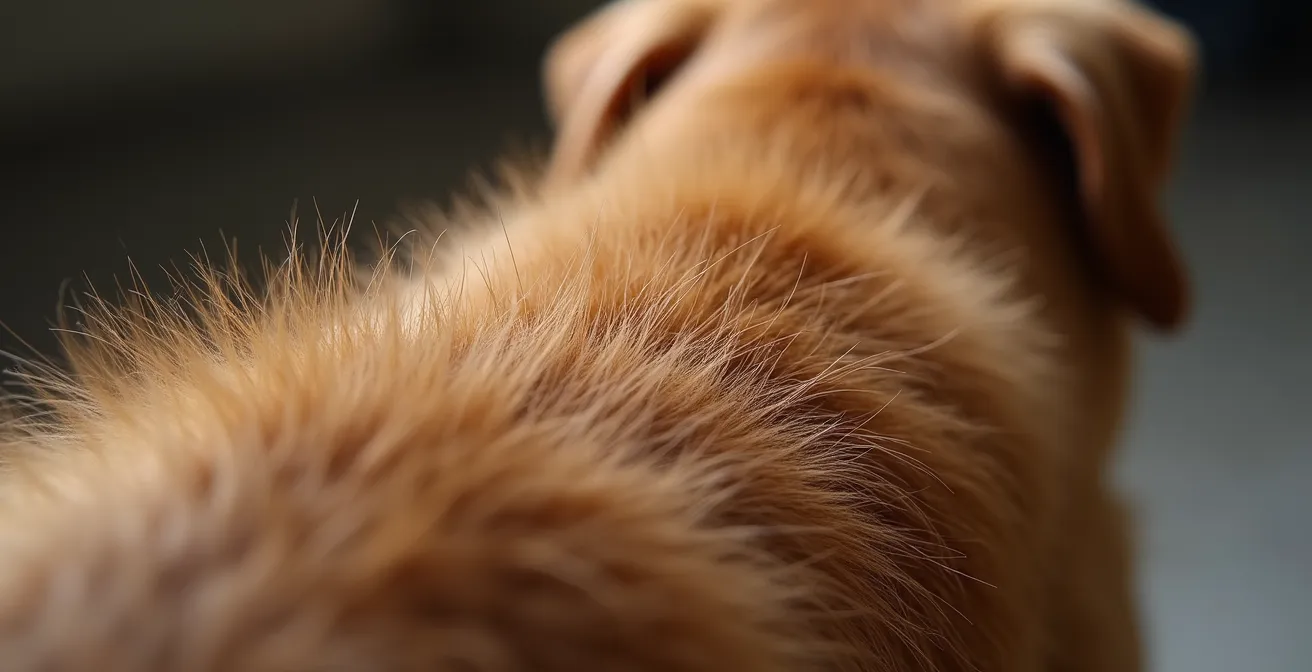
The following table provides a quick reference for distinguishing the meaning of raised hackles based on accompanying body language. Observing the full picture is non-negotiable.
| Hackle Type | Body Language | Meaning |
|---|---|---|
| Excitement Hackles | Loose body, wagging tail | Arousal from positive stimulus |
| Defensive Hackles | Stiff body, frozen stance | Fear or aggression response |
| Play Hackles | Play bow, bouncy movements | High arousal during play |
Pricked vs Pinned Ears: What the angle tells you about immediate intent?
A dog’s ears are like sensitive satellite dishes, constantly swiveling to gather information and broadcasting their immediate emotional state. While breed structure (like the floppy ears of a Basset Hound versus the upright ears of a German Shepherd) affects the visibility of these signals, the underlying muscle tension tells the same story across all dogs. A relaxed, neutral ear position is the baseline for a content dog.
Pricked ears, held forward and erect, indicate a high state of alertness and interest. The dog is focusing intently on something in the environment. This could be the sound of a treat bag, the sight of a squirrel, or the approach of a stranger. By itself, this isn’t a negative sign, but it signals that the dog’s attention is captured. When combined with a forward-leaning stance and a tense body, pricked ears become part of the “signal chain” of a potential challenge or threat assessment. The dog is gathering data before deciding on its next move.
The more critical signal to recognize is pinned ears. When a dog’s ears are pulled flat against its head, it is a significant indicator of fear, anxiety, or submission. A dog pinning its ears is often trying to protect them in anticipation of a conflict. It’s a defensive posture that screams “I am very uncomfortable.” This is where context becomes a matter of safety, as a leading animal behavior team explains.
if their ears are flat and pinned back or to the sides, your pooch is definitely signaling fearful dog body language. Depending on the overall body language followed by flattened ears, it might be a submissive gesture or a precursor to an attack. If the dog is growling, barking or looks like they’re preparing to pounce, you should approach with caution.
– Petcube Animal Behavior Team, Dog Language Translator Guide
Ignoring pinned ears is like ignoring a flashing red light. The dog is clearly communicating extreme distress. If you continue to approach or apply pressure, you are forcing a fearful animal into a corner where a bite may feel like its only option for self-preservation.
The ‘Play Bow’ Context: When is it actually a meta-signal for a pause?
The play bow—chest on the ground, rump in the air—is one of the most recognized and universally understood signals in the canine world. It’s an unambiguous invitation to play. It says, “Let’s have some fun!” However, its function is more sophisticated than a simple invitation. The play bow often acts as “communication punctuation,” a meta-signal that frames the context of other behaviors, especially rough ones. A dog might engage in a rough-and-tumble chase, then offer a quick play bow to say, “Remember, everything I just did was in fun! It wasn’t a real challenge.”
This is why a play bow can also function as a signal to pause or de-escalate play that is becoming too intense. If one dog is feeling overwhelmed, it might offer a play bow not to initiate more play, but to reset the interaction to a less intense level. It’s a way of checking in and ensuring that both parties are still on the same page. A reciprocated bow means “game on,” while an ignored bow can be a source of frustration for the initiating dog.
But like all signals, the play bow can be deceptive if not read in its full context. A true play bow is loose and wiggly. A stiff, prolonged “bow” with a hard stare and a closed mouth is not a play signal. It can be a stretching behavior, or more concerningly, a conflicted signal from a dog that is unsure how to proceed in a tense situation. They may be feigning playfulness while actually assessing a threat. The key is to watch what happens immediately after. Does the dog bound into playful action, or do they remain tense and watchful? The follow-through reveals the true intent behind the posture.
What to do instantly when a dog goes completely still while guarding a toy?
Of all the signals in the canine signal chain, the most dangerous and most immediate precursor to a bite is the “freeze.” This is the moment a dog goes completely still, often over a high-value resource like a toy, food bowl, or bone. The body becomes rigid, the eyes may fixate with a hard stare, and the mouth closes. All movement ceases. This is not a sign of thought or consideration; it is the calm before the storm. The dog has tried other, more subtle signals to communicate its discomfort—perhaps a look away, a lip lick, or a slight stiffening—and they have been ignored. The freeze is its final, silent warning: “If you come any closer, I will bite.”
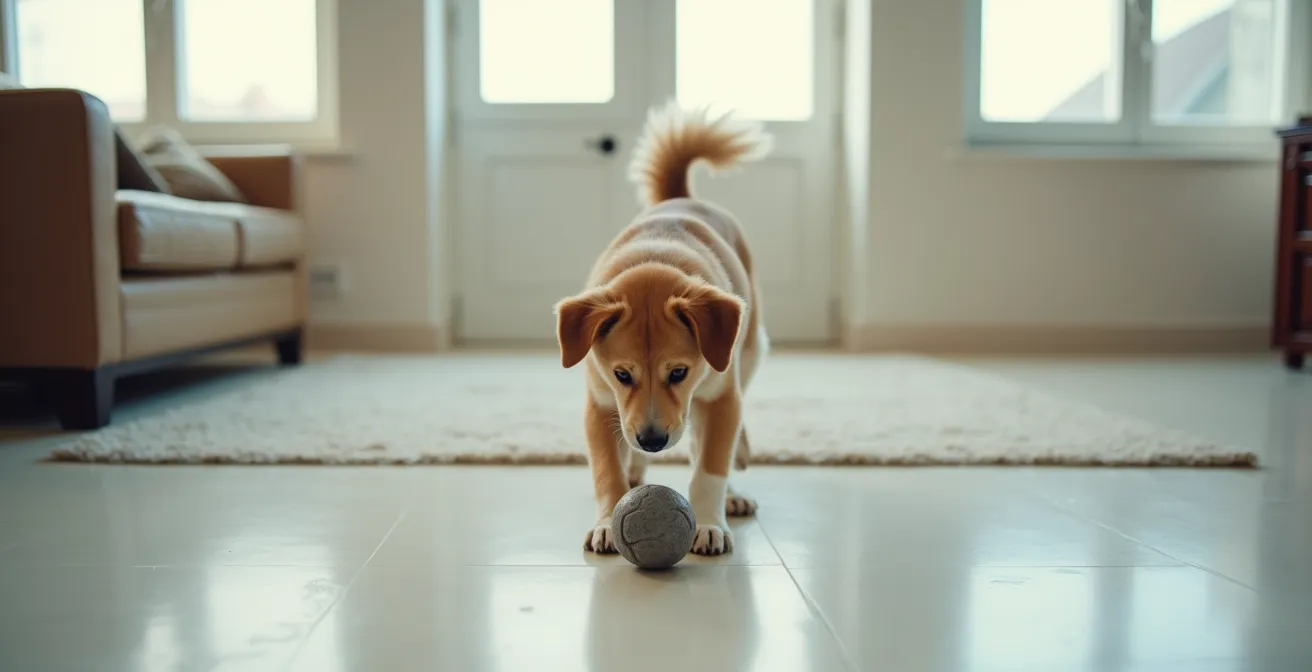
Witnessing a freeze is a critical moment that demands an immediate and precise reaction from you. Your goal is not to challenge the dog or retrieve the object. Your one and only goal is to de-escalate the situation and remove yourself as a threat. Any forward movement, reaching, or direct eye contact at this stage will likely trigger an attack. The dog has made its boundary clear, and crossing it will have consequences. Your immediate actions can either prevent a bite or guarantee one.
If you find yourself in this situation, it is imperative to follow a strict de-escalation protocol. This is not a negotiation; it’s a safety procedure. The following steps are designed to communicate to the dog that you are not a threat and that you respect its warning.
Your emergency de-escalation checklist for resource guarding
- Stop all movement immediately: Do not reach for the object or move toward the dog. Your stillness mirrors their freeze and stops the escalation.
- Avert your gaze: Turn your head slowly to the side. Direct eye contact is a threat; looking away is a sign of appeasement.
- Turn your body sideways: Presenting the side of your body makes you appear smaller and less confrontational than a head-on posture.
- Take one slow step backward: Maintain your sideways orientation and slowly increase the distance. Do not turn your back and run, which could trigger a predatory chase response.
- Redirect attention if safe: Once you have created some distance, toss a handful of high-value treats away from the dog and the guarded object. This can break their focus and allow you to retreat safely.
Why looking away is a polite gesture in dog language, not ignoring you?
In human culture, looking away can be seen as rude, dismissive, or a sign of disinterest. In the world of canine communication, it is often the exact opposite: a polite, respectful gesture designed to de-escalate tension and show non-threatening intent. These are known as “calming signals,” a term popularized by renowned dog trainer Turid Rugaas. A dog that turns its head away, averts its gaze, yawns, or licks its lips is actively trying to avoid conflict and pacify a situation it finds stressful.
When you approach a nervous dog and it turns its head away, it’s not ignoring you. It’s saying, “I see you, I am a little uncomfortable with this direct approach, and I am choosing to be polite rather than confrontational.” This is a crucial piece of communication. A well-socialized dog will offer these signals to diffuse tension with another dog or a person. Punishing or misinterpreting this as disobedience is a fundamental error. Instead, it should be seen as a request for space or a less direct approach.
Another classic appeasement signal is showing the whites of the eyes, often called “whale eye.” This happens when a dog turns its head away from a stressor but keeps its eyes angled toward it. You see a crescent moon of white in the corner of their eye. This is a clear sign of anxiety and internal conflict. The dog wants to look away to appease but also feels compelled to keep an eye on the perceived threat. A dog showing whale eye is on high alert and feeling stressed. Continuing to pressure a dog in this state is asking for the situation to escalate from appeasement to defense.
According to Turid Rugaas, author of ‘On Talking Terms With Dogs: Calming Signals,’ dogs use yawning to calm themselves in tense situations and to calm others, including their owners. She suggests yawning at your dog to provide comfort during stressful moments, such as a vet visit.
– Turid Rugaas, as cited by the American Kennel Club
How to test for resource guarding potential using the ‘Trade Game’ safely?
Resource guarding—the behavior where a dog uses threats to keep control of food, toys, or even a specific person—is a serious issue that often begins subtly. The best way to prevent it from escalating is through proactive training, and the “Trade Game” is the gold standard for teaching a dog that a human approaching its possessions is a good thing, not a threat. The game rewires the dog’s emotional response from “You’re going to take my thing!” to “You’re going to give me something even better!”
The core principle is to never create a conflict. You are not forcibly taking an item; you are offering a high-value trade. You start with low-stakes items. For example, offer a piece of their regular kibble in exchange for a boring toy they don’t care much about. When they drop the toy to take the kibble, praise them, let them eat it, and immediately give the toy back. This last step is crucial: it teaches the dog that giving things up doesn’t mean losing them forever.
Gradually, you work up a “value ladder.” You trade a slightly better treat for a slightly more interesting toy. The process must be slow and always set up for success. This game is especially critical during a puppy’s development. In fact, behavioral research indicates that 8-16 weeks is the critical window for preventing resource guarding through these positive trade games. If at any point you see warning signs—body stiffening, a hard stare, or the dog trying to eat the item faster as you approach—you must stop immediately. This is a sign that the value is too high or the pressure is too great, and it’s time to consult a professional certified trainer or behaviorist. Forcing the issue will only confirm the dog’s fear and worsen the guarding.
Key Takeaways
- A wagging tail only indicates emotional arousal, not specific intent. Context is everything.
- The “freeze” is the most dangerous warning signal a dog can give and is an immediate precursor to a bite.
- Punishing a growl does not stop aggression; it only removes the audible warning, creating a far more dangerous “silent biter.”
Why Punishing a Growl Increases the Risk of a Bite Without Warning?
A growl is your dog’s last polite, audible warning. It is the final word in a long sentence of discomfort that likely included a stiff body, a hard stare, pinned ears, and a tense mouth. The growl is not the problem; it is a symptom of the problem. It is the dog’s clearest way of saying, “I am incredibly uncomfortable with this situation, and I need you to stop and create space immediately.” It is a gift of communication, a final off-ramp before the situation escalates to a bite.
When you punish a dog for growling—whether by yelling, hitting, or using a “correction”—you do not eliminate the underlying fear or aggression. You simply teach the dog that this specific warning signal is unacceptable and will result in punishment. The dog learns that growling doesn’t work to solve its problem. So, what does it do next time it feels the same level of stress? It skips the growl it was punished for and goes directly to the next tool in its arsenal: its teeth. This is how you create a “silent biter,” a dog that attacks with no apparent warning.
This phenomenon is one of the most critical concepts for any dog owner to understand. As a veterinary professional organization on animal behavior notes, these louder signals are a dog’s “shout” after their quieter “requests for space” have gone unheard. By attending to these early signs, we create safer interactions for everyone.
if polite requests for help or requests for space go unheard, their body language and behavior may escalate to a louder shout (think: lunge or growl) to get others to listen. Attending to the early signs of fear, anxiety, and stress… is essential for deepened relationships, safer living with dogs, and helping dogs live happier, healthier, fuller lives.
– Fear Free Happy Homes, Dog Body Language 101
The correct response to a growl is to thank the dog for the information, immediately stop what you are doing, and create space. Then, you can analyze the situation to understand what triggered the response and work with a professional to address the root cause of the dog’s discomfort through counter-conditioning and desensitization.
By learning to read the entire signal chain and respecting every piece of communication—especially the growl—you move from being a simple owner to a responsible, knowledgeable guardian. This understanding is the true foundation of a safe and trusting relationship with any dog.