
The “premium” pet food you’re buying might be legally designed to mislead you about its actual meat content and quality.
- Labels manipulate ingredient lists using water weight, making “fresh meat” seem more prominent than denser, more nutritious “meat meal.”
- Terms like “Dinner” or “Recipe” legally allow a food to contain as little as 25% of the named meat, with the rest being cheap fillers.
- “Ingredient splitting” is a common trick where a single low-quality ingredient (like peas) is listed in multiple forms to push it down the list.
Recommendation: Stop trusting the front of the bag. The real story is in the fine print, the guaranteed analysis, and understanding the regulatory loopholes that govern pet food.
As a conscious pet owner, you stand in the aisle, a brightly colored bag of “premium” kibble in your hand. The label screams “Real Chicken First Ingredient,” “Grain-Free,” and “Made in the USA.” You feel confident you’re making the best choice for your companion. But what if I told you that label is a carefully constructed piece of legal fiction, designed by marketing teams to exploit your good intentions? You’ve been taught to look at the first ingredient, but this is one of the most common and outdated pieces of advice in the industry. It’s a platitude that marketers rely on.
The truth is, the pet food industry operates within a set of regulatory loopholes that allow manufacturers to present a low-quality, filler-heavy product as a high-protein, premium meal. These aren’t illegal activities; they are formulation tricks built into the system. This is where the real deception lies—not in breaking the law, but in exploiting it to its fullest extent. Concepts like “ingredient splitting,” water weight manipulation, and legally-defined naming conventions are the tools of the trade.
But if the primary advice—”check the first ingredient”—is flawed, what’s the alternative? The key is not just to read the label, but to decode it. It’s about understanding the “why” behind the ingredient order, not just the “what.” This article will not give you a list of “good” or “bad” brands. Instead, it will arm you with the technical knowledge of an industry insider. We will dissect the legal definitions that allow “Chicken Dinner” to contain less meat than “Chicken Food,” expose how “fresh meat” can be a red herring, and reveal the nutritional science that lazy formulations ignore. You will learn to see the label for what it truly is: a data sheet that, once you know the code, tells you everything the marketing on the front of the bag is trying to hide.
This guide provides a comprehensive breakdown of the most common and deceptive practices in the pet food industry. Follow along as we unpack each trick, giving you the tools to make a truly informed decision for your pet’s health.
Summary: Decoding the Deception in Your Pet’s Food Bowl
- Why “Chicken Dinner” has less meat than “Chicken Recipe” legally?
- How to calculate the daily feeding cost of raw vs kibble accurately?
- Grain-Free vs Grain-Inclusive: Which is linked to DCM heart issues?
- The “Human Grade” Myth: What does it actually mean for your dog’s health?
- How to store dry kibble to prevent fat rancidity after opening the bag?
- Why “Made in USA” doesn’t mean the ingredients were sourced ethically?
- Why feeding just meat and rice causes skeletal deformities in puppies?
- Why “Fresh Meat” as the First Ingredient Can Be Misleading in Dry Kibble?
Why “Chicken Dinner” has less meat than “Chicken Recipe” legally?
The name on the front of a pet food bag is not a creative choice; it’s a legal declaration governed by strict AAFCO (Association of American Feed Control Officials) percentage rules. This is one of the first and most powerful regulatory loopholes manufacturers use. A single word change, like adding “Dinner” or “Recipe” to the name, drastically alters the minimum required meat content, allowing a product to appear meat-focused while being composed primarily of fillers.
The most telling distinction is between the “95% Rule” and the “25% Rule.” A product named “Chicken Dog Food” must contain at least 95% chicken (when excluding water). However, if the name changes to “Chicken Dinner,” “Chicken Recipe,” or “Chicken Entrée,” the legal requirement plummets to just 25% chicken. This means 75% of what you’re buying can be cheaper ingredients like corn, soy, or wheat. The industry uses these appealing, human-like terms to evoke a sense of a complete meal, while legally justifying a far lower meat content and production cost. Even more diluted is the “With” rule, where “Dog Food With Chicken” only requires 3% chicken, and the “Flavor” rule, which requires only trace amounts detectable by a trained animal.
This side-by-side comparison from AAFCO’s official guidelines reveals the stark reality of how naming conventions dictate content, as detailed in a breakdown of labeling requirements.
| Rule Name | Required Meat % | Example Names | Real Content |
|---|---|---|---|
| 95% Rule | 95% (dry: 70%) | “Chicken Dog Food” | Mostly meat |
| 25% Rule (Dinner/Recipe) | 25% (wet: 10%) | “Chicken Dinner” | 75% fillers |
| 3% “With” Rule | 3% | “With Chicken” | 97% other |
| Flavor Rule | <1% | “Chicken Flavor” | Trace amounts |
Understanding this framework is the first step to seeing past the marketing. The name is a direct signal of meat quantity. If you see words like “dinner,” “platter,” “entrée,” or “formula,” you should be immediately skeptical and assume the product’s bulk comes from carbohydrates, not the protein pictured on the bag.
How to calculate the daily feeding cost of raw vs kibble accurately?
Comparing the cost of raw food to kibble isn’t as simple as looking at the price per pound or kilogram. A bag of kibble might seem cheaper upfront, but its caloric density and the inclusion of fillers can be deceptive. The only accurate way to compare is by calculating the cost per calorie—specifically, the cost per 1,000 kilocalories (kcal). This metric equalizes the comparison by focusing on the actual energy your pet receives from the food, not just the bulk weight of the product.
To do this, you must first find the caloric content on the label, usually listed as “kcal/cup” or “kcal/kg.” Then, you determine the total calories in the entire package. Finally, you divide the package price by the total calories and multiply by 1,000. This gives you a standardized cost that can be compared across any type of food, from nutrient-dense raw patties to airy, carbohydrate-heavy kibble. This method often reveals that some “expensive” raw or fresh foods are more cost-effective on a per-calorie basis than a mid-range kibble that requires larger feeding portions to meet a pet’s energy needs.
Beyond the food itself, a true cost analysis must include the hidden costs associated with each feeding style. For raw feeding, this includes the electricity to run a freezer, the cost of essential supplements to ensure a complete and balanced diet, and your time spent on safe thawing and preparation. For kibble, hidden costs include proper airtight storage containers to prevent rancidity and potential waste if a large bag goes stale before it can be used.
Action Plan: Calculating Your Pet’s True Meal Cost
- Find the caloric content on the pet food label (usually listed as kcal/cup or kcal/kg).
- Calculate total calories in the package by multiplying the caloric density by the package’s total weight or volume.
- Apply the formula: (Price of Food / Total kcal in package) × 1000 to get the cost per 1000 kcal.
- Factor in hidden raw food costs: freezer electricity (approx. $5-10/month), thawing time (15 min/day), and balancing supplements ($10-20/month).
- Factor in hidden kibble costs: one-time purchase of airtight storage containers ($30-50) and potential waste from rancidity if not stored correctly.
By using this comprehensive calculation, you move beyond the sticker price and gain a genuine understanding of what it costs to fuel your pet. The results can be surprising and empower you to make a decision based on nutritional value per dollar, not just packaging.
Grain-Free vs Grain-Inclusive: Which is linked to DCM heart issues?
The “grain-free” marketing trend exploded based on the premise that grains are unnatural, allergenic fillers in pet food. However, the conversation shifted dramatically when the FDA began investigating a potential link between certain diets and a serious heart condition called non-hereditary dilated cardiomyopathy (DCM). The initial narrative blamed grain-free foods, but the science has become far more nuanced. The issue appears to be less about the absence of grains and more about the presence of high levels of pulses (peas, lentils, chickpeas) and potatoes used to replace them.
As Lisa Freeman, a board-certified veterinary nutritionist at Tufts University, clarifies, the problem is not as simple as “grain-free.”
In fact, it appears to be more closely associated with diets containing pulses, rather than with the presence or absence of grains in a diet. In the past, it was primarily grain-free diets that included high levels of pulses and potatoes as ingredients to replace grains, but now some grain-inclusive diets contain pulses and can be associated with DCM as well.
– Lisa Freeman, DVM, PhD, DACVIM, Tufts University Clinical Nutrition Service
These diets, often referred to as “BEG” diets (Boutique companies, Exotic ingredients, Grain-free), frequently use peas, lentils, and other legumes as major protein and carbohydrate sources. One of the leading theories is that these ingredients may interfere with the absorption or synthesis of taurine, an amino acid crucial for heart health, or contain other antinutrients. The FDA itself, after reviewing 1,382 reports of DCM cases, stated it could not establish a definitive causal relationship, highlighting the complexity of the issue. A key red flag for consumers is seeing pulses like peas, lentils, or chickpeas listed among the top ten ingredients, or seeing multiple forms of them (e.g., pea protein, pea flour) scattered throughout the list—a classic example of ingredient splitting to disguise their high concentration.
The “Human Grade” Myth: What does it actually mean for your dog’s health?
The term “human-grade” is one of the most powerful—and most misused—marketing buzzwords in the pet food industry. Many consumers assume it means the food is made with the same quality of ingredients you’d find at a grocery store. While that’s the implication, the legal definition is far more stringent, and many companies use the phrase deceptively. A product cannot be legally called “human-grade” simply because it contains a few “human-grade ingredients.”
For a pet food to be officially and legally considered human-grade, 100% of its ingredients and supplements must be edible for humans, and the food must be manufactured, packaged, and stored in a facility that is licensed for producing human food. This is a high bar that very few companies actually meet. The more common, deceptive practice is for a brand to highlight one or two ingredients, like chicken or carrots, as “human-grade” while the rest of the formula and the production facility fall under the less-regulated feed-grade standards. Feed-grade ingredients can include materials not deemed safe for human consumption.
Case Study: The Legal Standard for “Human-Grade”
To earn the “human-grade” claim legally, a company must be able to provide documentation proving its entire supply and production chain is compliant with human food safety standards. This means every single ingredient, from the meat to the vitamin premix, must pass the same standards as food for people. Furthermore, the kitchen or facility where the food is cooked and packaged must hold a human food facility license and be subject to FDA or USDA inspections. A brand that truly meets this standard will be transparent and able to furnish these documents upon request. Any hesitation or vague response is a major red flag, indicating they are likely using the term as a marketing ploy rather than a legally defensible fact.
As a consumer, you must be your own advocate. Don’t be swayed by the term alone. Demand proof. Ask companies for their facility license number. Remember, “made with human-grade ingredients” is not the same as being a “human-grade food.” The latter term applies to the entire product and process, guaranteeing a level of safety and quality that the former only hints at.
How to store dry kibble to prevent fat rancidity after opening the bag?
You buy a large, economical bag of high-quality kibble, pour it into a convenient plastic container, and toss the original packaging. This common practice, known as “kibble dumping,” is one of the biggest mistakes a pet owner can make and actively accelerates food spoilage. The fat sprayed onto kibble to enhance palatability and add calories is highly susceptible to oxidation. Once exposed to air and light, these fats begin to break down, a process that creates rancidity. Rancid fats not only taste bad, leading to food refusal, but they also lose their nutritional value and can cause gastrointestinal upset and other health issues.
The original pet food bag is not just simple packaging; it is an engineered, multi-layer barrier designed specifically to protect the food from oxygen and light, preserving the fats and fat-soluble vitamins. Most high-quality bags have a grease-proof liner that is crucial for maintaining freshness. When you dump the kibble into a plastic container, you discard this primary protective layer. Furthermore, plastic containers are often not washed thoroughly between bags, allowing old, rancid fat residue to contaminate the new food.
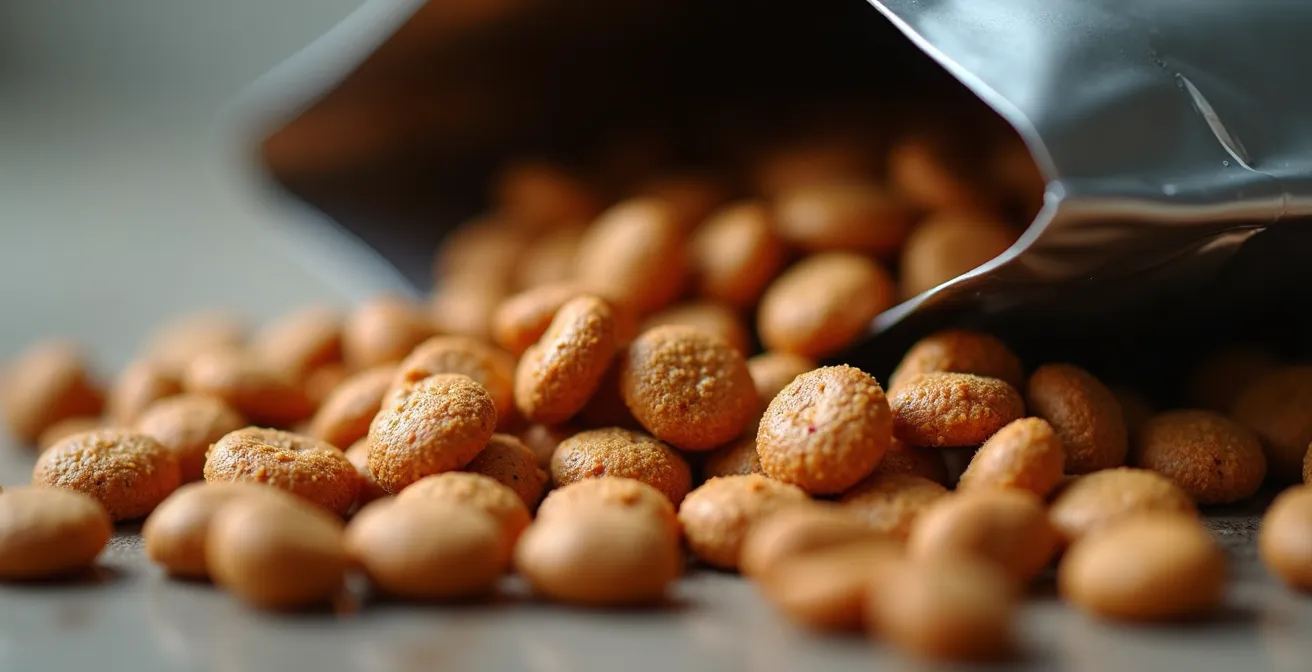
The best practice, endorsed by veterinarians and nutritionists, is to place the entire original bag inside an airtight container. This “bag-in-a-box” method provides two layers of protection: the engineered barrier of the bag and the seal of the container. This preserves the food’s integrity, prevents the buildup of rancid oils in your container, and keeps the lot number and expiration date readily available in case of a product recall. As a rule of thumb, an open bag of kibble should be used within a month to ensure optimal freshness and prevent the negative effects of fat oxidation.
Why “Made in USA” doesn’t mean the ingredients were sourced ethically?
The “Made in USA” label is a powerful marketing tool that evokes a sense of safety, quality, and patriotism. Consumers often interpret this claim to mean that every component of the product is from the United States. However, the Federal Trade Commission (FTC) standard for this claim contains a significant loophole that the pet food industry widely exploits. The rule states that a product must be “all or virtually all” made in the U.S., but it allows for foreign-sourced ingredients as long as they are not core to the product’s identity.
This is where the deception lies. What constitutes a “core” component is open to interpretation. Critically, the complex vitamin and mineral premixes added to nearly all commercial kibbles to make them “complete and balanced” are almost universally sourced from overseas, most often from China. Because these premixes make up a small percentage of the final product’s weight, manufacturers can legally claim “Made in USA” even though the essential micronutrients are imported. A transparent company will admit this global supply chain reality, while a deceptive one will hide behind the patriotic label.
Furthermore, the “Made in USA” claim says absolutely nothing about the ethical or welfare standards of the ingredients that are sourced domestically. It doesn’t tell you if the chicken was raised cage-free, if the beef was grass-fed, or if the farming practices were environmentally sustainable. A factory-farmed animal raised in poor conditions in the U.S. still qualifies for the label. True ethical sourcing requires a much deeper level of transparency, including certifications for animal welfare (like Global Animal Partnership), environmental impact assessments, and fair labor practices—details the “Made in USA” sticker conveniently ignores.
Why feeding just meat and rice causes skeletal deformities in puppies?
The well-intentioned but dangerous trend of feeding puppies a simple “bland diet” of boiled meat and white rice on a long-term basis is a recipe for nutritional disaster. While suitable for a day or two to calm an upset stomach, this diet is severely unbalanced and can lead to devastating skeletal deformities, especially in growing large-breed puppies. The core of the problem lies in a critical mineral imbalance, specifically the calcium-to-phosphorus (Ca:P) ratio.
Muscle meat is naturally very high in phosphorus but extremely low in calcium. An ideal diet for a growing puppy should have a Ca:P ratio of approximately 1.2:1. Unsupplemented meat and rice can have a ratio as skewed as 1:20. When the body detects low blood calcium, it pulls the mineral directly from the bones to compensate, leading to a condition known as nutritional secondary hyperparathyroidism. This results in soft, weak, and brittle bones that are prone to fracture and malformation. As a scientific review from the Purina Institute highlights, this imbalance between calcium and phosphorus is one of the most critical nutritional factors for skeletal health.
Beyond the Ca:P ratio, a meat-and-rice diet is deficient in numerous other essential micronutrients that are vital for proper development. These include:
- Calcium: Directly required for building bone density.
- Zinc: Crucial for immune function and cell division.
- Copper: Necessary for forming connective tissues like cartilage and ligaments.
- Iodine: Essential for thyroid hormone production, which regulates metabolism and growth.
- Vitamins D and E: Vitamin D enables calcium absorption, while Vitamin E is a powerful antioxidant that protects cells from damage.
For large and giant breed puppies, the margin for error is even smaller. Both a deficiency and an excess of calcium can cause serious orthopedic problems like osteochondrosis. This is why formulated puppy foods are so meticulously balanced; they are designed to provide these nutrients in precise amounts that a simple homemade diet cannot replicate without expert veterinary nutritionist guidance.
Key Takeaways
- The name tells a story: “Chicken Dinner” is not “Chicken Food.” One requires only 25% meat, the other 95%. Know the AAFCO naming rules.
- “Made in USA” is not a guarantee of ethical or 100% domestic sourcing. Critical vitamin premixes are almost always imported, often from China.
- “Fresh Meat” as the first ingredient is a marketing trick that uses water weight to inflate its position on the label before cooking.
Why “Fresh Meat” as the First Ingredient Can Be Misleading in Dry Kibble?
This is the industry’s most sophisticated and effective deception: the “fresh meat first” trick. You’ve been trained to look for a whole meat source like “Deboned Chicken” or “Fresh Beef” as the number one ingredient. It feels intuitive—more meat is better. However, ingredient lists are ordered by pre-cooking weight. Fresh meat contains approximately 70-80% water, while a rendered “meat meal” (like chicken meal or lamb meal) contains only about 10% water. This water weight is the key to the formulation trick.
During the extrusion process used to make kibble, most of this water is cooked off. The fresh chicken that weighed the most at the start of the process contributes far less protein to the final product than you think. A lower-ranking ingredient like “chicken meal” is already dehydrated and concentrated, meaning it provides a much denser source of protein and nutrients by final weight. As The Farmer’s Dog points out, beef loses weight through water evaporation in the cooking process, while rice gains weight. This means any starches end up occupying even more volume in the final product, while the meat portion is lowered.
This table illustrates the dramatic difference in protein contribution between fresh meat and meat meal once the water is removed during cooking.
| Ingredient Type | Water Content | Protein After Cooking | Position on Label |
|---|---|---|---|
| Fresh Chicken | 70-80% | 20-30% of original | Often #1 (pre-cooking) |
| Chicken Meal | 10% | 90% retained | Often #2-3 |
| Reality Check | Chicken meal in position #2 often provides more protein than fresh chicken at #1 | ||
Consequently, a food listing “Chicken Meal” as the second or third ingredient may actually contain significantly more animal protein than a food that lists “Fresh Chicken” first, followed by a series of carbohydrate fillers. This isn’t to say fresh meat is bad, but its position as the top ingredient is often a deliberate marketing strategy that leverages water weight to make a kibble appear more meat-rich than it truly is on a dry matter basis—the only accurate way to compare.
Now that you are armed with this knowledge, you are no longer a passive consumer. You are an informed advocate for your pet’s health. The next time you’re in the pet food aisle, pick up that bag, turn it over, and start decoding. Don’t just read the ingredient list—interrogate it. Apply these principles and see what you uncover about the food you’ve been buying.