
If you feel trapped at home by your dog’s destructive separation anxiety, it’s because common advice like “give them a toy” fails to address the root cause: this isn’t bad behavior, it’s a clinical panic disorder. The key isn’t distraction, but a methodical, step-by-step process of desensitization that works *under* your dog’s panic threshold. This guide provides that systematic plan to dismantle their fear, not just manage it, so you can both regain your peace and freedom.
The sound of your keys jingling. The sight of you putting on your shoes. For most people, these are mundane, thoughtless actions. For you, they are the prelude to chaos. You feel like a prisoner in your own home, every departure meticulously planned and every return filled with dread. What will you find this time? A scratched-up door? A destroyed crate? Or just the heartbreaking sound of a dog who has been panicking for hours?
You’ve probably tried everything the internet suggests: long walks before you leave, special puzzle toys, leaving the TV on. Yet, the destruction and distress continue. This is because these well-meaning tips fail to grasp the fundamental truth of the situation. Your dog is not being “bad,” “naughty,” or “spiteful.” Your dog is having a panic attack, an overwhelming and involuntary physiological response identical to what a human experiences. Their destructive behavior is not a protest; it’s a desperate, frantic attempt to escape an unbearable feeling of terror.
The only way to achieve real, lasting change is to stop trying to manage the behavior and start treating the underlying panic disorder. This requires a completely different approach—one that is methodical, gradual, and rooted in empathy. It’s about systematically dismantling the triggers and rebuilding your dog’s sense of safety, one tiny, successful step at a time. This is not a quick fix, but a structured journey to give your dog the coping skills they so desperately need.
This article will guide you through that professional, step-by-step process. We will deconstruct the panic response and provide a clear, actionable plan to help your dog learn that being alone is safe, not scary. Here is the path to reclaiming your freedom and your dog’s peace of mind.
Summary: Your Path to Calmer Departures
- Why separation anxiety is a panic attack and not “spiteful” behavior?
- How to make your keys and shoes boring triggers before you even open the door?
- Fluoxetine vs Training Alone: When is medication necessary for learning to happen?
- The “Cry It Out” Mistake: Why letting them panic makes the anxiety worse
- How to greet an anxious dog upon return without reinforcing the frenzy?
- Why high-pitched repetitive barking signals separation distress, not territoriality?
- The “Crate Confinement” Risk: How over-crating causes psychological shutdown?
- How Your Home’s Lighting and Sound Environment Is Secretly Stressing Your Sensitive Pet?
Why separation anxiety is a panic attack and not “spiteful” behavior?
The first and most crucial shift in perspective is understanding what is happening inside your dog’s brain. When a dog with separation anxiety sees you prepare to leave, their brain is not making a conscious choice to be destructive. Instead, their amygdala—the brain’s fear center—hijacks their rational thought. A flood of stress hormones like cortisol and adrenaline courses through their body, triggering an involuntary fight-or-flight response. The destruction you see—chewing doorframes, clawing at windows, frantic barking—is a desperate attempt to relieve this overwhelming internal pressure and reunite with their source of safety: you.
Attributing this to “spite” or “revenge” is an error of anthropomorphism. Your dog isn’t thinking, “I’ll teach them for leaving me.” They are thinking, “I am in danger, I am trapped, I must escape to survive.” This is a panic disorder, not a behavioral issue. It is as uncontrollable for them as a severe panic attack is for a human. They cannot “just get over it” or “learn their lesson” through punishment. In fact, punishing them upon your return only adds confusion and fear to an already terrified state, confirming their belief that the world is an unsafe place without you.
Recognizing this as a medical condition is the key to effective treatment. It allows you to approach the problem with empathy and a methodical plan, rather than frustration and discipline. Your role is not that of a disciplinarian, but of a supportive guide helping them navigate an overwhelming phobia. Every training step must be designed to keep them “sub-threshold”—calm and below the point where panic takes over. This understanding transforms the entire process from a battle of wills into a journey of healing.
How to make your keys and shoes boring triggers before you even open the door?
For a dog with separation anxiety, your departure routine is a sequence of terrifying predictions. The sound of your keys, the act of putting on your jacket, picking up a bag—each is a small signal that their world is about to fall apart. This is known as trigger stacking, where each cue adds another layer of anxiety until panic becomes inevitable. Our goal is to dismantle this predictive chain by making these triggers utterly meaningless.
This process is called desensitization. Instead of only picking up your keys when you leave, you must make them the most boring object in the house. Pick them up, walk to the kitchen, put them down, and sit back on the sofa. Do this 15-20 times a day. Put on your shoes, walk to the fridge for a drink, and take them off. The goal is for your dog to see these actions and think, “Oh, that again. It never means anything.” This method systematically severs the link between the cue and the departure.
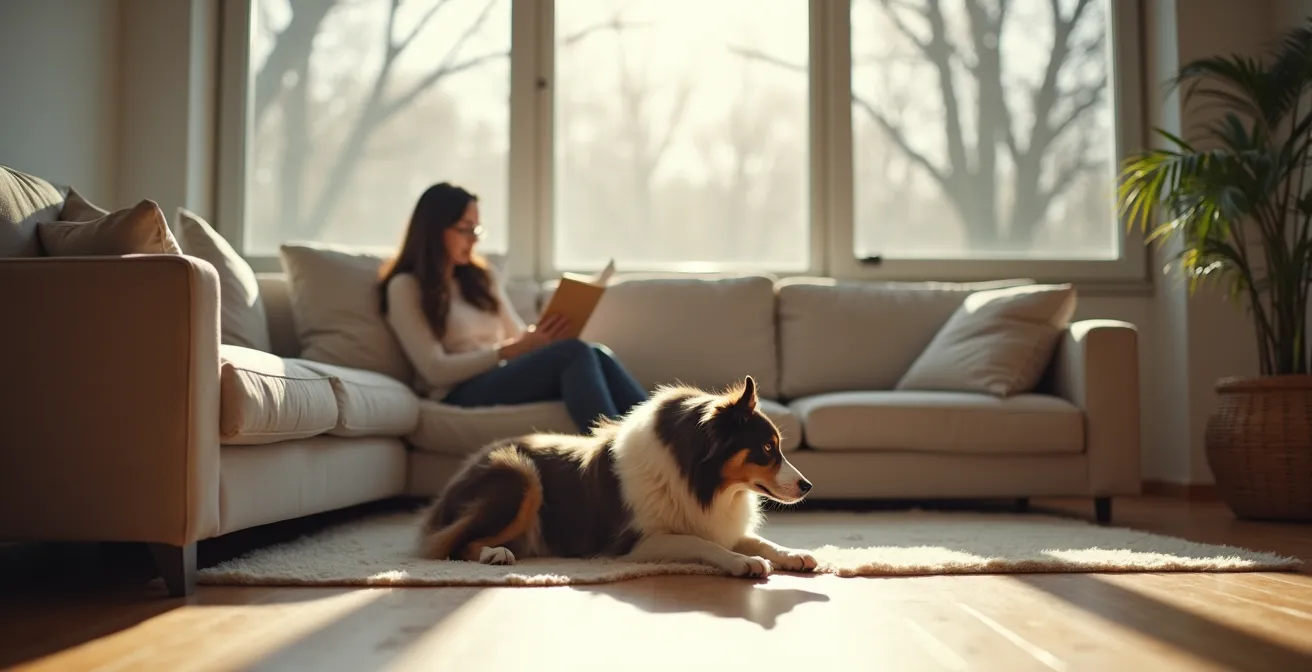
The FRIDA Protocol, developed by trainers for a dog with extreme separation anxiety, is a perfect example of this. It involves breaking down the departure into dozens of micro-steps and repeating them without ever actually leaving, until the dog no longer reacts. By repeatedly exposing the dog to these triggers in a context that does not lead to abandonment, the triggers lose their power. You are effectively “re-wiring” your dog’s brain to associate these cues with non-events, laying the foundation for calm departures.
Fluoxetine vs Training Alone: When is medication necessary for learning to happen?
The decision to use medication can be difficult for owners, often feeling like a last resort or a sign of failure. It’s essential to reframe this. In cases of moderate to severe separation anxiety, behavior medication is not an “easy way out”; it is a vital tool that makes learning possible. A brain flooded with panic is incapable of forming new, positive associations. Anti-anxiety medication, like Fluoxetine (Prozac), works by adjusting brain chemistry to lower the baseline level of anxiety. This creates a state where the dog can remain calm enough—or sub-threshold—to actually absorb the behavior modification training you are doing.
Think of it this way: you cannot teach a child to swim while they are actively drowning. You must first get them to safety. Medication is the life raft that brings your dog’s head above water so they can start learning the strokes. In fact, clinical research shows that 72% of dogs improved with fluoxetine plus behavior modification, compared to just 50% who improved with training alone. This demonstrates that for many dogs, medication is the key that unlocks the door to recovery.
The choice to medicate is a conversation to have with your veterinarian or a veterinary behaviorist. It is not a standalone cure but part of a comprehensive treatment plan. If your dog panics the moment you touch the doorknob, exhibits self-harm behaviors, or you’ve seen no progress after a month of diligent training, their anxiety is likely too high for training alone to be effective. The following table, based on guidance from a recent analysis of treatment options, can help you assess your situation.
| Severity Indicator | Training Alone | Consider Medication |
|---|---|---|
| Dog can be left for 30+ seconds | ✓ Recommended | Usually unnecessary |
| Panic starts immediately | Rarely effective | ✓ Strongly recommended |
| Self-injury during separation | Insufficient | ✓ Essential |
| No progress after 4 weeks | Reassess approach | ✓ Consult veterinary behaviorist |
Using medication gives your dog a fighting chance to overcome their phobia. It helps them stay calm long enough for the desensitization exercises to work, turning an impossible task into a manageable one.
The “Cry It Out” Mistake: Why letting them panic makes the anxiety worse
One of the most damaging pieces of old-school advice is to let a dog “cry it out.” The theory is that the dog will eventually tire and realize nothing bad is happening. This could not be more wrong. This method, known in behavior science as “flooding,” forces a dog to endure their greatest fear without escape. Instead of learning that being alone is safe, the dog’s panic is repeatedly reinforced, making the anxiety far worse over time.
As the MSD Veterinary Manual states in its guide to behavior modification in dogs, this approach is extremely risky and often backfires.
Flooding is far more stressful than any other treatment strategy and if not used correctly will make things worse. The most common problem is increased fear.
– MSD Veterinary Manual
When a dog is subjected to prolonged, inescapable distress, they may eventually stop struggling. Owners might mistake this quiet for calmness, but it is often a dangerous psychological state called learned helplessness. The dog has not become calm; they have simply shut down. They have learned that nothing they do can stop the terrifying feeling, so they give up. Internally, their stress hormone levels remain sky-high, and their fear of abandonment becomes even more deeply entrenched. You are not teaching them to cope; you are teaching them that they are helpless against their terror.
Effective separation anxiety training is the polar opposite of flooding. It is about meticulously avoiding the panic state. Every single training session should end on a positive, calm note, well before the dog shows any signs of anxiety. By never allowing them to go “over threshold,” you slowly build their confidence and prove to them, through repeated success, that they are capable of being calm and safe on their own.
How to greet an anxious dog upon return without reinforcing the frenzy?
You walk through the door, and your dog explodes into a frenzy of jumping, whining, and frantic licking. Your natural instinct is to respond with equally high emotion—praise, petting, and excitement. While it feels like you are reassuring your dog, you are actually reinforcing the very anxiety you’re trying to solve. An over-the-top greeting confirms your dog’s belief that your return is a massive, highly emotional event, which by extension makes your absence equally significant and stressful.
The key to a healthy reunion is to be incredibly boring. Your goal is to model calm, neutral energy. This teaches your dog that arrivals and departures are normal, insignificant parts of the day, not cause for wild celebration or panic. By downplaying your return, you lower the emotional stakes of being separated. This requires going against every instinct you have, but it’s a critical piece of the puzzle.
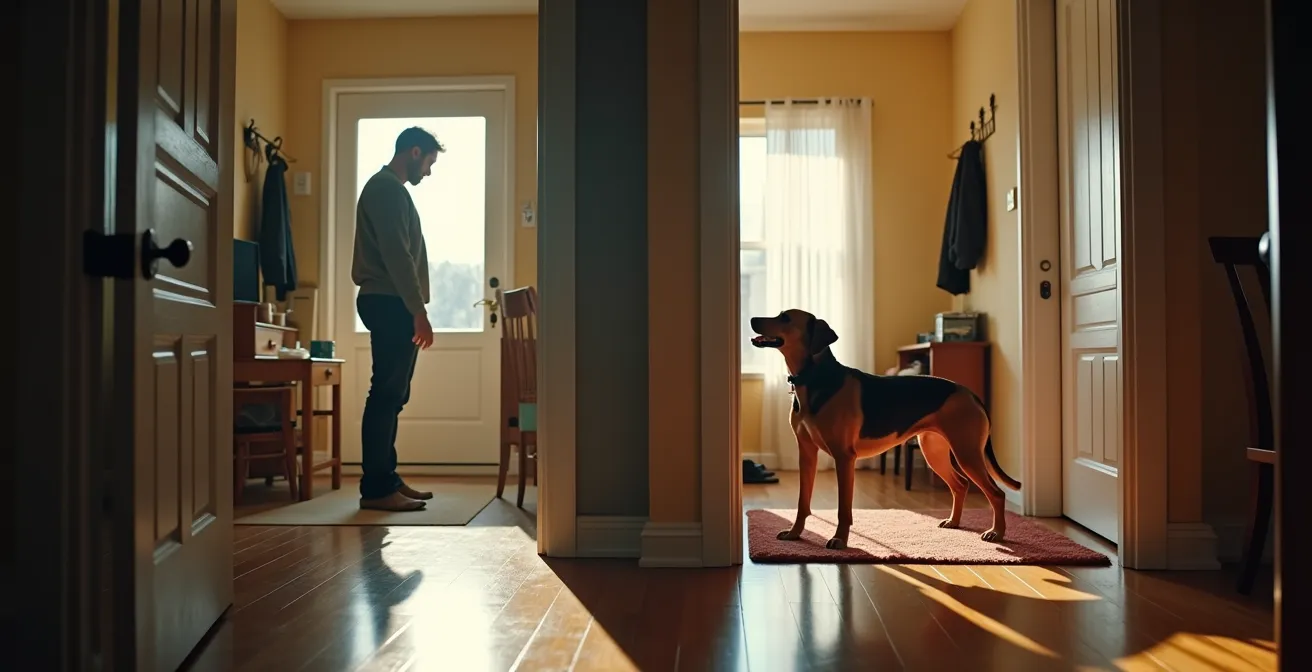
The following steps, often called the “Neutral Return Protocol,” should be practiced every time you enter your home, whether you were gone for two minutes or two hours.
- Enter the home without making eye contact with your dog.
- Keep your body turned sideways, not facing the dog directly, to appear less confrontational.
- Place your belongings down calmly and move slowly and deliberately.
- Wait for your dog to show any sign of calm behavior, such as sitting, lying down, or even just stopping the jumping for a second.
- After 3-5 minutes of sustained calm, you can initiate a low-key interaction, like a gentle scratch under the chin.
- If they remain overly energetic, redirect them to a calm activity, like asking them to “go to your mat” or scattering a few treats on the floor for them to sniff out.
This approach communicates to your dog that your presence is a calm, predictable constant, not a scarce resource to be frantically guarded. It’s a powerful, non-verbal way to reshape their perception of being alone.
Why high-pitched repetitive barking signals separation distress, not territoriality?
Not all barks are created equal. As an owner trying to diagnose the problem, learning to interpret your dog’s vocalizations is crucial. A territorial bark is typically a sharp, lower-pitched “woof” or “ruff,” triggered by a specific stimulus like a person walking past the window. It’s a confident sound meant to alert and ward off a potential intruder. The dog’s posture is often forward and assertive.
In contrast, the barking associated with separation anxiety is a cry for help. It is often higher-pitched, monotonous, and repetitive, sometimes escalating into a frantic howl or yelp. This isn’t a confident warning; it’s a vocalization of distress. It doesn’t happen in response to a specific trigger but starts shortly after you leave and can continue for hours. It’s often accompanied by other signs of panic, such as pacing, drooling, or attempting to escape. A dog barking from distress may be moving throughout the house, not just standing guard at a window or door.
Correctly identifying the type of bark is fundamental to choosing the right solution. Responding to distress barking with anti-barking devices or punishment is ineffective and cruel, as it punishes the symptom of a panic attack without addressing the cause. Recording your dog when you are gone is the best way to understand what is truly happening. Listening to the pitch, observing the timing, and noting any accompanying behaviors will give you a clear diagnosis and confirm that you are dealing with separation distress, not a territorial issue.
Your Checklist: Identify Distress Barking
- Check the pitch: Is the barking high-pitched and frantic, or low and sharp? Distress barking is almost always higher.
- Observe the timing: Does the barking start within minutes of your departure, or is it only triggered by specific events (e.g., mail carrier)?
- Look for accompanying behaviors: Do you see other signs of panic on your recording, such as pacing, drooling, or destruction?
- Record the duration: Is the barking persistent and monotonous for a long period, or is it a short, episodic burst?
- Note the location: Is the dog barking from one spot (like a window), or are they moving frantically around the home while barking?
Answering these questions will provide definitive proof of separation anxiety, ensuring you focus your efforts on the correct, empathy-based treatment plan.
The “Crate Confinement” Risk: How over-crating causes psychological shutdown?
For many dog owners, the crate is a sanctuary—a safe, den-like space for their pet. Because of this, “crate your dog” is one of the most common pieces of advice for destructive behavior. However, if a dog suffers from separation anxiety, a crate can quickly become a prison. Forcing a panicking dog into a confined space can dramatically intensify their fear, adding confinement anxiety (claustrophobia) on top of their isolation distress. This can lead to dangerous escape attempts, resulting in broken teeth and bloody paws.
Worse, a dog left to panic in a crate may eventually fall silent. This is often misinterpreted as the dog “settling down,” but it is frequently the onset of learned helplessness. The dog has not learned to be calm; they have learned that escape is impossible and have psychologically shut down. A concert attendee’s dog showed this tragic progression: after initial frantic escape attempts, the dog became still, but with a tucked tail and rapid, shallow breathing—outwardly “calm” but internally terrified and resigned. This is not a training success; it is a welfare crisis.
It’s crucial to honestly assess your dog’s relationship with their crate. A crate is only a viable tool if your dog already sees it as a genuine safe space. As this guide from the Anti-Cruelty Society highlights, the dog’s own behavior is the clearest indicator of whether the crate is a sanctuary or a prison.
| Behavior | Crate as Sanctuary | Crate as Prison |
|---|---|---|
| Entry behavior | Enters voluntarily, even when door open | Resists entry, needs coaxing |
| Body language inside | Relaxed posture, normal breathing | Panting, drooling, tense muscles |
| Exit behavior | Calm departure, may stay inside | Rushes out frantically |
| Alone behavior | Sleeps or rests quietly | Scratching, biting bars, escape attempts |
If your dog shows any signs of the “Crate as Prison” column, you must stop using it for separation immediately. Your training plan should focus on a dog-proofed room or area instead, as forcing crate confinement will only deepen their trauma.
Key Takeaways
- Separation anxiety is an involuntary panic disorder, not malicious behavior. Empathy is your starting point.
- Effective training involves systematic desensitization, always working below the dog’s panic threshold to build confidence.
- In severe cases, medication is a crucial tool that enables the brain to learn, not a shortcut or a failure.
How Your Home’s Lighting and Sound Environment Is Secretly Stressing Your Sensitive Pet?
When treating a panic disorder, every detail matters. We often focus on the big triggers like grabbing our keys, but the ambient environment of your home plays a significant, often overlooked, role. For a highly sensitive dog already on high alert, subtle environmental stressors can contribute to their overall anxiety load, making it easier for them to tip over their panic threshold. The problem has become increasingly common, as post-pandemic research shows separation anxiety in dogs increased by over 700% between 2020 and 2022.
Consider the lighting. A dark house can increase a dog’s sense of insecurity, while flickering fluorescent lights or dramatic shadows from passing cars can be startling. Leaving a few soft, warm lights on can create a more stable and calming visual environment. Sound is even more impactful. The high-pitched whine of an old refrigerator, the sudden clank of an ice maker, or the sharp sounds from a television show can be jarring. Conversely, total silence can amplify every creak and groan of the house, making a dog hyper-vigilant to every noise.
Managing the soundscape is a powerful way to promote calm. Leaving on a quiet talk radio station or a fan can provide a consistent, low-level “white noise” that masks startling outside sounds. Furthermore, specialized music therapy has shown remarkable results. Research on the “Through a Dog’s Ear” series found that classical music with simple arrangements and slow tempos, like Pachelbel’s Canon in D, measurably reduced stress behaviors and anxiety-related barking. This isn’t just about leaving music on; it’s about curating a sound environment specifically designed to be soothing to the canine nervous system.
Creating a calm sensory environment won’t cure separation anxiety on its own, but it lowers your dog’s baseline stress level. This makes them less reactive and more receptive to the core behavior modification work, giving your training a greater chance of success.
The journey to resolving separation anxiety is a marathon, not a sprint. It requires patience, consistency, and a deep sense of empathy for what your dog is experiencing. By following this methodical, sub-threshold approach, you are not just stopping destruction; you are healing a phobia and rebuilding your dog’s confidence from the ground up. Begin today by taking the first small step: pick up your keys, and then put them right back down.