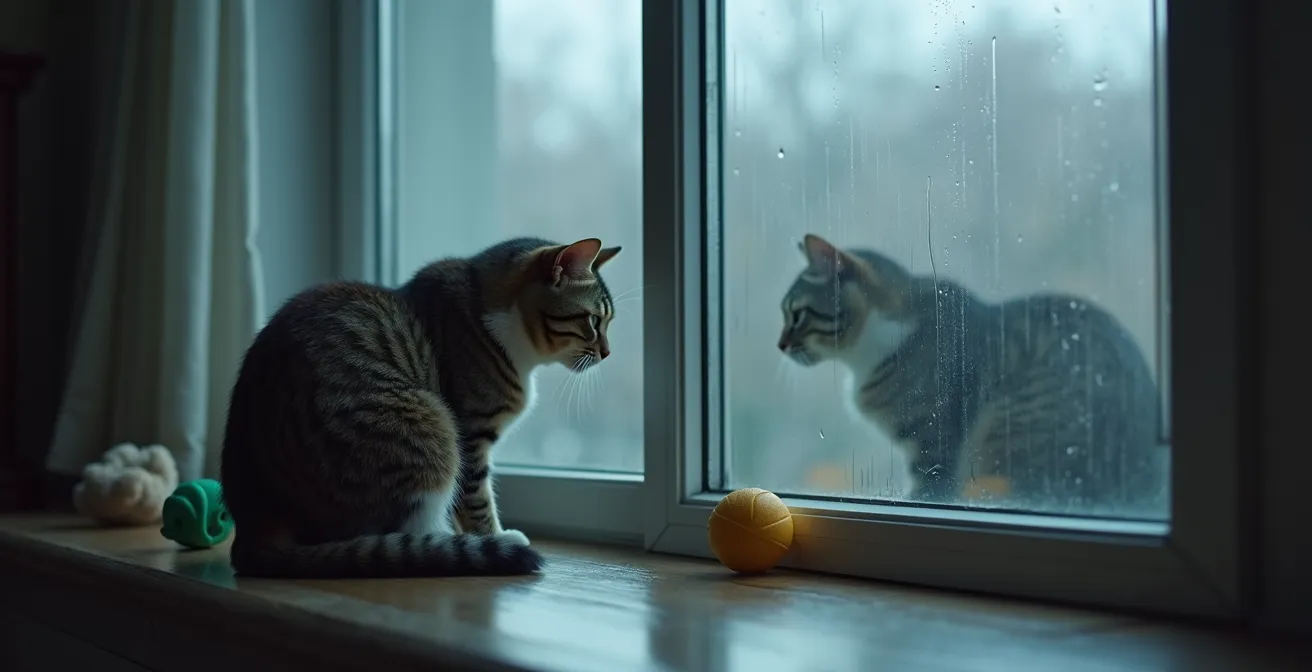
Your cat’s “laziness” is likely not a personality trait but a clinical sign of chronic depression, a condition known as anhedonia.
- A persistent loss of interest in play is a primary indicator of mental decline, not just simple boredom.
- Environmental factors like confinement and a lack of mental stimulation can lead to measurable cognitive atrophy and behavioral shutdown.
Recommendation: Use a structured assessment to track behavioral changes and consult a professional if symptoms persist for more than two weeks.
As a cat owner, you’ve likely witnessed your once-playful companion transform, now spending most of their days sleeping in a sunbeam and ignoring their favorite toys. It’s easy to dismiss this shift as your cat “just getting older” or having a “low-energy” personality. Many owners assume this lethargy is a benign, inevitable part of an indoor cat’s life. This common assumption, however, overlooks a critical distinction that can have profound implications for your pet’s well-being.
From a veterinary psychiatry standpoint, this behavioral shift is often a red flag. What you’re observing may not be laziness, but anhedonia—the clinical inability to experience pleasure—a core symptom of chronic depression in felines. This is not a simple mood swing; it is a state of behavioral shutdown that can be triggered by grief, boredom, stress, or underlying medical conditions. Recognizing the difference between a content, calm cat and one suffering from depression is the first, most crucial step toward intervention and recovery.
This guide provides a clinical framework to help you move beyond the “lazy cat” assumption. We will equip you to identify the subtle signs of anhedonia, understand the neurological impact of an under-stimulated environment, and determine the appropriate line of defense—from targeted play therapy to necessary pharmacological support. By learning to see your cat through a clinical lens, you can become their most effective advocate and partner in their mental health care.
To navigate this complex topic, this article is structured to provide clear, actionable insights. Each section addresses a key aspect of feline depression, from initial diagnosis to advanced intervention strategies, empowering you to take a proactive role in your cat’s emotional wellness.
Summary: A Clinical Guide to Feline Depression
- Why a Loss of Interest in Play Is the First Red Flag of Mental Decline?
- How to Reintroduce a Grieving Pet to Social Activities After a Loss?
- Prozac vs Play Therapy: Which Should Be the First Line of Defense?
- The “Crate Confinement” Risk: How Over-Crating Causes Psychological Shutdown?
- When to Call a Behaviorist: The 2-Week Rule for Behavioral Changes
- Why a Lack of Mental Stimulation Causes Brain Atrophy in Indoor Pets?
- Fluoxetine vs Training Alone: When Is Medication Necessary for Learning to Happen?
- Why Your Dog Chases Shadows and How to Stop Obsessive Compulsive Disorders?
Why a Loss of Interest in Play Is the First Red Flag of Mental Decline?
The most significant and often misinterpreted sign of feline depression is a decline in play. Owners frequently label this as laziness, but in clinical terms, it is anhedonia: the loss of interest in previously rewarding activities. For a cat, whose natural instincts are built around the cycle of hunting (stalking, chasing, pouncing), play is not a luxury; it is a fundamental expression of their cognitive and physical health. When a cat consistently ignores a favorite wand toy or stops engaging in mock hunting, it’s a profound behavioral signal that their internal motivation system is malfunctioning.
This isn’t simple boredom, which might manifest as ignoring one toy in favor of another. Anhedonia is a global shutdown of interest. The cat no longer derives pleasure from the “kill” at the end of a chase or the mental challenge of a puzzle feeder. As a result, the neural pathways associated with seeking, motivation, and reward begin to weaken. This is why a simple lack of play is a more telling indicator of mental decline than changes in sleep or appetite, as it directly reflects a breakdown in the cat’s core behavioral drives.
Case Study: The Impact of Structured Enrichment
To illustrate this point, consider the findings from VCA Hospitals on enrichment programs. Their reports show that indoor cats diagnosed with depressive symptoms responded with measurable improvements when placed on a structured enrichment schedule. Cats provided with rotating toys, challenging puzzle feeders, and scheduled interactive play with fishing pole-type toys that trigger hunting instincts showed a significant increase in engagement and a reduction in anhedonic behaviors within just two to three weeks. This demonstrates that play is not just an activity but a therapeutic tool to reactivate dormant motivational circuits.
To help owners objectively assess this, it’s crucial to move from subjective feelings to concrete data. Tracking specific play-related behaviors is the first step in building a case for a veterinary consultation.
Anhedonia Assessment Checklist for Cat Owners
- Monitor play initiation: Note if your cat ignores previously favorite toys for more than 48 hours.
- Document hunting behaviors: Track any reduction in stalking, pouncing, or “killing” behaviors during their typical active periods (dawn and dusk).
- Measure play duration: Compare current play session length with a baseline; healthy cats often engage for 10-15 minutes per session.
- Observe interaction time: Note if your cat disengages and walks away from interactive play attempts within the first 30 seconds.
- Track foraging interest: Check if treat-dispensing toys or puzzle feeders, a key foraging activity, remain untouched for multiple days.
How to Reintroduce a Grieving Pet to Social Activities After a Loss?
Grief is a profound stressor that can trigger a severe depressive episode in cats. The loss of a bonded companion—whether human or another animal—disrupts their predictable social structure and routine, often leading to a state of withdrawal and social shutdown. A grieving cat may hide, refuse to interact, and show signs of anhedonia. Rushing this process or forcing interaction can increase their anxiety and deepen the depressive state. The key to reintroduction is to create a sense of safety and predictability, allowing the cat to dictate the pace of re-engagement.
The therapeutic approach must be passive and non-demanding at first. Your goal is to re-establish your presence as a source of comfort, not pressure. This involves sharing space without forcing contact, maintaining a consistent daily routine (especially feeding times), and using non-invasive communication like slow blinking from a distance. These actions communicate safety and respect the cat’s need for space while gently reminding them of your supportive presence. Scent is also a powerful tool; providing items with the owner’s or the deceased pet’s scent can offer a form of transitional comfort.
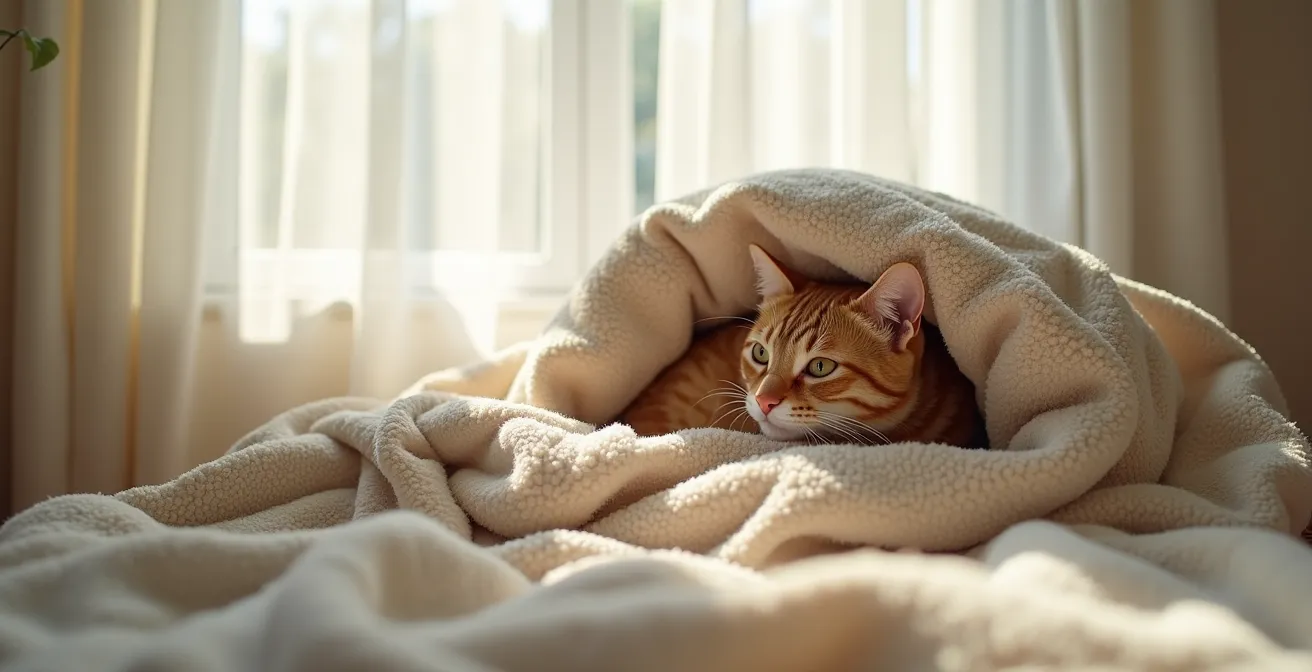
As the image above illustrates, creating a “safe space” with comforting, familiar scents is a cornerstone of this recovery phase. It allows the cat to engage in comfort-seeking behavior on their own terms. Only after the cat begins to show signs of reduced stress, such as approaching you or spending more time in shared family spaces, should you slowly initiate low-pressure interactive activities. Rushing to fill the void with a new pet is almost always counterproductive and can exacerbate the existing stress.
A structured, phased approach is critical for success. The following protocol provides a clear, step-by-step method for helping a cat navigate the grieving process and slowly re-engage with their social environment. Patience is paramount; each cat’s timeline is unique, and any signs of stress, such as flattened ears or a twitching tail, indicate a need to return to the previous phase.
- Phase 1 – Passive Proximity (Days 1-7): Share the same room without direct interaction. Focus on maintaining routine feeding times to provide predictability.
- Phase 2 – Non-Demanding Interaction (Days 8-14): Practice slow blinking from over 6 feet away. Speak in soft, gentle tones without approaching the cat.
- Phase 3 – Initiated Interaction (Day 15+): Introduce long-distance toys like wand toys. Gradually decrease the space between you and the cat during play, letting them close the final gap.
Prozac vs Play Therapy: Which Should Be the First Line of Defense?
When an owner first confronts the reality of feline depression, the question of intervention becomes paramount. The two primary therapeutic avenues are behavioral modification (led by play therapy) and psychopharmacology (medication like Fluoxetine, or Prozac). The decision of which to use first is not arbitrary; it’s a clinical judgment based on the severity and duration of symptoms. For mild to moderate cases, especially first-time episodes in younger cats, play therapy is always the first line of defense. It addresses the root cause of much indoor cat depression: a lack of instinctual fulfillment.
Play therapy is not just “playing with your cat.” It is a structured, prescriptive approach designed to re-engage the cat’s natural hunting sequence: stalk, chase, catch, kill. As a veterinary professional, this is often a direct prescription. As Dr. Julia Albright, a board-certified veterinary behaviorist, notes:
Behavioral issues should be considered a medical issue. Play is important – I prescribe exercise for my patients in chunks of about two minutes, three to four times daily.
– Dr. Julia Albright, DVM, DACVB, dvm360 Fetch Conference Presentation
However, when depression is severe—marked by self-harm, complete social withdrawal, or a failure to respond to weeks of dedicated enrichment—medication becomes a necessary tool. It is not a “cure” but a facilitator. Anxiolytic medications like Fluoxetine work by increasing serotonin levels in the brain, which helps to reduce the paralyzing anxiety that prevents a cat from engaging with their environment. Medication opens a “window of opportunity” where the cat is calm enough to respond to the behavioral therapy that was previously ineffective.
The following decision matrix, based on data from veterinary behavior specialists, helps clarify when each intervention is most appropriate. It’s a triage tool to guide a conversation with your veterinarian, not a substitute for one.
| Intervention Type | Best For | Timeline to Effect | Success Indicators |
|---|---|---|---|
| Play Therapy First | Mild depression, young cats, first episodes | 1-2 weeks | Increased toy engagement, initiated play |
| Medication First | Severe symptoms, self-harm risk, 30+ days failed enrichment | 2-6 weeks loading period | Reduced anxiety allowing play engagement |
| Combined Approach | Moderate symptoms with environmental stressors | 4-8 weeks full protocol | Sustained behavior improvement after medication taper |
The “Crate Confinement” Risk: How Over-Crating Causes Psychological Shutdown?
While often associated with dogs, prolonged or improper confinement—whether in a crate, a small room, or a barren apartment—is a significant and often overlooked cause of psychological distress in cats. This is because it strips them of their three most critical behavioral needs: the ability to explore, the freedom to retreat, and the opportunity to control their environment. An indoor environment that lacks complexity and choice is, from a cat’s perspective, a cage. This type of chronic, low-grade stress is a direct pathway to behavioral shutdown and depression.
When a cat is confined without adequate stimulation, it enters a state of learned helplessness. It learns that its actions have no effect on its environment. There is nothing new to investigate, no high place to climb for safety, and no way to engage in natural foraging or hunting behaviors. This lack of agency is profoundly stressful. As reported by veterinary behavior specialists, environmental stress is a particularly common cause of depression for indoor cats who lack the outlets to express these innate drives. The cat’s world shrinks, and its behavioral repertoire shrinks along with it, leading to apathy and withdrawal.
The antidote to confinement-induced stress is not simply more space, but more *complexity*. A small space can be transformed into an “active sanctuary” by focusing on verticality, novelty, and sensory enrichment. The goal is to give the cat choices and opportunities to engage its mind and body, even within a limited footprint. This prevents the psychological shutdown that stems from a monotonous and uncontrollable environment. Implementing a strategy of active enrichment is a direct therapeutic intervention against depression.
Here are key strategies to convert a confined space into an enriching habitat:
- Vertical Exploration: Install temporary shelving or cat trees at varying heights (minimum of three levels) to allow climbing and perching.
- Sensory Stimulation: Create a “scent garden” with cat-safe plants like catnip, cat grass, and rosemary. Install a window perch with a view of outdoor activity.
- Novelty and Foraging: Implement a strict toy rotation, swapping out 3-4 toys every 48 hours. Use puzzle feeders and hide them at different heights to encourage movement.
- Textural Variety: Introduce a range of surfaces such as sisal mats, fleece blankets, and corrugated cardboard scratchers to provide tactile stimulation.
When to Call a Behaviorist: The 2-Week Rule for Behavioral Changes
One of the most challenging decisions for a cat owner is determining when a behavioral change warrants professional help. A cat having a single “off” day is normal. But a persistent pattern of negative behavior is a clinical sign that requires intervention. As a general guideline, a “two-week rule” is a sound clinical benchmark: any significant negative behavioral change that persists for two weeks or more, despite initial attempts at enrichment, necessitates a call to your veterinarian. This initial veterinary visit is non-negotiable, as its primary purpose is to rule out underlying medical causes for the behavior change, such as pain, thyroid issues, or urinary tract disease.
Once medical causes have been ruled out, the path forward involves behavioral specialists. However, not all behavior professionals are the same. It is crucial for owners to understand the different roles to ensure they are getting the right help. The three main types of professionals are the primary veterinarian, a certified cat behavior consultant, and a board-certified veterinary behaviorist (DACVB). Each plays a distinct role in the diagnostic and treatment process.
A primary veterinarian is the first stop for triage. A Certified Cat Behavior Consultant is ideal for tackling issues rooted in the environment or learned behaviors, such as litter box problems or inter-cat aggression, using modification techniques. A Veterinary Behaviorist is a veterinarian with specialized training in animal psychiatry, and they are the only ones qualified to diagnose complex conditions and prescribe medication. They are essential for severe cases involving high anxiety, aggression, or when other interventions have failed.
This triage guide can help you determine the appropriate professional to contact based on your cat’s specific situation and the interventions you have already tried.
| Professional Type | Primary Role | When to Contact | Typical Cost Range |
|---|---|---|---|
| Veterinarian | Rule out medical causes first | Any behavior change lasting 48+ hours | $50-200 initial exam |
| Veterinary Behaviorist (DACVB) | Complex cases requiring medication | Failed 2+ intervention attempts | $300-500 consultation |
| Certified Cat Behavior Consultant | Environmental/behavioral modification | Non-medical behavior issues | $150-300 per session |
While the two-week rule is a good general guideline, certain behaviors are “red line” indicators that require immediate emergency consultation. These are signs of severe physical or psychological distress that cannot wait.
- Complete anorexia lasting over 24 hours.
- Self-mutilation, including chewing on limbs or excessive grooming that causes wounds.
- Sudden, unprovoked aggression toward humans or other pets.
- Complete withdrawal with no response to any stimuli for over 48 hours.
- Inappropriate elimination accompanied by blood in urine or stool.
Why a Lack of Mental Stimulation Causes Brain Atrophy in Indoor Pets?
The brain, like any other organ, adheres to the “use it or lose it” principle. For an indoor cat living in an under-stimulated environment, the lack of challenges, novelty, and problem-solving opportunities leads to more than just boredom; it can lead to demonstrable cognitive decline. This process is akin to a form of brain atrophy. The neural circuits responsible for curiosity, learning, and adaptability are not exercised, and they weaken over time. The cat’s world becomes small and predictable, and its brain adapts by pruning away the connections it no longer needs.
This is not a theoretical concept. The link between a barren environment and negative psychological states is well-documented. For instance, research from PMC reveals that 53.33% of cats with separation-related problems also showed significant symptoms of depression and apathy. This highlights how a single stressor—the absence of a primary attachment figure—can trigger a cascade of negative cognitive and emotional effects when the cat lacks other outlets for mental engagement. An enriched environment provides the cognitive “scaffolding” that helps a cat cope with other life stressors.
Mental stimulation forces the brain to create and strengthen neural pathways. A puzzle feeder is not just a way to slow down eating; it is a complex problem-solving task that engages foraging instincts and executive function. Learning a new trick through clicker training, navigating a new climbing structure, or investigating a novel scent all build cognitive resilience. This “mental exercise” increases blood flow to the brain, promotes the growth of new neurons (neurogenesis), and keeps the mind flexible and adaptive.

Conversely, a cat with nothing to do will turn inward, often developing maladaptive coping mechanisms like over-grooming, or simply sinking into a state of chronic lethargy and anhedonia. Providing consistent, varied mental stimulation is not an optional luxury for an indoor pet; it is a neurological necessity for preventing the very real phenomenon of cognitive atrophy and maintaining long-term mental health.
Fluoxetine vs Training Alone: When Is Medication Necessary for Learning to Happen?
For cats suffering from severe anxiety or depression, the brain can enter a state where learning is physiologically impossible. Chronic stress floods the system with cortisol, which inhibits executive function and memory formation. In this state, the cat is in “survival mode,” and its capacity to engage with and learn from behavioral training is effectively zero. An owner may try to implement play therapy or clicker training, only to be met with fear, aggression, or complete shutdown. This is the critical juncture where medication like Fluoxetine (an SSRI) becomes not just helpful, but necessary for learning to even begin.
Medication in this context serves as a bridge. It is not intended to be a lifelong solution or a substitute for training. Its purpose is to lower the baseline level of anxiety to a point where the cat’s brain can “come back online.” By increasing available serotonin, the medication helps to chemically interrupt the cycle of fear and reactivity. This creates an “activation window,” typically occurring within 2-6 weeks of starting the medication, during which the cat is calm enough to be receptive to behavioral modification for the first time.
Case Study: Medication as an Enabler for Training
Dr. Albright’s veterinary practice offers a clear example of this principle. They documented numerous cases where cats with severe anxiety showed zero progress after six weeks of intensive behavior modification alone. However, after introducing SSRIs alongside the continued therapy, a significant breakthrough occurred. Within the medication’s activation window, 70% of these previously untrainable cats showed marked improvement. They became capable of successfully completing tasks like target training and puzzle-solving, which had been impossible before. This demonstrates that medication wasn’t the “cure”; it was the key that unlocked the cat’s ability to learn from the cure.
During this activation window, it is crucial to implement positive, confidence-building training exercises. The goal is to build new, positive associations with activities that were previously stressful. These sessions should be short, rewarding, and timed to coincide with the medication’s peak efficacy (often 2-4 hours post-dose).
- Target Training: Start with a treat on the end of a stick and progress to having the cat touch its nose to the stick for a reward. This builds a foundation for cooperative care.
- Level-1 Puzzle Feeders: Begin with simple puzzles with partially open compartments, gradually increasing the difficulty as the cat gains confidence.
- “Successful Hunt” Sequence: Use a wand toy to guide the cat through a complete stalk-catch-kill cycle, ensuring they get the satisfaction of the “catch.”
- Confidence Building: Place high-value treats at increasing heights on a cat tree to encourage climbing and exploration.
Key Takeaways
- Apathy is a medical symptom, not a personality trait; loss of play (anhedonia) is the primary red flag for feline depression.
- Behavioral therapy and environmental enrichment are the first line of defense, but medication is a crucial tool when anxiety prevents learning.
- Persistent behavioral changes (over two weeks) or any “red line” behaviors require immediate professional consultation to rule out medical issues and establish a treatment plan.
Why Your Dog Chases Shadows and How to Stop Obsessive Compulsive Disorders?
The behavior described in this section’s title—a dog chasing shadows—is a classic, widely recognized example of an Obsessive-Compulsive Disorder (OCD). While less commonly discussed, felines can develop equally debilitating compulsive behaviors rooted in the same anxiety, stress, and lack of environmental stimulation. In cats, these behaviors manifest differently but are no less serious. Common feline compulsions include over-grooming to the point of creating bald spots or skin lesions (psychogenic alopecia), repetitive vocalization, tail chasing, or “wool sucking” (chewing on fabrics).
These are not “quirks” or “bad habits.” They are maladaptive coping mechanisms. As veterinary behaviorists report, some cats develop these repetitive behaviors as a way to self-soothe in the face of chronic stress or intense boredom. The repetitive action provides a predictable, controllable outlet when the cat’s external world feels chaotic or empty. The behavior itself can release endorphins, creating a feedback loop that makes the compulsion difficult to break. It becomes the brain’s default response to any form of arousal or anxiety.
The key to managing feline OCD is a two-pronged approach: enriching the environment and implementing an “interrupt and redirect” protocol. First, you must address the underlying cause of the stress by increasing mental and physical stimulation through play, puzzle feeders, and vertical space. This reduces the cat’s need to engage in self-soothing behaviors. Second, when the compulsive behavior does occur, you must intervene in a way that doesn’t add more stress. Yelling or punishing the cat will only increase their anxiety and worsen the compulsion.
The “Interrupt and Redirect” protocol is a systematic, non-confrontational method for breaking the compulsive cycle and teaching the cat a more appropriate coping strategy. It requires patience and consistency.
- Step 1 (Interrupt): Make a soft, unique sound (like a gentle click or a soft whistle) to break the cat’s fixation without startling them.
- Step 2 (Redirect): Immediately redirect their attention to a high-value activity they enjoy, such as a favorite interactive toy or a highly palatable treat.
- Step 3 (Reward): Reward their engagement with the new, positive activity for at least 30 seconds to reinforce the alternative behavior.
- Step 4 (Document): Keep a behavior journal to track the triggers that precede the compulsive behavior and note which redirection techniques are most successful.
- Step 5 (Build Control): Over time, gradually increase the time between the interruption sound and offering the redirect to help build the cat’s impulse control.
Your role as an observant owner is the most critical first step in your cat’s mental health journey. Begin today by applying these assessment techniques, documenting your findings, and scheduling a consultation with your veterinarian to discuss your concerns.