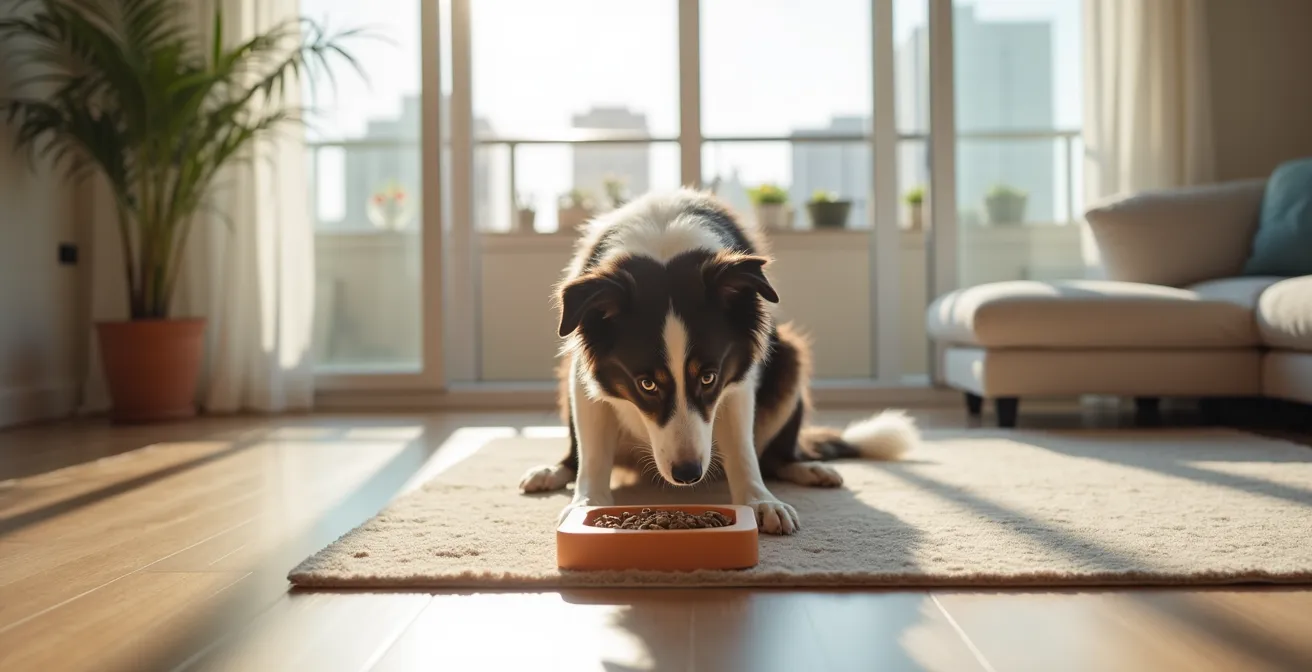
The key to a calm, happy high-energy dog in a small apartment isn’t more physical exercise, but a strategic plan for ‘Cognitive Calorie Burn’.
- Mental activities like sniffing and problem-solving are often more tiring and fulfilling for intelligent breeds than purely physical exertion.
- Failing to complete your dog’s natural predatory play sequence or providing overly difficult challenges can increase frustration and destructive behaviors.
Recommendation: Shift your focus from simply exercising your dog to strategically managing their sensory and cognitive needs with a structured, rotating enrichment plan.
That familiar feeling of guilt hits as you watch your high-energy dog pace restlessly around your small apartment. You see the boundless energy cooped up, sometimes manifesting as a chewed-up shoe or incessant barking. The common advice echoes in your mind: longer walks, more trips to the park, a new basket of toys. Yet, despite your best efforts, the restless energy remains. You’re physically tired, but your dog still seems profoundly bored and unfulfilled.
This is a common struggle for urban pet owners. We try to solve a brain problem with a body solution. While physical exercise is vital, it often fails to address the sophisticated cognitive needs of working breeds like Border Collies, Australian Shepherds, or German Shepherds. These animals were bred for complex tasks, not just endurance running. Their minds are craving a job to do, a problem to solve.
But what if the real solution wasn’t about adding more miles to your walks, but about fundamentally changing their nature? The secret lies in a concept we’ll call Cognitive Calorie Burn. It’s a science-backed approach focused on tiring out your dog’s brain, not just their body. This strategy satisfies their innate instincts, from hunting and foraging to problem-solving, creating a deep sense of calm and fulfillment that an hour-long run simply cannot replicate.
This guide will move beyond generic tips and provide you with a systematic framework to design a powerful enrichment strategy. We will explore the neuroscience of canine boredom, delve into practical ways to create sensory experiences in limited spaces, and reveal the common mistakes that accidentally increase stress. Prepare to transform your dog’s well-being by giving them the mental workout they desperately need.
In this article, you’ll discover a complete system for building a mentally stimulating environment for your pet, even within the four walls of your apartment. We’ll break down the science and provide practical, actionable steps to get you started.
Summary: Building a Brain-Based Enrichment Plan for Your Apartment Dog
- Why a lack of mental stimulation causes brain atrophy in indoor pets?
- How to build a sensory garden on a balcony without using toxic plants?
- Food Puzzles vs Scent Games: Which Burns More Mental Energy for Working Breeds?
- The “Impossible Puzzle” Mistake That Increases Aggression Instead of Calming It
- How to rotate toys weekly to maintain novelty without buying new gear?
- Why your cat needs to “kill” the toy at the end of the play session?
- Why 15 minutes of sniffing burns as many calories as a 1-hour walk?
- Why a 20-Minute Scent Walk Is More Tiring Than a 1-Hour Run?
Why a lack of mental stimulation causes brain atrophy in indoor pets?
An under-stimulated brain is more than just a bored brain; it’s a brain that can physically change for the worse. The principle of neuroplasticity—the brain’s ability to reorganize itself by forming new neural connections—is a double-edged sword. Just as an enriched environment fosters growth, a barren one can lead to cognitive decline. For intelligent, high-energy breeds confined to an apartment, this is a critical concern. When a dog’s brain isn’t challenged, it enters a state of passive rest, failing to activate the pathways needed for learning and emotional regulation.
The key player in this process is a protein called Brain-Derived Neurotrophic Factor (BDNF), which is essentially fertilizer for brain cells. It supports the survival of existing neurons and encourages the growth and differentiation of new ones. Engaging in novel, problem-solving activities triggers the release of BDNF. As a 2019 Nature study reveals, enrichment directly impacts gene expression related to neuroplasticity. When stimulation is absent, BDNF levels can drop, hindering the brain’s ability to adapt and even leading to a reduction in neural connections over time—a form of atrophy.
This biological reality underscores why enrichment is not a luxury but a necessity. As experts in canine neurology explain, the brain is in a constant state of flux based on its experiences.
From their very first puppy experiences through their late senior years, your dog’s brain continues to grow and change as a result of what life throws their way… This is why socializing your puppy and providing training & enrichment throughout your dog’s life is so important to their overall well-being.
– Creature Good Dog Training, The Science Behind Positive Reinforcement
A lack of mental work doesn’t just lead to boredom-induced behaviors like chewing or barking; it fundamentally deprives the brain of the ingredients it needs to stay healthy, resilient, and sharp. Providing consistent cognitive challenges is a direct investment in your dog’s long-term neurological health.
How to build a sensory garden on a balcony without using toxic plants?
A small apartment balcony can be transformed from a sterile space into a rich, multi-sensory environment that satisfies your dog’s powerful sense of smell. The goal is to create a “sensory garden,” a dedicated area where your dog can safely explore a variety of scents and textures. This provides a crucial outlet for natural foraging and exploratory behaviors, contributing significantly to their daily “Cognitive Calorie Burn.” The key is choosing the right elements and ensuring everything is pet-safe.
Start with verticality to maximize your limited space. Wall-mounted planters or tiered shelving can host a variety of dog-safe, aromatic herbs. Plants like rosemary, basil, mint, and thyme are not only non-toxic but also offer distinct, stimulating scents. As your dog investigates these different smells, their brain is hard at work processing new information. You can also incorporate different textures underfoot. Create a “texture tray” with sections of sand, smooth river stones, or pieces of cork bark to provide varied tactile feedback.
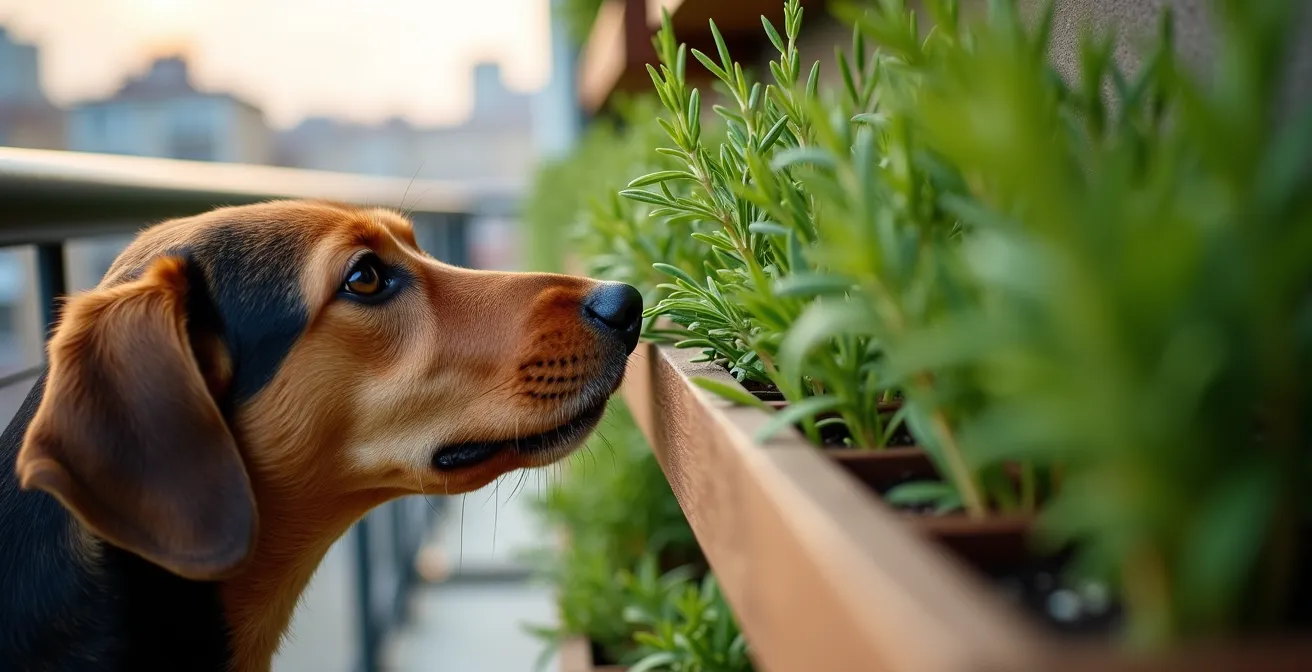
To further enrich the experience, think beyond just plants. Consider adding other sensory stations. A small, pet-safe water fountain provides soothing auditory stimulation and a novel drinking source. Bamboo chimes can add another layer of sound. To encourage natural digging instincts without destroying your planters, provide a designated “digging box” filled with pet-safe soil or sand. By creating a landscape of varied sensory inputs, you turn a boring balcony into a dynamic exploratory zone.
Here are some practical ideas for creating multi-sensory stations in your small space:
- Set up a ‘texture tray’ with sand, smooth river stones, and cork bark for varied tactile experiences.
- Install wall-mounted planters at different heights with dog-safe herbs (mint, rosemary, basil) to encourage stretching and balance.
- Create a ‘sound zone’ with a small pet-safe water fountain or bamboo chimes for auditory stimulation.
- Designate a ‘digging box’ filled with pet-safe soil for natural foraging behavior.
- Rotate scents weekly by introducing lavender oil on terracotta pots or placing sheep’s wool pieces strategically.
Food Puzzles vs Scent Games: Which Burns More Mental Energy for Working Breeds?
When it comes to burning mental energy, both food puzzles and scent games are excellent tools. However, for high-energy working breeds, they engage the brain in fundamentally different ways, with scent games often providing a more profound and tiring workout. Food puzzles, like a treat-dispensing ball or a snuffle mat, primarily engage a dog’s problem-solving and foraging instincts. They require focus, persistence, and fine motor skills to manipulate the toy and access the reward. This is a fantastic way to make mealtime last longer and provide a moderate cognitive challenge.
Scent games, on the other hand, tap into a much more primal and neurologically demanding part of the canine brain. A dog’s olfactory system is extraordinarily powerful; it’s how they primarily interpret their world. When a dog is engaged in a scent game—like “find it” with hidden treats around the apartment—they are not just solving a puzzle; they are using their most dominant sense to create a detailed mental map of their environment. This process of detection, discrimination, and pinpointing a scent’s source is incredibly taxing.
This is why the impact of scent work is so disproportionate to its physical intensity. The sheer amount of brainpower required for olfactory processing is immense. In fact, many experts agree on the powerful effect of this activity. As experts from Tug-E-Nuff confirm, a mere 20 minutes of dedicated sniffing can be as tiring for a dog as a full hour-long walk. This is the essence of Cognitive Calorie Burn—achieving exhaustion through intense mental, rather than physical, effort.
While food puzzles are a vital part of any enrichment plan, scent games hold the edge for burning maximum mental energy. For a working breed cooped up in an apartment, a 15-minute scent work session before you leave for the day can be more effective at settling them down than a rushed morning walk. The ideal strategy incorporates both: use food puzzles for meals and structured scent games as a dedicated, high-intensity mental workout.
The “Impossible Puzzle” Mistake That Increases Aggression Instead of Calming It
In our eagerness to challenge our smart dogs, it’s easy to make a critical mistake: providing a puzzle that is too difficult. We assume a harder puzzle means a better workout, but the opposite is often true. When a dog is repeatedly faced with a challenge they cannot solve, it doesn’t build resilience; it builds frustration. This phenomenon, known as barrier frustration, can lead to a host of behavioral problems, including excessive barking, destructive behavior, and even redirected aggression.
Barrier frustration occurs when a dog is prevented from obtaining something they desire. An unsolvable puzzle toy becomes a barrier between the dog and the food inside. The dog’s repeated, failed attempts to get the reward can escalate their arousal level from focused effort to frantic anxiety. Instead of a calming, problem-solving activity, the puzzle becomes a source of intense stress. As one expert explains, this is a common trigger for negative behaviors.
Barrier frustration refers to the frustration and anxiety a fenced or barriered-in dog feels when prevented from being able to get at something they want or desire. This frustration can lead to a range of behavioral issues, including excessive barking, destructive behavior, and even aggression.
– Dr. Tiffany Tupler, PetMD
The solution is to adopt an “errorless learning” approach. The goal of enrichment should be to build confidence, not to test a dog’s limits. Always start with puzzles that are extremely easy for your dog to solve—so easy that they succeed on the first or second try. This allows them to understand the “game” and associate the puzzle with a positive, successful experience. Only when they are consistently and confidently solving the easy version should you gradually increase the difficulty.
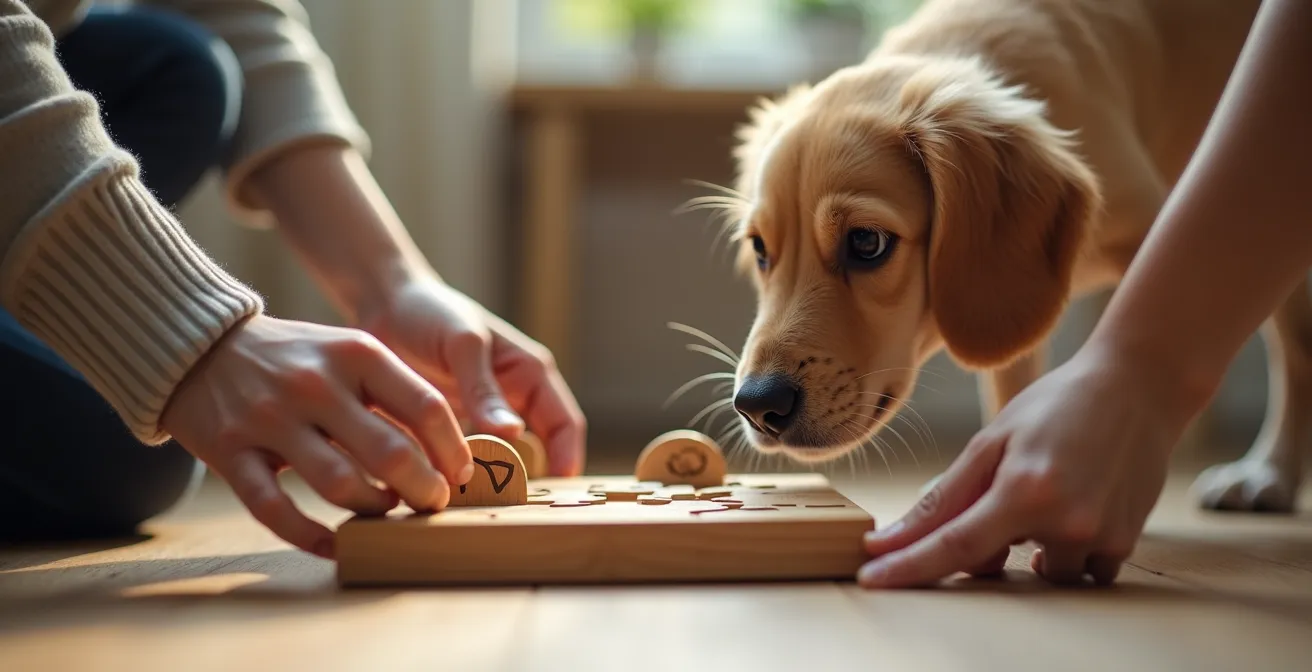
This “scaffolding” technique ensures the dog is always operating in a state of productive challenge, not overwhelming frustration. If you ever see your dog biting at the puzzle, pawing frantically, or whining in frustration, the puzzle is too hard. Take it away and reset to a much easier version later. Remember, the goal of enrichment is a calm, focused, and satisfied mind, not a frustrated one.
How to rotate toys weekly to maintain novelty without buying new gear?
A key principle of effective enrichment is novelty. A dog’s brain is wired to be stimulated by new things. However, novelty doesn’t mean you need a constant stream of brand-new toys. In fact, you can “hack” your dog’s perception of novelty and maintain their interest in their existing toys by implementing a strategic rotation system. A toy that has been out of sight (and smell) for a week can seem almost brand new when it’s reintroduced. This prevents “toy burnout” and saves you a significant amount of money.
The most effective method is the “Three-Bin System.” It’s a simple yet powerful way to structure your toy rotation. You’ll need three storage bins. One bin holds the toys currently in use, another holds toys in storage, and the third is for toys that are being “recharged.” This system ensures there’s always something “new” to look forward to, keeping your dog’s engagement levels high without any new purchases. The reintroduction of a familiar but forgotten toy can be a source of great excitement.
This structured approach is far more effective than simply having a big basket of toys available at all times. When all toys are always accessible, they become part of the background noise and lose their value. A limited, rotating selection makes each toy special. As one owner who found success with this method notes:
Every Sunday night the toys get swapped out. Your dog will be so excited to see what comes out of the closet! They will want to play with the toys they have each week instead of getting bored and finding their own amusement.
– Wear Wag Repeat
To maximize the novelty effect, you can also “recharge” the scent of the toys in storage. Tossing in a sprig of rosemary, a few drops of vanilla extract on a cloth, or even one of your own worn t-shirts can infuse the toys with intriguing new smells, making them even more exciting upon their return.
Your Action Plan: The Three-Bin Toy Rotation System
- Bin 1 (In Use): Keep 3-4 varied toys accessible to your dog for the current week. This should include different types, like a chew toy, a puzzle toy, and a soft toy.
- Bin 2 (In Storage): Store another batch of 3-4 toys completely out of your dog’s sight and smell for a minimum of one week.
- Bin 3 (Being ‘Recharged’): Place a third batch of toys in a sealed bin or bag with a novel scent. Add rosemary sprigs, a vanilla-scented cotton ball, or a used t-shirt to infuse them with new smells.
- Weekly Rotation: Every Sunday, perform the swap. Move the “In Use” toys (Bin 1) to storage (Bin 2). Move the “Recharged” toys (Bin 3) to become the new “In Use” toys. Move the toys from storage (Bin 2) into the “Recharging” bin (Bin 3) with a new scent.
- Toy ‘Frankensteining’: Get creative with old toys. Combine them in new ways, like stuffing a worn plush toy inside a puzzle ball or tying several old rope toys together into a new configuration to create something entirely novel.
Why your cat needs to “kill” the toy at the end of the play session?
While this article focuses on dogs, a crucial enrichment principle shared by both dogs and cats is the need to complete the full predatory sequence. For any predator, play is a rehearsal for hunting. This biological sequence follows a predictable pattern: Search → Stalk → Chase → Bite → Kill → Dissect. When we engage our pets in play, we are often only fulfilling the “chase” portion of this sequence. A game of fetch or chasing a laser pointer that abruptly ends leaves the animal’s brain in a state of unresolved arousal.
Imagine a sprinter who is stopped just inches from the finish line in every race. This is the feeling our pets experience when a high-arousal game ends without a satisfying conclusion. They have successfully chased their “prey” (the toy), but they have been denied the crucial “bite” and “kill” phases. This incomplete sequence is a major source of frustration and can manifest as over-excitement, an inability to settle down after play, or even mouthing and nipping at the owner as the dog seeks a target for their unresolved drive.
The “kill” phase is the climax of the hunt. It provides a definitive end point that allows the brain’s arousal systems to switch off and transition into a state of calm and satisfaction. Allowing your dog to “win” the game is not spoiling them; it is providing a biologically appropriate conclusion to the activity.
Case Study: The Complete Prey Sequence
The biological prey sequence in predators follows a specific pattern: Search → Stalk → Chase → Bite → Kill → Dissect. When play ends at the ‘chase’ phase without completion, it leaves the sequence incomplete, causing frustration and unresolved energy in both dogs and cats. The final ‘dissect’ stage can be simulated by giving the pet a food-stuffed toy or a safe chew to work on, representing the consumption of the ‘prey’ and bringing the entire sequence to a satisfying close.
Simulating this completion is simple but transformative for your play sessions. Here’s how to do it safely:
- After a game of fetch or a chase session with a flirt pole, let your dog “win” and proudly carry the toy.
- Allow them to shake and “kill” the toy vigorously for 30-60 seconds. This is a natural and healthy release of energy.
- Provide a “dissection” phase immediately after by trading the toy for a high-value chew or a food-stuffed puzzle toy.
- End the session with your pet in possession of their “prize,” not with you taking it away, which can create resource guarding.
Why 15 minutes of sniffing burns as many calories as a 1-hour walk?
The claim that a short period of sniffing can be as tiring as a long walk often seems unbelievable, but it’s rooted in the extraordinary physiology of the canine nose. A dog’s primary sense is smell, and the brainpower they dedicate to it is staggering. This intense neural activity is what we refer to as Cognitive Calorie Burn. While physical exercise burns calories through muscle movement, sniffing burns them through intense brain processing. It’s the difference between doing a manual labor job and taking a three-hour final exam—both are exhausting, but in very different ways.
The anatomical differences are profound. As research from Zoetis Petcare shows, dogs have up to 300 million olfactory receptors in their noses, compared to a mere 6 million in humans. Furthermore, the portion of a dog’s brain devoted to analyzing smells is, proportionally, 40 times greater than ours. When your dog is on a “sniffari,” with their nose to the ground, they aren’t just smelling “grass.” They are reading a complex story: which other dogs have been there, what they ate, their emotional state, and in which direction they went. Their brain is processing this firehose of data in real-time.
This massive computational load requires a significant amount of energy. The brain is a metabolically expensive organ, and when it’s working this hard, it’s burning calories and inducing fatigue. This is why a 15-minute walk where your dog is allowed to freely sniff every bush and lamppost can leave them more tired and satisfied than a 30-minute forced march at a steady heel.
We often fall into the trap of thinking exercise only counts if it involves running and panting. But for a dog, mental exercise is just as, if not more, important for their overall well-being. Letting your dog use their nose is not a lazy walk; it’s a targeted brain workout that fulfills a deep biological need and effectively tires them out.
Key Takeaways
- Embrace Cognitive Calorie Burn: The goal is to tire out your dog’s brain, not just their body. Mental fatigue is often more effective than physical fatigue for calming high-energy breeds.
- Honor the Full Prey Sequence: Play isn’t just about chasing. Ensure every session has a satisfying “bite” and “kill” phase to prevent frustration and promote calm.
- Prioritize Novelty Through Rotation: A rotating selection of toys is more engaging than a constant, overwhelming supply. Use a system to keep things fresh without constant buying.
Why a 20-Minute Scent Walk Is More Tiring Than a 1-Hour Run?
While we’ve established that sniffing is physiologically taxing, its profound fatiguing effect goes even deeper, into the realm of psychology and behavioral science. A brisk run provides physical release, but a “scent walk”—where the dog dictates the pace and agenda with their nose—activates a fundamental neural circuit in the brain known as the “seeking system.” This is the same dopamine-fueled system that drives motivation, exploration, and the feeling of eager anticipation. It’s the rewarding sensation of searching for and finding something valuable.
As the renowned animal behaviorist Dr. Patricia McConnell notes, this is the most effective way to achieve healthy exhaustion.
The best way I know to tire out a dog out in a healthy way is not to get it physical exercise, but to give it mental exercise… letting a dog use its nose-brain connection… and the pay off is huge.
– Patricia McConnell, The Other End of the Leash
When a dog is sniffing, they are on a mission. They are actively seeking information, processing it, and making choices about where to go next. This self-directed exploration provides a deep sense of agency and purpose. A one-hour run, by contrast, is often a passive activity for the dog’s brain. They are simply following their human, their mind disengaged. The scent walk is an active mental pursuit; the run is passive physical compliance. The data backs this up, with studies showing even short sniffing sessions have a powerful effect, as research from TryFi indicates that 10 minutes of sniffing can be as tiring as a much longer walk.
The ‘Seeking System’ and Behavioral Fulfillment
According to veterinary experts, sniffing activates the brain’s ‘seeking system,’ a core emotional circuit that drives curiosity and exploration. This system provides a powerful form of mental enrichment that helps dogs process their world, creating a deeper sense of behavioral and emotional fulfillment than physical exercise alone can provide. Engaging this system is like allowing a human to scroll through their favorite news site or social media feed—it’s mentally stimulating and intrinsically rewarding.
For a high-energy dog in an apartment, this is the ultimate enrichment hack. You don’t need a huge park or hours of free time. You need to transform your daily walk from a human-led march into a dog-led sensory exploration. Giving your dog 20 minutes to truly immerse themselves in the olfactory landscape of their neighborhood will do more to calm their mind and satisfy their spirit than an hour of pounding the pavement.
By shifting your perspective from physical mileage to cognitive engagement, you can create a truly fulfilling life for your high-energy companion, no matter the size of your home. Start today by trading a few minutes of fast walking for slow, deliberate sniffing, and watch the transformation begin.