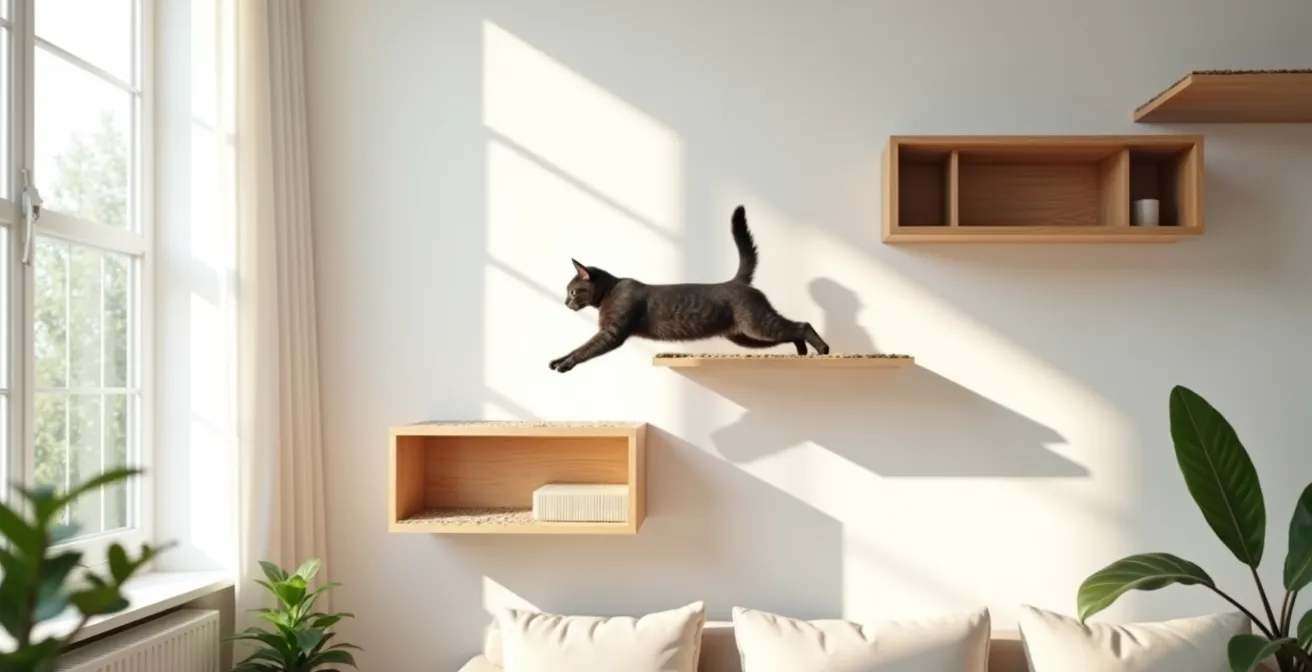
The key to a stylish cat wall is treating it as a bespoke architectural installation, not just pet furniture.
- Success depends on understanding feline ergonomics for spacing and kinetic loads for secure mounting.
- Aesthetic integration is achieved by selecting materials with intention and dedicating space exclusively to the cat’s pathway.
Recommendation: Begin by auditing your wall structure and your cat’s physical capabilities before selecting a single shelf.
The desire for a cat-friendly home often clashes with a curated interior aesthetic. The market is flooded with cumbersome carpeted towers and plastic perches that scream “crazy cat person” rather than “design-conscious homeowner.” Many attempt a DIY solution, putting up a few shelves in the hope of creating vertical space. Yet, the result is often a disjointed, underutilized, and potentially unsafe assembly that does little to enhance the room’s decor or the cat’s well-being.
As an interior architect, I propose a fundamental shift in perspective. A cat superhighway should not be an afterthought or a compromise. It should be conceived and executed as a piece of living, kinetic architecture. The secret lies in moving beyond the simple act of “putting up shelves” and embracing the principles of structural integrity, feline ergonomics, and intentional aesthetic integration. It involves analyzing the dynamic forces of a pouncing cat—its kinetic load—and designing a structure that is not only safe but visually deliberate.
This approach requires you to think like a designer. You must consider the flow of movement, the texture of surfaces, and the interplay of the installation with the existing lines of your home. It’s about creating a vertical topography that is both a stimulating environment for your cat and a sophisticated architectural feature for your living space. This guide will provide the foundational principles to design and install a cat wall that is structurally sound, ergonomically perfect for your feline, and a beautiful addition to your home.
This comprehensive guide details the architectural and aesthetic considerations for creating a flawless feline superhighway. Explore the sections below to master each critical aspect of the design and installation process.
Summary: Architecting a Feline Superhighway for the Modern Home
- Why gaps between shelves must be adjusted for your cat’s age and weight?
- How to find studs and use toggle bolts for drywall mounting?
- Felt vs Cork vs Wood: Which prevents slipping during high-speed chases?
- The “Knick-Knack” Mistake: Why mixing vases and cat shelves is a disaster?
- Where to mount for “Cat TV”: Angles for bird watching without frustration?
- How to use window film to stop barrier frustration in reactive dogs?
- How to create vertical space without drilling holes in the wall?
- Wobbly Cat Trees: Why Instability Causes Your Cat to Ignore Expensive Furniture?
Why gaps between shelves must be adjusted for your cat’s age and weight?
The functionality of a cat superhighway is dictated by the principles of feline ergonomics. A common design flaw is applying a one-size-fits-all spacing, ignoring the vast differences in agility and size across a cat’s lifespan and breed. The distance a spry one-year-old can leap with confidence is drastically different from the comfortable step of a senior cat or the powerful, heavy-set bound of a large breed like a Maine Coon. A misjudged gap can render the entire system unusable or, worse, lead to a dangerous fall.
Designing for your specific cat involves a precise calculation of both vertical and horizontal distances. Kittens and senior cats require shorter, more conservative gaps to encourage use and prevent injury. An adult cat in its prime can handle more ambitious distances, allowing for a more dynamic and visually interesting layout. The width of the shelves is equally crucial; “launch pads” and landing zones should be significantly wider to accommodate the physics of a jump, providing a stable platform for takeoff and landing. This tailored approach ensures the highway is not just accessible but is actively and safely enjoyed.
Case Study: Reinforcing for a Heavyweight Jumper
A cat owner with a 20-pound Maine Coon faced the challenge of creating a wall system that could withstand significant kinetic load. Standard installation was insufficient. By reinforcing the perches with a 1×4 board mounted directly to wall studs and using longer screws, they created a system that remained perfectly stable even after months of the cat bounding energetically upon it. This demonstrates the critical need to adapt mounting strategies to the specific weight and activity level of the user.
- Kittens (under 1 year): Keep vertical jumps to a maximum of 8-10 inches and horizontal gaps to no more than 12 inches.
- Adult cats (1-8 years): Can comfortably handle vertical jumps of 12-18 inches. Horizontal gaps can be up to 3.5 feet, but test your cat’s comfort level.
- Senior cats (8+ years): Prioritize safety. Place shelving lower to the ground with spacing no more than 12 inches apart to create a gentle staircase effect.
- Large breeds (e.g., Maine Coon): Require wider shelves (a minimum of 11 inches deep) and the strongest possible mounting support to handle their weight and force.
How to find studs and use toggle bolts for drywall mounting?
The structural integrity of your cat wall is non-negotiable. While aesthetics guide the layout, physics dictates the mounting. A shelf that seems secure to the touch may fail under the dynamic kinetic load of a cat leaping at speed. The single most important factor in ensuring safety is anchoring your shelves directly into the wall studs—the vertical wood beams that form your home’s frame. Relying solely on drywall anchors for anything other than a very small, low-activity cat is an architectural gamble. A high-quality electronic stud finder is an essential tool for this task, allowing you to precisely locate the center of these beams.
This close-up view demonstrates the critical hardware for a secure installation. A stud finder pinpoints the structural support, while a heavy-duty toggle bolt prepares to anchor the shelf bracket firmly, ensuring it can handle a cat’s dynamic movements.
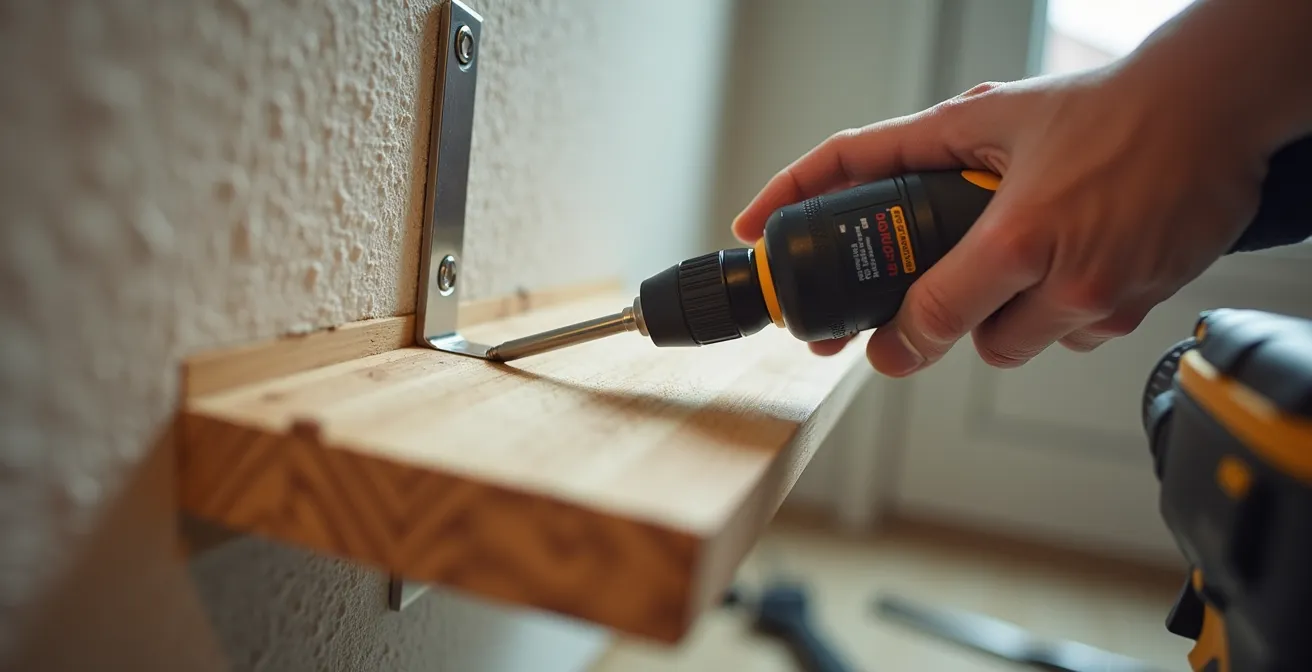
According to a guide on secure cat shelf installation, mounting into studs is non-negotiable for any cat over 15lbs or for multi-cat households. In situations where a stud is not perfectly positioned for your design, you cannot simply revert to a weak plastic anchor. This is where heavy-duty toggle bolts become your best option. Unlike standard screws, a toggle bolt has wings that spring open behind the drywall, distributing the weight over a much larger surface area. This provides a significantly more secure hold than anchors that rely on friction within the drilled hole. In standard US construction, wall studs are typically spaced 16 inches center-to-center, a crucial measurement to factor into your layout planning from the very beginning.
Felt vs Cork vs Wood: Which prevents slipping during high-speed chases?
The choice of surface material for your cat shelves is an intersection of aesthetics, durability, and, most importantly, grip. A beautiful bare wood shelf may complement your minimalist decor, but its low-traction surface can be treacherous for a cat navigating a corner at high speed. The material must provide enough purchase for claws to engage during acceleration, deceleration, and sharp turns. This is not merely a comfort feature; it is a critical safety component that prevents slips and falls, fostering the cat’s confidence in using the highway.
Your selection should be a deliberate balance of function and style. Cork offers an excellent combination of grip and a natural, bohemian look, while sisal rope provides maximum traction and durability for a more rustic aesthetic. Felt and carpet offer superior noise dampening and a cozy feel but may show wear more quickly. An advanced strategy is to use different materials for different zones: a high-grip material like cork or sisal for launch pads and tight corners, and a softer felt or berber carpet for designated lounging areas. The following table, based on an analysis of material performance, provides a clear comparison to inform your architectural choice.
| Material | Grip Level | Claw Durability | Noise Dampening | Aesthetic Style | Maintenance |
|---|---|---|---|---|---|
| Cork | Excellent | Good | Moderate | Bohemian/Natural | Easy to clean |
| Felt | Good | Poor-Moderate | Excellent | Cozy/Soft | Requires regular replacement |
| Bare Wood | Poor | Excellent | Poor (amplifies) | Minimalist | Simple maintenance |
| Sisal | Excellent | Excellent | Good | Natural/Rustic | Very durable |
| Berber Carpet | Excellent | Good | Excellent | Traditional | Vacuum regularly |
The “Knick-Knack” Mistake: Why mixing vases and cat shelves is a disaster?
A common error that undermines both the aesthetic and function of a cat wall is the “knick-knack” mistake: attempting to create a hybrid display of cat furniture and decorative objects. This approach is fundamentally flawed. A cat superhighway is a zone of high-speed, dynamic activity. It is not a static display shelf. Placing a fragile vase, a picture frame, or any unsecured object within the cat’s pathway is inviting disaster. At best, you will face constantly broken items; at worst, a startled cat could be injured by falling debris or lose its footing and fall.
The principle of intentional space dictates that a cat highway must be a dedicated, exclusive-use zone. From an architectural perspective, its lines and form should be the decoration. If you wish to have decorative shelves, they must be spatially distinct from the feline pathway. To prevent accidental collisions from a swatting tail or a misjudged leap, design experts recommend maintaining at least a 30 inches minimum vertical gap between the highest point of a cat shelf and the lowest point of any nearby decorative shelf. If you must decorate near the highway, the objects themselves must be chosen for their cat-proof qualities.
Consider these strategies for safe and stylish co-habitation:
- Material Choice: Opt for unbreakable decor such as rubber sculptures, solid wooden objects, or lightweight woven baskets that pose no threat if knocked over.
- Secure Placement: Mount flat artwork directly to the wall behind the shelves, well out of the range of a “tail-whip.” If using plants, ensure they are non-toxic to cats and secured in heavy planters on surfaces completely separate from the highway.
- Total Separation: The safest and most aesthetically clean approach is to keep all fragile and precious items on a completely different wall or shelving system, allowing the cat wall to exist as a pure, functional architectural feature.
Where to mount for “Cat TV”: Angles for bird watching without frustration?
A prime function of a vertical superhighway is to provide access to “Cat TV”—a clear, stimulating view of the world outside a window. The placement of these viewing perches is a delicate balance of providing enrichment without causing frustration or compromising your home’s interior ambiance. A poorly positioned shelf can block light, create uncomfortable viewing angles, or place the cat too close to the glass, heightening arousal and potential frustration if they cannot access the birds or squirrels they see.
The ideal “Observer’s Lounge” is a wide, comfortable shelf positioned adjacent to a window, not directly above it. This allows the cat a full, relaxed viewing angle while preventing the shelf from casting a shadow and darkening the room. For cats with a strong hunting instinct, a “Hunter’s Blind” can be created with a partially obscured perch near the edge of a curtain, allowing them to “stalk” from cover. The shelf should be positioned approximately 12-14 inches from the window itself, providing a comfortable distance for observation without feeling pressed against the glass. The goal is to create a serene and engaging viewing experience that enriches the cat’s day.
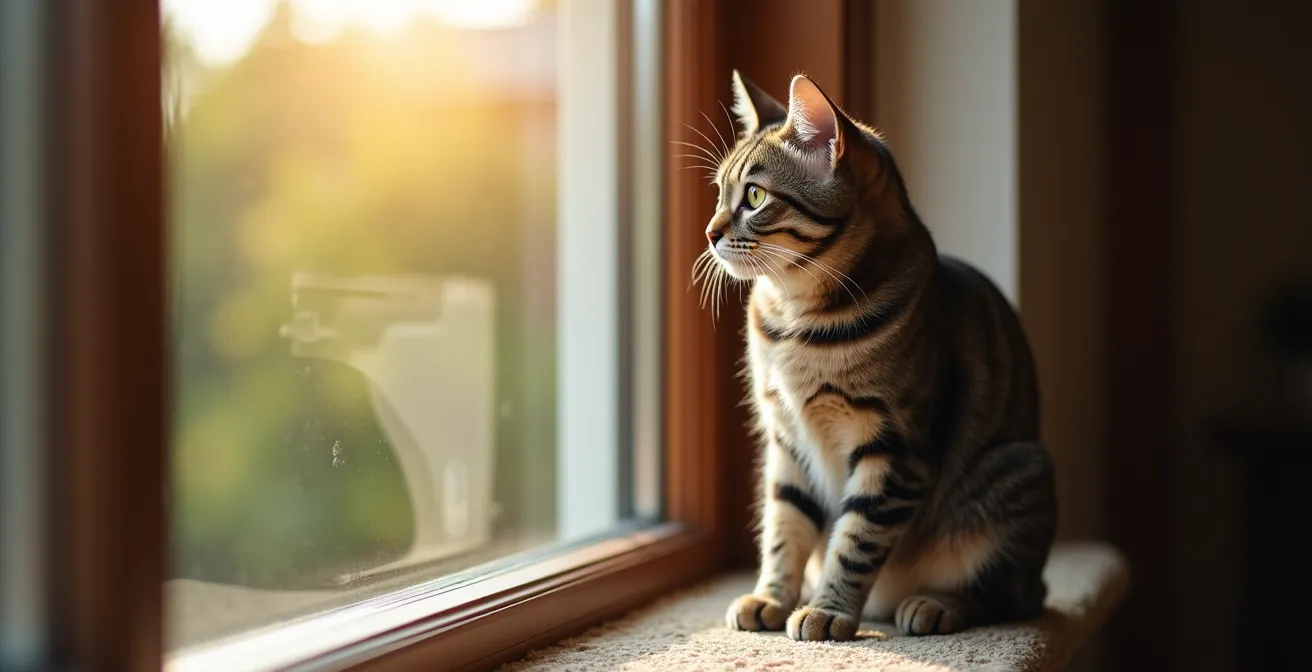
Case Study: The Window Positioning Strategy
In one documented instance, owners installed a beautiful walkway directly over their living room windows. While their cats used it, they noticed it significantly reduced the room’s brightness by blocking light from reflecting off the ceiling. Their architectural solution was to reposition the shelves to be adjacent to the windows. This restored the room’s natural light while still providing their cats with an excellent vantage point, proving that placement impacts the entire room’s environment.
How to use window film to stop barrier frustration in reactive dogs?
While this article focuses on feline architecture, a valuable principle can be borrowed from the world of canine behavior management: controlling environmental stimuli to reduce frustration. In dogs, “barrier frustration” occurs when they become overly aroused by sights outside a window or fence they cannot reach. A common management tool is the application of translucent window film, which obscures the specific trigger (like a passing dog) while still allowing light to enter. This lowers the dog’s arousal level by removing the constant, frustrating stimulus.
This concept of managing overstimulation has direct relevance for some cats. For a highly prey-driven or territorial cat, a constant, unobscured view of birds or a neighbor’s cat can lead to stress, obsessive behaviors, and redirected aggression. While window film is one option, a more architecturally integrated solution is to use your cat wall design to control sightlines and redirect energy. Instead of offering a complete, overwhelming panorama, you can design perches that offer partial or focused views. More importantly, the superhighway itself provides a positive, physical outlet for the energy that might otherwise become frustration. A cat that can patrol its vertical territory and engage in a stimulating climb is less likely to fixate on an uncatchable squirrel.
Therefore, a well-designed cat wall does more than just provide a view; it becomes part of a holistic environmental management strategy. By carefully planning perch locations and providing ample opportunity for climbing, leaping, and resting, you create a system that channels your cat’s natural instincts into positive, enriching activity, mitigating the very frustration that visual barriers are designed to prevent.
How to create vertical space without drilling holes in the wall?
For renters or homeowners hesitant to commit to permanent fixtures, the challenge of creating vertical space seems insurmountable. However, an architectural mindset finds solutions by looking at the existing topography of the room. The goal is to create a “furniture highway” by using freestanding pieces to build a safe and stable vertical landscape. This requires a keen eye for stability, height progression, and securing items to one another without touching the walls.
The most elegant no-drill solutions are often floor-to-ceiling tension pole systems. These act as the primary support columns from which platforms, hammocks, and steps can be attached, creating a fully functional cat tree or partial highway. Another effective strategy is the progressive stacking of sturdy, existing furniture. An ottoman can lead to the arm of a sofa, which leads to a low console, which then leads to the top of a robust bookshelf. The key is ensuring each piece is heavy and stable enough that it will not wobble or shift when the cat leaps on or off it.
Case Study: The IKEA Transformation
A clever cat owner, faced with a no-drill restriction, created a highly effective vertical space using two IKEA Hemnes bookcases. By placing matching shelves between them at staggered heights, they built a staircase. To ensure safety and grip, they added stair gripper carpet treads to each shelf. Their Maine Coon hybrid uses the setup daily as a primary vantage point and pathway, demonstrating that a creative combination of freestanding furniture can be just as effective as a wall-mounted system.
For this approach to be successful, you must audit the stability of each component. Lightweight or top-heavy furniture should never be used as part of a feline highway. The connections between pieces must also be considered, sometimes using non-damaging straps or brackets to link them for added security.
Key Takeaways
- Treat your cat wall as a piece of architecture, focusing on structural integrity and feline ergonomics.
- Always mount into studs or use heavy-duty toggle bolts to support the dynamic kinetic load of a jumping cat.
- Choose surface materials for grip and safety, not just aesthetics, and create dedicated, exclusive pathways free of decorative objects.
Wobbly Cat Trees: Why Instability Causes Your Cat to Ignore Expensive Furniture?
The concept of stability is the unifying principle behind every successful piece of feline architecture, from a simple cat tree to an elaborate superhighway. A cat’s instinct is finely tuned to detect the slightest wobble or shift underfoot. In the wild, an unstable branch signals danger. In your living room, an unstable perch does the same. This is why cats will often ignore an expensive, feature-rich cat tree: if the base is too small or the connections are loose, it fails their fundamental safety audit. They will not use, let alone enjoy, a structure they do not trust with their lives.
This principle of trust extends to every element of your design. Shelves must be utterly immobile. Connections must be tightened and periodically checked. The structure must feel like an extension of the wall itself—solid, reliable, and permanent. One of the most effective ways to enhance stability, for both freestanding trees and wall-mounted elements, is strategic placement. As noted by feline behavior experts, cats feel more secure in corners.
Cats love corners, since they feel more secure with their backs against a wall, and 2 walls are better than one.
– WhyCatWhy Editorial Team, Cat Vertical Space 101: The Ultimate Guide
Positioning a cat tree or the anchor point of a wall system in a corner leverages two walls for additional support and psychological security. Before investing time and money, it’s crucial to audit any potential furniture for its foundational stability.
Cat Tree Stability Audit Checklist
- Wobble Test: Apply firm pressure to the top and sides from multiple angles. Any give or wobble is a red flag.
- Base Inspection: Assess the base. Is it wide and heavy enough to counteract the height and a leaping cat’s force? If not, plan to add a wider plywood sheet underneath.
- Hardware Check: Examine all connections. Are they securely tightened? Are any screws or bolts worn or stripped? Plan to tighten all hardware upon assembly and periodically thereafter.
- Bracing Potential: Consider if the structure can be braced against a wall using non-damaging tension rods for extra rigidity.
- Corner Placement: Evaluate if positioning the tree in a corner is possible. This simple placement trick dramatically increases stability and the cat’s sense of security.
Now that you are equipped with the architectural principles for designing a safe, functional, and beautiful cat superhighway, the next step is to begin the planning phase for your own unique space and feline.