
The key to assessing a senior pet’s quality of life isn’t counting ‘good days vs. bad days,’ but becoming a compassionate detective of their gradual decline.
- Most significant changes aren’t dramatic events but subtle shifts in behavior, mobility, and routine that signal underlying system failures.
- Transforming subjective worries into objective data—using charts and logs—provides clarity and removes emotional guesswork from decision-making.
Recommendation: Start tracking specific, measurable signs today. This data is the most powerful tool you and your veterinarian have to ensure your pet’s comfort and dignity.
Watching a beloved pet grow old is a journey of deep love and quiet worry. One of the most difficult questions any owner faces is how to gauge their companion’s quality of life when the decline isn’t a sudden crisis, but a slow, subtle fading. You see a little more stiffness in the morning, a little less enthusiasm for a favorite toy, a new hesitance on the stairs. These moments are confusing and emotionally fraught. Many owners fall into the trap of tracking “good days” versus “bad days,” a subjective measure that often leads to more anxiety than clarity.
Conventional wisdom often points to quality-of-life scales or checklists. While these can be helpful starting points, they don’t always capture the unique, gradual erosion of well-being specific to your pet. The real challenge lies in distinguishing normal aging from chronic discomfort, or stubbornness from a medical condition like cognitive dysfunction. The gradual nature of these changes makes it easy to second-guess what you’re seeing.
But what if the approach wasn’t about waiting for a clear “bad day” to make a decision? The true key to navigating this stage is to shift your mindset. This article will guide you on how to become a compassionate ‘detective of decline.’ We will move beyond vague feelings and into the world of objective observation. By learning to recognize and systematically track the specific, subtle system failures of an aging body, you can gather the factual data needed to partner with your veterinarian and make the most informed, loving decisions for your pet’s final chapters.
This guide will walk you through the most common but often misunderstood signs of decline in senior pets. By exploring the ‘why’ behind these changes, you will gain the tools and confidence to assess your pet’s world with both compassion and clarity.
Summary: A Guide to Compassionate Assessment of Your Aging Pet
- Why your old dog pacing at night is likely Dementia, not stubbornness?
- How to encourage a senior cat with kidney disease to eat their prescription food?
- Lump Mapping vs Memory: Why you need a physical chart for senior tumors?
- The Temperature Regulation Failure: Why seniors get hypothermia in mild cold?
- When to upgrade to an orthopedic bed: The pressure point test
- When to increase preventive screening frequency: The signs 90% of owners miss
- When does chronic arthritis pain become a violation of Freedom from Pain?
- Multimodal Pain Management: Why One Pill Is Not Enough for Chronic Arthritis?
Why your old dog pacing at night is likely Dementia, not stubbornness?
That restless, late-night pacing you’re witnessing in your senior dog is one of the most commonly misinterpreted signs of aging. It’s easy to dismiss it as a new quirk or a form of stubbornness, but it’s often a primary symptom of Canine Cognitive Dysfunction (CCD), or dog dementia. This is not a behavioral problem; it’s a neurodegenerative disease that affects memory, learning, and spatial awareness. The anxiety and confusion tend to worsen in the evening, a phenomenon known as “sundowning.”
The numbers are significant; according to research, more than 28% of dogs aged 11-12 years showing signs of dementia, a figure that jumps to 68% for dogs over 15. Recognizing pacing as a medical symptom rather than a behavioral issue is the first step toward providing relief. This is a classic ‘system failure’ of the brain. The goal is not to correct the behavior but to manage the underlying anxiety and confusion.
Creating a supportive environment can make a world of difference for a dog with CCD. Your role is to reduce triggers for anxiety and increase feelings of security. Simple environmental changes can significantly improve their comfort and your sleep quality. Consider these interventions:
- Install dimmable nightlights to prevent total darkness, which can increase disorientation.
- Use a white noise machine to mask sudden sounds that might startle them.
- Provide a puzzle toy or a calming lick mat about an hour before their usual sundowning time begins.
- Maintain a predictable evening routine with meals, potty breaks, and bedtime at the same time every night.
- Keep the home well-lit during the sunset hours to ease the transition from day to night.
How to encourage a senior cat with kidney disease to eat their prescription food?
A diagnosis of Chronic Kidney Disease (CKD) in a senior cat brings a critical dietary challenge: getting them to eat a therapeutic renal diet. These prescription foods are lower in phosphorus and protein to reduce the workload on the kidneys, but they are often less palatable than what your cat is used to. Anorexia, or loss of appetite, is a major concern in CKD, as it can be caused by nausea from the buildup of toxins in the blood. Forcing a cat to eat can create a food aversion, making the problem even worse.
The goal is to encourage, not force. Your strategy should be a combination of making the food more appealing and medically managing the underlying nausea and appetite loss. A slow transition is key. Start by mixing a tiny amount (less than 10%) of the new food with their old food, and increase the ratio over several weeks. Warming the wet food slightly can enhance its aroma and make it more enticing. You can also try adding a small amount of a ‘topper’ like low-sodium tuna water or a renal-friendly flavor enhancer, but always discuss this with your veterinarian first.
When these methods aren’t enough, it’s time to talk to your vet about medical intervention. This is not a failure on your part; it’s a necessary step in managing a complex disease. Anti-nausea medications can be highly effective, and appetite stimulants can be a game-changer. For example, a clinical trial on appetite stimulants in cats with CKD found that transdermal mirtazapine increased appetite in 60% of cats and led to significant weight gain. These interventions directly address the physiological reasons your cat isn’t eating, allowing them to feel well enough to accept their therapeutic diet.
Lump Mapping vs Memory: Why you need a physical chart for senior tumors?
As pets age, lumps and bumps become a common occurrence. While many are benign fatty tumors (lipomas), some can be more serious. Simply relying on your memory to track their size, shape, and location is a recipe for anxiety and uncertainty. Did that lump on his side get bigger? Was it always this firm? This is where you step into the role of a ‘detective of decline’ by implementing lump mapping. This involves creating a physical diagram of your pet’s body and systematically documenting every lump.
This objective record is invaluable for you and your veterinarian. It transforms vague worry into concrete data, allowing your vet to make more informed decisions about which lumps require a fine-needle aspirate or biopsy. A new, rapidly growing mass is a much higher priority than one that has remained unchanged for years. The process of measuring provides a clear, factual basis for your observations, as this detailed image of a caliper in use demonstrates.
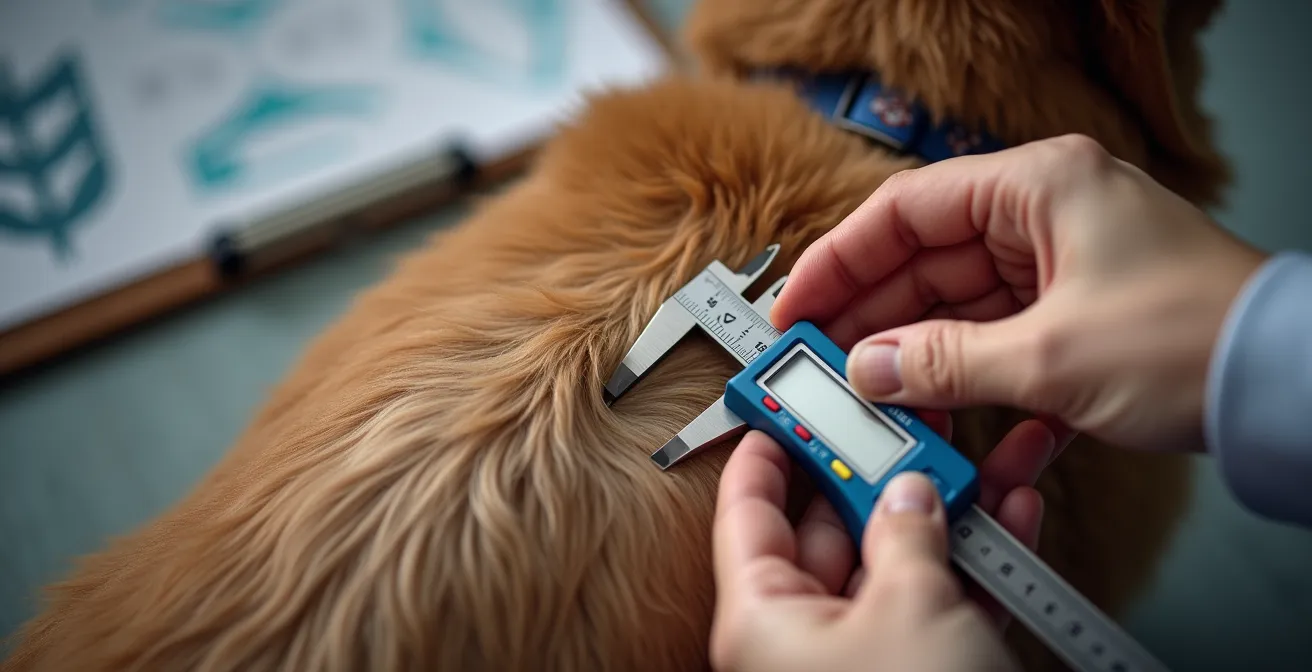
To start your own lump map, simply print a blank outline of a dog or cat and mark the location of each mass. Next to it, create a log. Following the guidelines from the American Animal Hospital Association (AAHA), you should track several key parameters on a weekly or bi-weekly basis. This structured approach ensures you capture all the critical information your veterinarian needs.
| Parameter | What to Measure | How to Document | Frequency |
|---|---|---|---|
| Location | Exact position on body | Mark on body diagram | Initial discovery |
| Size | Width x Length in mm/cm | Use calipers or ruler | Weekly |
| Firmness | Soft to hard | 1-5 scale (1=soft, 5=hard) | Weekly |
| Mobility | Fixed vs moveable | Yes/No – moves under skin? | Weekly |
| Color | Skin appearance | Normal/Red/Purple/Black | Weekly |
The Temperature Regulation Failure: Why seniors get hypothermia in mild cold?
Have you noticed your older pet seeking out sunny spots more often or shivering in a room you find comfortable? This isn’t just a preference; it’s a sign of a critical system failure: impaired thermoregulation. As pets age, their ability to maintain their core body temperature becomes less efficient. This is due to a combination of factors, including a slower metabolism, decreased muscle mass (which generates heat), and often, reduced body fat and a thinner coat.
This makes senior pets highly susceptible to hypothermia, even in mildly cool environments that a younger animal would easily tolerate. An open window on a 65°F (18°C) day or sleeping on a cool tile floor can be enough to dangerously lower their body temperature. As their caregiver, you must become their external thermostat, proactively providing warmth rather than waiting for them to show signs of being cold, like shivering, which is a late-stage indicator of distress.
The key is to create a consistently warm and draft-free environment. This doesn’t mean overheating your house but rather creating safe ‘heat islands’ where your pet can rest comfortably. There are many safe heating solutions available, but it’s crucial to choose options that prevent the risk of burns, especially for pets with limited mobility who can’t move away from a source that’s too hot.
- Self-warming mats: These are the safest option as they reflect the pet’s own body heat and require no electricity.
- Microwaveable heat pads: Always test the temperature on your own skin first and wrap the pad in a towel. They need to be replaced every few hours.
- Electric heated beds: Only use these under supervision and ensure the pet can easily move off the bed if it becomes too warm. Look for low-voltage models with chew-proof cords.
- Safe apparel: A well-fitting sweater or coat made of stretchy material can help, but ensure it doesn’t constrict joints or the neck area.
- Strategic bed placement: Move beds away from drafty doors and windows, and place them near (but not directly on) a heating vent.
When to upgrade to an orthopedic bed: The pressure point test
The plush, fluffy bed your pet loved as an adult may become a source of discomfort in their senior years. As muscle mass declines and arthritis develops, pressure points on the hips, shoulders, and elbows become more sensitive. A bed that is too soft or has lost its support can cause them to sink, making it difficult to stand up and putting painful pressure on their joints all night long. This is when an orthopedic bed becomes a medical necessity, not a luxury.
So, how do you know it’s time to upgrade? Perform the pressure point test. Lie on the floor and place your elbow on your pet’s current bed, putting your weight on it. If you can feel the hard floor through the padding, the bed is offering insufficient support. A proper orthopedic bed, typically made of high-density memory foam, will distribute weight evenly and cushion these bony prominences, providing significant pain relief and improving restorative sleep.
When choosing an orthopedic bed, consider these features tailored for a senior pet:
- Low Profile: The bed should be easy for them to step into, not requiring a big leap. A height of 4-6 inches is ideal.
- Waterproof Liner: Incontinence can be a part of aging. A waterproof liner beneath the cover is essential for hygiene and to protect the foam core.
- Non-Slip Base: The bed should not slide away when your pet tries to get on or off it, which could cause a fall.
- Supportive Bolsters: Many senior pets appreciate a raised edge to lean against or rest their head on, which can provide a sense of security.
When to increase preventive screening frequency: The signs 90% of owners miss
The most powerful tool in managing a senior pet’s health is early detection. Unfortunately, the earliest signs of major geriatric diseases like kidney failure, heart disease, or diabetes are incredibly subtle and easy to miss. A slight increase in thirst, a minor change in breathing rate, or sleeping a little more deeply—these are the micro-changes that 90% of owners overlook until the disease is more advanced and harder to treat. This is why a shift in preventive care is critical as your pet enters their senior years.
As a rule of thumb, most veterinarians recommend increasing wellness visits from annually to biannually (every six months) once a pet is considered a senior (typically around 7-8 years for large dogs and 10-11 for cats and small dogs). This allows your vet to catch changes in bloodwork, urine, and blood pressure far earlier. Veterinary practice data confirms that biannual wellness visits for senior pets are highly effective at detecting conditions in their early stages when treatment has a much better prognosis.
At home, your role as a ‘detective of decline’ is to track these subtle signs. A weekly wellness log transforms you from a worried observer into an empowered data collector. By measuring a few key metrics consistently, you create a baseline that makes any deviation immediately obvious. This data is gold for your veterinarian and can be the key to catching a problem weeks or months earlier.
Your Weekly Wellness Log: 5 Key Points to Track
- Resting Respiratory Rate (RRR): Count the number of breaths your pet takes in one minute while they are sound asleep. A normal rate is typically between 15-30 breaths per minute. A consistent increase can be an early sign of heart or lung issues.
- Water Intake: Measure the amount of water you put in the bowl each day or use a marker to track the level. A significant, sustained increase (e.g., more than 20% over a few weeks) is a classic early sign of kidney disease or diabetes.
- Sleep Quality: Note the approximate number of hours slept and, more importantly, the number of times they wake up during the night. Increased restlessness can signal pain or anxiety.
- Mobility Score: Use a stopwatch to time how long it takes your pet to rise from a lying position. A gradual increase in this time is an objective measure of worsening arthritis or muscle weakness.
- Appetite Rating: Rate their appetite on a simple scale of 1-10 each day. Note any specific food refusals, as this can be more telling than simply eating less overall.
When does chronic arthritis pain become a violation of Freedom from Pain?
One of the five foundational freedoms of animal welfare is the ‘Freedom from Pain, Injury, or Disease.’ For a senior pet with chronic arthritis, this concept becomes a difficult ethical line to navigate. Arthritis is a progressive disease, and a day with zero pain is often an unrealistic goal. Our objective shifts to ensuring that the pain is managed to a level that does not fundamentally destroy their quality of life. The question becomes: when does manageable discomfort cross the line into unacceptable, pervasive suffering?
The answer is found not in a single dramatic moment, but in the erosion of joy and normal behaviors. Pain is a thief. It steals their desire to play, their interest in social interaction, and even their ability to rest comfortably. When pain begins to dictate every aspect of their day—when they no longer greet you at the door, when they flinch from a gentle touch, when they stop grooming themselves because it hurts to move—we are approaching a violation of this fundamental freedom. It’s no longer just about a stiff leg; it’s about the loss of their very essence. As Veterinary Partner, an authority on animal health, wisely states:
Quality life involves eating or at least interest in food. An animal that is hungry has vitality that must be considered.
– Veterinary Partner – VIN
This vitality is what pain erodes. To assess this, you must learn to recognize the subtle ways pets disguise chronic pain. They are masters of hiding their discomfort, a survival instinct left over from their wild ancestors. Look for these ‘pain disguise’ behaviors:
- Social withdrawal: Hiding or no longer seeking interaction with family members.
- Hesitation: Pausing before attempting stairs, jumping onto furniture, or getting into the car.
- Irritability: Growling or hissing when you touch a sore area, even accidentally.
- Excessive licking: Constantly licking or chewing at a painful joint.
- Postural changes: A newly arched back in cats or a hunched, tucked-tummy stance in dogs.
- Decreased grooming: A matted or unkempt coat in cats is a major red flag for pain.
- Surface preference: A sudden reluctance to walk on slick floors like tile or hardwood.
Key Takeaways
- Assessing quality of life is not about a single moment, but about tracking patterns of subtle system failures over time.
- Transforming subjective worries into objective data (logs, charts, measurements) is the most effective way to partner with your vet.
- Effective management of a senior pet involves proactive support for their specific age-related challenges, from cognitive function to pain control.
Multimodal Pain Management: Why One Pill Is Not Enough for Chronic Arthritis?
When dealing with the complex, chronic pain of arthritis, there is no single ‘magic bullet.’ The idea that one pill can solve the problem is a common misconception. The pain from arthritis is not a single entity; it involves inflammation, nerve sensitization, and the physical stress of joint instability. A truly effective approach, known as multimodal pain management, targets this pain from multiple angles simultaneously. It’s like assembling a team of specialists rather than relying on a single general practitioner.
A typical multimodal plan might combine a daily anti-inflammatory drug (NSAID) to reduce joint inflammation, a second medication like gabapentin to block pain signals in the nervous system, and long-term joint-protecting injections like Adequan. This pharmaceutical foundation is then supported by non-drug therapies. Physical therapy helps rebuild the stabilizing muscles around the joint, laser therapy can provide targeted, drug-free relief, and most importantly, weight management reduces the daily physical load on the sore joints. Each modality does a different job, and their synergistic effect is far greater than any single treatment alone.
This might sound expensive, but a multimodal approach can be tailored to any budget. The most effective pain management strategy—weight control—is also the cheapest. You can build a plan by layering different strategies, starting with a strong and affordable foundation.
- Base (Free to Low-Cost): This is the most critical layer. It includes strict weight management through portion control and modifying the home with non-slip rugs and ramps to prevent falls.
- Middle (Affordable): This layer adds support with high-quality joint supplements (glucosamine, chondroitin), omega-3 fatty acids for their anti-inflammatory properties, and a routine of gentle, low-impact exercise like short, slow walks.
- Top (Investment): This includes prescription medications, formal physical therapy sessions, and complementary therapies like acupuncture or laser therapy, as recommended and prescribed by your veterinarian.
By shifting from a reactive to a proactive and observational mindset, you provide your aging companion with the greatest gifts: comfort, dignity, and a life where joy is still possible. The next step is to begin this tracking process and schedule a consultation with your veterinarian to create a multimodal care plan tailored to your specific findings and your pet’s needs.