
Viewing yourself as an animal ‘guardian’ instead of an ‘owner’ legally elevates your pet from property to a ward, subjecting you to a higher fiduciary standard of care with significant legal and financial consequences.
- Courts may apply a “best interests of the animal” standard in custody disputes, moving beyond simple property rules.
- Failures in care, including passive neglect like lack of mental stimulation or allowing obesity, can create legal liability.
Recommendation: Proactively audit your care routines, training methods, and home environment against established welfare models like the Five Freedoms to meet this rising legal standard.
The language we use to describe our relationship with the animals in our lives is evolving. Many now prefer the term ‘guardian’ over ‘owner,’ viewing it as a more compassionate and respectful descriptor. While this shift often begins as a matter of personal ethics, its legal implications are profound and largely underestimated. This is not merely a semantic change; it represents a fundamental paradigm shift in animal law, transforming an animal from a piece of property into a legal ward with interests that must be protected.
Most people assume being a good pet owner means providing food, water, and affection. But the legal framework of guardianship demands much more. It introduces the concept of a fiduciary duty—a legal obligation to act in the animal’s best interests, even above your own convenience or financial constraints. This higher standard of care is increasingly being recognized in courtrooms, creating new liabilities for well-meaning individuals who may be unaware of their elevated responsibilities. Understanding this distinction is no longer optional; it is critical for protecting both your animal’s welfare and your own legal standing.
This article will deconstruct the legal and ethical differences between ownership and guardianship. We will explore how this shift impacts everything from your pet’s life expectancy and your estate planning to your potential liability in cases of neglect or custody disputes. By understanding these new responsibilities, you can ensure you are truly acting as a guardian in the fullest sense of the word, equipped to provide a lifetime of safety and well-being.
To navigate this complex legal and ethical landscape, we have structured this guide to address the most critical aspects of animal guardianship. The following sections will provide a clear roadmap for understanding your duties and implementing best practices.
Summary: The Legal Consequences of the Shift to Animal Guardianship
- Why Viewing Yourself as a Guardian Improves Your Pet’s Life Expectancy?
- How to create a Will Trust for your pet to ensure their future safety without legal loopholes?
- Owner vs Guardian: Which Legal Status Offers Better Protection in Court Cases?
- The Passive Neglect Mistake That Could Cost You Custody of Your Animal
- How to audit your home environment to meet strict guardianship standards for mental health?
- Why a video is worth more than 10 phone calls when reporting abuse?
- The “Punishment” Error: Why alpha rolls violate the freedom from fear?
- Are You Meeting the Five Freedoms? A Self-Audit for Modern Pet Owners
Why Viewing Yourself as a Guardian Improves Your Pet’s Life Expectancy?
Adopting a guardianship mindset fundamentally alters your approach to an animal’s health from reactive to proactive. An owner might treat illness as it arises, but a guardian actively works to prevent it, focusing on ‘healthspan’—the period of healthy, vibrant life—not just lifespan. This proactive stance involves meticulous monitoring and early intervention, which has a direct, measurable impact on longevity. It means tracking subtle changes in weight, mobility, and behavior as key health indicators, rather than waiting for obvious signs of distress.
The most significant impact is seen in preventative wellness and weight management. Obesity is a common problem in companion animals, often overlooked by owners but taken seriously by guardians as a welfare issue. It is a leading cause of chronic inflammation, arthritis, and metabolic disease. Recent research from Banfield Pet Hospital shows that dogs with an ideal body condition live significantly longer than their obese counterparts, with an average difference of nearly 1.5 years. A guardian sees maintaining a healthy weight not as a cosmetic goal, but as a core duty in maximizing their ward’s quality and length of life.
This philosophy extends to all areas of wellness. A comprehensive study on ‘healthspan’ in dogs found that those receiving proactive care experienced exceptional longevity and a significant delay in the onset of major diseases. This care includes annual bloodwork to establish baseline health metrics, dental cleanings to prevent systemic infections, and breed-specific screenings for genetic conditions. By investing in prevention, a guardian not only adds years to their pet’s life but adds life to their years, fulfilling the core duty of ensuring their well-being.
How to create a Will Trust for your pet to ensure their future safety without legal loopholes?
One of the most critical duties of a guardian is planning for the animal’s future should you become incapacitated or pass away. A common mistake is simply naming a caregiver in a standard will. Legally, pets are considered property, and you cannot leave property (money) to other property (your pet). A will provision is merely a request, creating no legal obligation for the named person to care for the animal or use designated funds for that purpose. This can lead to devastating outcomes where the animal is surrendered to a shelter.
The legally enforceable solution is a Pet Trust. Unlike a will, a trust is a legal arrangement that appoints a trustee who has a fiduciary duty to manage the funds and ensure the caregiver adheres to your specific instructions. This transforms your wishes from a hopeful request into a set of legally binding directives.
Case Study: The Legal Power of Pet Trusts
An analysis by estate planning service Trust & Will revealed a critical flaw in simple will provisions for pets: they offer no legal enforcement. Their solution is the creation of formal pet trusts, where a trustee is legally bound by fiduciary duties. This ensures that the funds set aside are used exclusively for the pet’s care according to detailed standards. The most effective trusts specify everything from veterinary protocols and dietary needs to enrichment requirements, making the guardian’s long-term wishes for their animal’s quality of life legally enforceable after they are gone.
Creating an effective trust requires careful thought and detailed documentation. It’s not enough to simply set aside money; you must provide a clear blueprint for your animal’s life. This includes everything from dietary preferences and medical history to their favorite toys and socialization needs. The goal is to make the transition as seamless as possible and ensure their standard of living does not decline.

As seen in the thoughtful process of estate planning, every detail matters. The more specific your instructions, the better the trustee can enforce your wishes and protect your animal’s welfare. This is the ultimate act of guardianship: ensuring your commitment to their well-being endures beyond your own lifetime.
Action Plan: Key Components of an Ironclad Pet Trust
- Appoint Key Roles: Formally name a caregiver (responsible for daily care) and a separate trustee (responsible for managing funds and enforcing care standards).
- Provide Detailed Care Instructions: Document specific dietary needs, veterinary visit frequency, medication schedules, and even enrichment or social requirements.
- Calculate Realistic Funding: Accurately estimate the pet’s remaining life expectancy and calculate costs for food, routine vet care, potential emergencies, and insurance. Avoid excessive funding which could be challenged in court.
- Include Contingency Plans: Name successor caregivers and trustees in case your first choices are unable to serve. Include provisions for your own temporary or permanent incapacitation.
- Document Pet Identification: Include clear photos, a detailed description, and microchip numbers to ensure the correct animal is being cared for under the trust.
Owner vs Guardian: Which Legal Status Offers Better Protection in Court Cases?
The distinction between “owner” and “guardian” is most starkly revealed in a courtroom. While some municipalities have adopted the term “guardian” in their ordinances, “owner” remains the dominant legal status nationwide, defining animals as property. This has profound consequences in legal disputes. Under ownership status, a pet in a custody battle is subject to property division rules, much like a piece of furniture. A judge’s primary goal is to determine who holds the title, not what environment is best for the animal.
However, the guardianship model is beginning to influence judicial decisions. In jurisdictions where this concept is gaining traction, courts are more willing to consider the “best interests of the animal,” a standard borrowed from child custody law. This allows a judge to look beyond ownership papers and evaluate which party is better equipped to provide for the animal’s physical and psychological well-being. This shift gives the animal’s welfare a legal standing it simply does not have under a strict property framework.
This higher standard also applies to liability. As an owner, you have a standard duty of care. As a guardian, you are held to a higher fiduciary duty. As the American Veterinary Medical Association (AVMA) points out, this is a critical legal distinction. In their official policy, the AVMA stresses the legal weight of the term:
Guardian is a legal term with significant legal implications and repercussions. The ward’s interests are always to prevail over those of the guardian.
– American Veterinary Medical Association, AVMA Policy on Ownership vs Guardianship
This means a failure to meet the animal’s needs could be judged more harshly if you present yourself as a guardian. The following table breaks down the practical differences in various legal contexts.
| Legal Context | Owner Status | Guardian Status |
|---|---|---|
| Custody Disputes | Property division rules apply | Best interests of animal considered |
| Liability Cases | Standard duty of care | Higher fiduciary duty standard |
| Medical Decisions | Full autonomy in treatment choices | Required to meet minimum care standards |
| Insurance Coverage | Property loss coverage applies | May lose homeowner’s insurance coverage |
| Transfer Rights | Can sell or rehome freely | May require background checks and court approval |
While the legal landscape is still in flux, the trend is clear. Adopting the guardian title is not just a symbolic gesture; it signals to the world and the legal system that you accept an elevated level of responsibility for a sentient being, not just a possession.
The Passive Neglect Mistake That Could Cost You Custody of Your Animal
When most people think of neglect, they imagine active cruelty—physical abuse or withholding food and water. However, the guardianship model brings a more insidious form of harm to the forefront: passive neglect. This is the failure to provide for an animal’s comprehensive needs, particularly their mental and emotional well-being. It’s not what you do, but what you *fail* to do. Under a fiduciary standard of care, failing to provide adequate enrichment, socialization, or a stimulating environment can be legally interpreted as neglect.
Obesity is one of the most visible and widespread forms of passive neglect. Allowing an animal to become overweight is not just a health issue; it is a failure to meet the duty of care. Research indicates that between 20-40% of pet dogs are classified as obese, suffering from elevated inflammatory markers that contribute to pain and disease. In a legal context, this condition can be presented as evidence that a guardian has failed to protect their ward’s best interests.
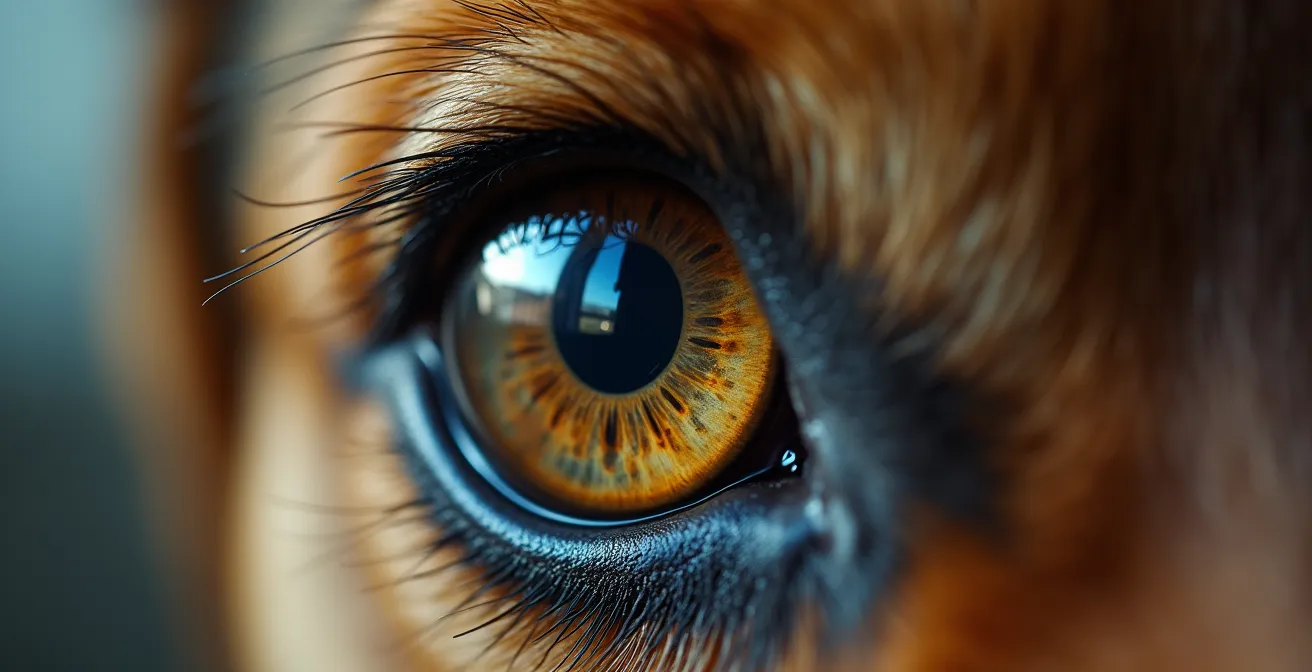
Beyond physical health, environmental deprivation is another critical area. An animal left for long hours in a sterile, empty home without enrichment is suffering. As the reflection in the eye above suggests, a barren environment is a form of neglect. This is no longer just a sad situation; it’s becoming legally actionable.
Case Study: Digital Evidence in Passive Neglect Cases
Modern animal welfare enforcement increasingly uses digital evidence to prove passive neglect. According to the ASPCA, footage from Ring doorbells, social media posts, and even GPS collar data are now admissible in court. In several recent cases, timestamped video showing dogs left alone for excessive periods or kept in barren environments has been used to demonstrate a pattern of isolation and lack of stimulation. This digital proof has been instrumental in successfully prosecuting neglect cases under the higher standards expected of a guardian, leading to loss of custody.
The rise of digital evidence means that patterns of passive neglect are easier to document and prove than ever before. For a guardian, this raises the stakes considerably. Your daily routines and the environment you provide are now under a microscope, and a failure to meet the animal’s holistic needs could have severe legal consequences.
How to audit your home environment to meet strict guardianship standards for mental health?
To avoid the pitfalls of passive neglect, a guardian must proactively assess and manage their animal’s environment. The traditional focus on basic food, water, and shelter is insufficient. The modern standard for animal welfare is the Five Domains Model, a scientific framework that goes beyond preventing negative states (like hunger or pain) to actively promoting positive ones (like pleasure and comfort). Auditing your home using this model is the most effective way to ensure you are meeting your fiduciary duty for an animal’s mental and physical health.
The model encourages a holistic view, prompting you to evaluate not just what you provide, but the animal’s experience of it. For example, under the Nutrition domain, it’s not enough to provide food. A guardian asks: Is the feeding process enriching? Are puzzle feeders used to engage the mind? Is fresh water easily accessible in multiple locations? It’s about providing choice, agency, and mental stimulation in every aspect of daily life.
As the model’s creator, Professor David Mellor, emphasized, the goal is a net positive welfare state. A quote from his research highlights this core principle: “The Five Domains Model focuses on providing positive experiences, not just avoiding negatives, which is the true essence of guardianship.” This requires a conscious effort to build an environment rich with opportunities for natural behaviors, comfort, and predictable, positive interactions.
A home audit using this framework is a practical exercise in empathy and observation. It forces you to see your home from your animal’s perspective. Here are key areas to assess based on the Five Domains:
- Nutrition: Evaluate the variety in feeding methods. Do you use puzzle toys, snuffle mats, or scatter feeding to make mealtime an engaging activity? Are there multiple, easily accessible water stations?
- Environment: Count the number of comfortable resting spots available. Does your pet have the choice of different surfaces, temperatures, and locations? Are there safe “escape routes” or high perches where they can retreat if they feel overwhelmed?
- Health: Review your preventive care schedule. Is your pet’s body condition score monitored monthly? Do you have a first-aid kit and an emergency plan?
- Behavior: Is there a rotation of enrichment items to prevent boredom? Are training sessions consistent, positive, and focused on building confidence? Does your pet have outlets for natural behaviors like digging, scratching, or foraging?
- Mental State: Assess the predictability of your routines, which helps reduce anxiety. Are interactions primarily consent-based, where you invite contact rather than forcing it? Are you actively monitoring for subtle signs of stress (lip licking, yawning, whale eye)?
By systematically reviewing these areas, you move from the passive role of an owner to the active, engaged role of a guardian, continuously striving to improve the welfare of the being in your care.
Why a video is worth more than 10 phone calls when reporting abuse?
A guardian’s duty does not end with the animals in their own home. It extends to a responsibility to act when witnessing animal cruelty or neglect. However, how you report it can be the difference between a successful intervention and a dismissed case. A phone call to authorities is often treated as “hearsay” in court—an uncorroborated report with limited legal weight. Video evidence, on the other hand, is considered ‘direct evidence’ and is profoundly more powerful in building a legal case.
A time-stamped, unedited video can establish crucial facts that a verbal report cannot. It provides objective, indisputable proof of the animal’s condition, the environment, the duration of neglect, and often, the identity of the responsible individual. This is why animal law experts and prosecutors overwhelmingly prefer video evidence.
Case Study: The Power of Video in Animal Cruelty Prosecutions
A legal analysis of animal abuse cases by the Animal Legal & Historical Center demonstrates that video evidence dramatically increases prosecution success rates. For example, a video can allow an expert to perform a body condition score remotely, establishing a clear metric of malnutrition. Timestamps can prove an animal was left without water for a specific duration, satisfying the legal definition of neglect. Unlike a phone report, a video is a silent, factual witness that is difficult to challenge in court, providing the hard evidence needed for conviction and removal of the animal from a harmful situation.
However, collecting this evidence must be done correctly to maintain its legal integrity. Any editing, narration, or commentary can render the footage inadmissible by introducing potential bias. The goal is to be an objective documentarian, not a narrator. By following proper protocol, a concerned citizen can provide law enforcement with a powerful tool to protect a vulnerable animal.
If you witness suspected abuse or neglect, following these steps can help ensure your report is effective:
- Establish Context: Begin with a wide shot of the environment before focusing on the animal.
- Verify Date and Time: If possible, capture a shot of a phone screen, a newspaper, or another timestamp indicator.
- Document the Animal: Film from multiple angles to clearly show the animal’s physical condition (e.g., visible ribs, injuries, matted fur).
- Capture the Environment: Systematically document the absence of adequate food, water, or shelter.
- Remain Silent: Do not speak or add commentary. Let the images speak for themselves.
- Establish a Pattern: If possible, record multiple incidents over time to show chronic neglect rather than a single event.
- Preserve the Evidence: Save the original, unedited file and provide it to authorities through official channels to maintain the chain of custody.
The “Punishment” Error: Why alpha rolls violate the freedom from fear?
A guardian’s commitment to an animal’s well-being extends deeply into training methodology. The methods you choose are no longer a private matter; they can be scrutinized as evidence of your fitness as a guardian. The use of aversive, punishment-based techniques—such as alpha rolls, prong collars, or shock collars—directly contradicts the fiduciary duty to protect an animal from harm, fear, and distress. This is not just an ethical opinion; it’s an emerging legal standard.
These methods are based on outdated and debunked dominance theories. Modern behavioral science understands that such techniques do not teach an animal what to do; they only create fear, anxiety, and a breakdown of trust. This directly violates one of the core tenets of animal welfare: the Freedom from Fear and Distress. Legally, using these tools can be presented as a failure to meet the accepted standard of care.
The International Association of Animal Behavior Consultants (IAABC) is one of many professional bodies that advocates for force-free training. Their position has legal implications, as their standards can be used in court to define what constitutes appropriate care.
Using techniques like alpha rolls or prong collars can be presented in a civil or criminal case as a failure to meet the ‘Freedom from Fear and Distress’, thereby breaching the standard of care expected of a ‘guardian’.
– International Association of Animal Behavior Consultants, LIMA Position Statement
The legal system is catching up to the science. The principle of LIMA (Least Intrusive, Minimally Aversive) is becoming the gold standard by which a guardian’s conduct is judged. Choosing to use punishment when positive reinforcement methods are available can be viewed as a conscious decision to cause distress.
Case Study: Legal Liability from Aversive Training Methods
Legal analysis shows that documented use of force-based training can create admissible evidence of character in custody disputes or neglect cases. Courts increasingly recognize that using punishment-based techniques contradicts a guardian’s duty to protect. Social media posts showing alpha rolls or the use of prong collars have been successfully used to question an individual’s fitness as a guardian. The LIMA principle is emerging as the legal benchmark for guardian conduct, making positive reinforcement not just a “nice” choice, but a legally defensible one.
For a guardian, this means training is a non-negotiable aspect of responsible care. Choosing a trainer who adheres to LIMA principles and positive reinforcement is not just better for your animal—it’s a crucial step in upholding your legal and ethical duties.
Key Takeaways
- The shift from “owner” to “guardian” is a legal change, not just a semantic one, imposing a higher fiduciary duty of care.
- Guardianship focuses on proactive wellness and “healthspan,” which measurably increases an animal’s life expectancy.
- Passive neglect, including lack of mental stimulation or allowing obesity, is a legally actionable failure under guardianship standards.
Are You Meeting the Five Freedoms? A Self-Audit for Modern Pet Owners
The ultimate measure of a guardian’s success is not the animal’s obedience or even its lifespan, but its overall welfare. The most widely accepted framework for assessing animal welfare is the Five Freedoms. Originally developed for livestock, they have become the universal standard for any animal under human care. They provide a comprehensive checklist for a guardian to audit their own practices and ensure they are meeting their profound responsibilities. This is the blueprint for fulfilling your fiduciary duty.
The Five Freedoms move beyond the simplistic “food, water, shelter” model and demand a more holistic approach. They are:
- Freedom from Hunger and Thirst: Providing ready access to fresh water and a diet to maintain full health and vigor.
- Freedom from Discomfort: Providing an appropriate environment including shelter and a comfortable resting area.
- Freedom from Pain, Injury, or Disease: Ensuring prevention or rapid diagnosis and treatment.
- Freedom to Express Normal Behavior: Providing sufficient space, proper facilities, and company of the animal’s own kind.
- Freedom from Fear and Distress: Ensuring conditions and treatment which avoid mental suffering.
A guardian doesn’t just meet these freedoms; they strive to excel within them. For example, “Freedom from Discomfort” isn’t just a roof over their head; it’s providing multiple bedding options, temperature choices, and safe spaces. “Freedom to Express Normal Behavior” isn’t just a walk in the park; it’s providing outlets for species-specific behaviors like digging, scent work, or climbing. It requires a deep understanding of the animal as a species and as an individual.
This higher level of care has financial implications. Proactive wellness, premium nutrition, and environmental enrichment cost more than basic maintenance. A guardian accepts this as part of their responsibility.
This commitment to a higher standard of care naturally involves greater financial investment, a key differentiator between the minimalist approach of ownership and the comprehensive responsibility of guardianship. A cost analysis from veterinary sources highlights this reality.
| Care Level | Annual Cost Range | Key Components |
|---|---|---|
| Minimum Legal (Owner) | $1,000-$2,000 | Basic food, annual vet visit, rabies vaccine |
| Standard Care | $2,500-$4,000 | Quality nutrition, bi-annual checkups, preventives |
| Proactive Wellness (Guardian) | $4,000-$7,000+ | Premium diet, quarterly wellness, insurance, enrichment budget |
Ultimately, the Five Freedoms provide a powerful ethical and practical compass. Regularly auditing your own practices against this framework is the hallmark of a true guardian. It is a continuous process of learning, observing, and adapting to better serve the complex needs of the sentient being you have taken into your care.
Embracing the role of a guardian is a profound commitment. It requires continuous education, proactive investment, and a legal and ethical framework centered on the animal’s best interests. To put these principles into practice, the first step is to evaluate your current care routines against the highest standards of animal welfare.