
The safest and most economical pet products are rarely the most heavily marketed; true value lies in material integrity and behavioral impact, not flashy features.
- Most “upgraded” pet products introduce unnecessary failure points or create behavioral problems.
- Simple, single-material items like stainless steel bowls and fixed nylon leashes consistently outperform complex, multi-material gadgets.
Recommendation: Before any purchase, ask: “What is the simplest, most durable solution to this problem?” This minimalist mindset will save you money and prevent future headaches.
Walking into a pet store for the first time can feel like a financial ambush. Aisles overflow with “must-have” gadgets, designer toys, and high-tech accessories, all backed by the persuasive force of a hundred-billion-dollar industry. The standard advice is to grab a bowl, a collar, a leash, and some toys. But this checklist approach is where new owners make their most expensive and sometimes dangerous mistakes. The critical question isn’t *what* to buy, but *which specific type* to choose within each category.
Most pet gear is designed to appeal to the human buyer, not to serve the animal’s fundamental needs. The market is saturated with products that solve non-existent problems or, worse, create new ones—from behavioral issues to serious injuries. This guide rejects the marketing fluff. We will not give you a shopping list. Instead, we will arm you with a minimalist, function-first mindset. By dissecting the most common gear choices, we’ll reveal the simple, often cheaper, options that are vastly superior in terms of safety, durability, and your pet’s well-being.
This article provides a detailed breakdown of the critical decisions you’ll face when selecting core pet accessories. By understanding the functional differences in materials and design, you can confidently choose equipment that serves its purpose effectively for years, rather than falling into a cycle of costly replacements and vet visits.
Table of Contents: A Deep Dive into Essential Pet Gear Decisions
- Why stainless steel bowls prevent chin acne better than plastic or ceramic?
- QR Code vs Engraved Tags: Which gets your lost dog home faster?
- Retractable Leash vs 6-Foot Nylon: Why flexi-leads cause more injuries?
- The Laser Pointer Trap: Why it causes obsession in dogs (but not cats)?
- When to replace a collar: The buckle wear signs 90% of owners miss
- Kong vs Nylabone: Which holds up to a Power Chewer without cracking teeth?
- Carpet vs Sisal Rope: Which texture encourages scratching over the sofa?
- Hiking with Dogs: Which Pet Gear Survives Rough Terrain and Water Exposure?
Why stainless steel bowls prevent chin acne better than plastic or ceramic?
The food bowl seems like the simplest purchase, yet it’s a prime example of how material choice directly impacts your pet’s health. Plastic bowls, often sold in bright colors and fun shapes, are a poor long-term investment. Plastic is a soft material that quickly develops microscopic scratches and grooves. These tiny imperfections become breeding grounds for bacteria, trapping food particles and saliva. For cats especially, this can lead to a persistent and uncomfortable condition known as feline acne, which appears as blackheads or pimples on their chin.
Ceramic bowls can be a better option, but only if they are made with high-quality, lead-free glaze. Cheaply made ceramic can chip, exposing porous earthenware underneath, or the glaze itself can contain harmful substances. The single best choice from a functional, minimalist perspective is stainless steel. It is non-porous, meaning it won’t harbor bacteria. It’s also incredibly durable, resistant to scratches and cracks, and easy to sanitize completely in a dishwasher.
According to veterinary recommendations, stainless steel is a superior choice for pets with skin sensitivities like chin acne because it is inert and does not trigger an immune reaction. While a plastic bowl might be cheaper initially, investing in a set of stainless steel bowls is a classic “buy it once” decision that prevents future skin issues and the need for replacement.
QR Code vs Engraved Tags: Which gets your lost dog home faster?
An ID tag is a non-negotiable piece of safety equipment. With the American Humane Association estimating that almost 10 million pets are lost each year, ensuring your contact information is accessible is vital. The modern debate pits the high-tech QR code tag against the traditional engraved tag. While QR tags seem advanced, they introduce critical failure points in a rescue scenario. They require the finder to have a smartphone, internet service, and the willingness to scan the tag and navigate a website.
A simple, deeply engraved metal tag has no technological barrier. Anyone who finds your pet can read your name and phone number instantly, day or night, with or without cell service. The goal in a lost-pet situation is to reduce friction for the finder. The fewer steps they have to take, the higher the chance of a quick, direct call to you. A QR code adds multiple steps and potential points of failure to this process.
The most effective strategy combines the best of both worlds, but if you must choose only one due to budget, the simple engraved tag is the most reliable. The table below breaks down the pros and cons of each system, making it clear why redundancy is the safest approach.
| Feature | Engraved Tags | QR Code Tags |
|---|---|---|
| Information Capacity | Limited (name & 1-2 phone numbers) | Unlimited (full profile, multiple contacts) |
| Technology Required | None | Smartphone with internet |
| Updatable | No – requires new tag | Yes – update online anytime |
| Finder Accessibility | Universal – anyone can read | Limited to smartphone users |
| Works Without Service | Yes | No – needs cellular/wifi |
| Recommended Strategy | Use both: engraved for immediate contact + QR for detailed backup | |
Retractable Leash vs 6-Foot Nylon: Why flexi-leads cause more injuries?
Retractable leashes are marketed with a promise of freedom for your dog. In reality, they are a significant safety liability for the dog, the owner, and the public. The core problem is the near-total lack of control. A dog at the end of a 15- or 20-foot thin cord can easily run into traffic, have an unwelcome encounter with another dog, or ingest something dangerous before you can react. The locking mechanism can fail, and the bulky plastic handle encourages a weak, insecure grip.
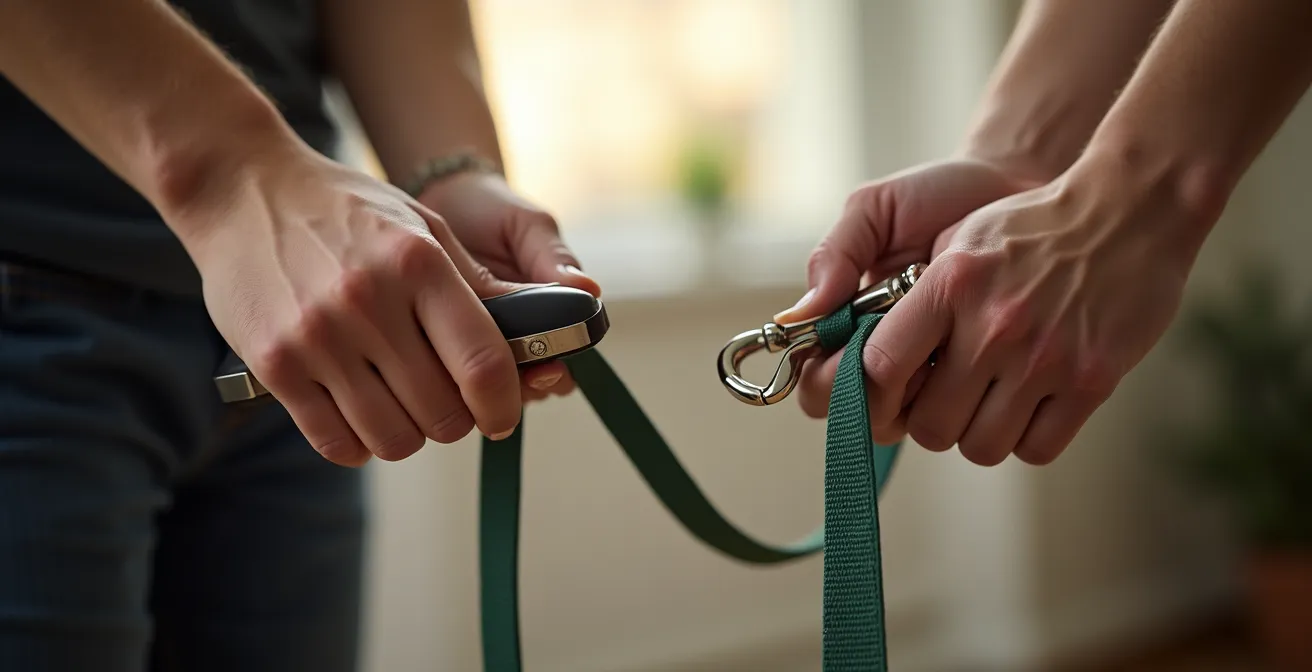
The thin cord of a retractable leash can cause severe injuries. A study looking at data over several years found 356,746 injuries from dog leashes treated at US emergency departments, with many linked to the specific dangers of retractable models. These leashes are notorious for causing:
- Severe burns and lacerations when the cord wraps around skin
- Finger amputations if a person gets tangled in the cord
- Serious falls for the owner when the dog makes a sudden bolt
- Eye and facial injuries when the clasp breaks and snaps back
A simple, 6-foot nylon or leather leash is the superior tool for almost every situation. It provides clear, constant communication between you and your dog, keeps them at a safe distance, and is virtually foolproof. It has no complex mechanical parts that can break. It is a simple, durable, and safe tool that fosters better walking habits and control.
The Laser Pointer Trap: Why it causes obsession in dogs (but not cats)?
The laser pointer seems like a perfect toy: cheap, easy, and it gets your pet moving. However, for dogs, it’s a psychological trap. The behavior it triggers is rooted in the canine prey sequence: Search -> Stalk -> Chase -> Bite/Kill. A laser pointer allows the dog to search, stalk, and chase, but they can never complete the sequence with a physical catch. This perpetual lack of resolution can be intensely frustrating, especially for terriers and herding breeds with a high prey drive.
This frustration often manifests as obsessive-compulsive behaviors. According to behaviorists, the inability to ‘catch’ the laser can lead to dogs frantically chasing shadows, reflections, and lights even when the toy isn’t present, a condition known as laser pointer syndrome. Cats, on the other hand, have a slightly different prey sequence and are generally less prone to this obsession, though it’s still not an ideal form of play. They are more satisfied by the ‘stalk and pounce’ part of the hunt, and the lack of a catch is less psychologically damaging.
Instead of creating a cycle of frustration, provide toys that allow your dog to complete their natural behavioral sequence. These are far more satisfying and mentally healthy. Biologically fulfilling alternatives include:
- Using a flirt pole, which allows for both chase and a satisfying physical catch.
- Providing puzzle toys that encourage “disemboweling” to get a food reward.
- Engaging in scent work games that stimulate the mind without the frustration.
- Playing with tug toys that satisfy the “bite and kill” portion of the prey drive.
When to replace a collar: The buckle wear signs 90% of owners miss
A collar is your pet’s most important piece of identification-carrying equipment, but it is also a common point of failure. A broken collar can lead to a lost pet. Most owners replace a collar only when it looks dirty or frayed, but the real danger lies in the invisible wear and tear on its hardware—the buckle and D-ring where the leash attaches. These components are under constant stress.
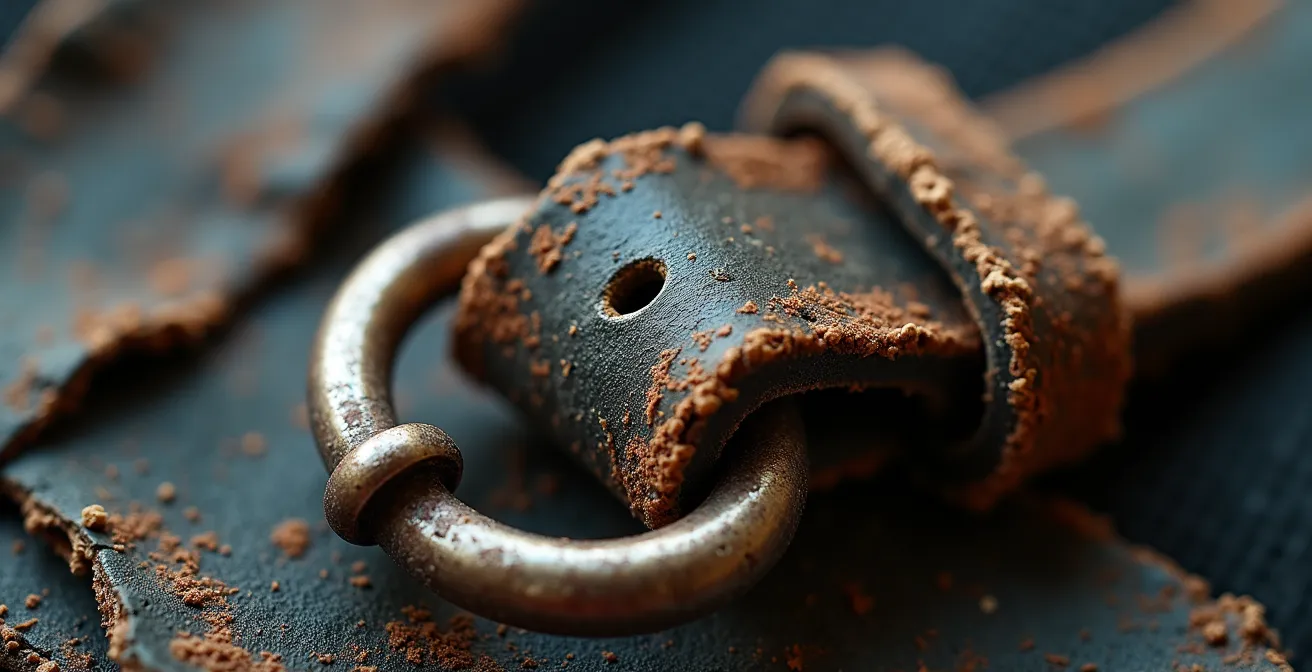
Plastic side-release buckles are particularly susceptible to degradation. UV light from the sun makes them brittle over time. They can develop microscopic stress cracks in the prongs that are invisible to the naked eye but can cause the buckle to shatter under sudden pressure. Metal D-rings can rust, develop sharp edges, or become deformed from repeated leash clipping. Regular inspection is not optional; it’s a critical safety habit.
Different materials wear out in different ways, and knowing what to look for is essential for preventing a catastrophic failure. This guide provides a clear reference for what constitutes a critical wear sign, prompting immediate replacement.
| Material | Critical Wear Signs | Check Frequency | Average Lifespan |
|---|---|---|---|
| Leather | Dryness, cracking, thinning at holes | Monthly | 2-3 years |
| Nylon | UV fading, brittleness, stitch rot | Monthly | 1-2 years |
| Biothane | Deep nicks compromising core webbing | Monthly | 3-5 years |
| Plastic Buckles | Microscopic cracks in prongs, whitening | Weekly | 6-12 months |
| Metal D-Rings | Rust, deformation, sharp edges | Monthly | 2-4 years |
Kong vs Nylabone: Which holds up to a Power Chewer without cracking teeth?
In the world of “indestructible” chew toys, KONG and Nylabone are giants. However, they serve fundamentally different purposes and carry different safety profiles. Misunderstanding this difference can lead to expensive dental damage. Many hard plastic toys, including some Nylabone products, are too rigid for a dog’s teeth. A powerful chewer can easily suffer a slab fracture—a painful and costly injury where a piece of the tooth shears off.
Veterinary dentists advocate for a simple, practical safety check called the “thumbnail test.” As explained by pet health experts, if you cannot make a small dent in a toy with your thumbnail, it is too hard and poses a risk to your dog’s teeth. The classic rubber KONG passes this test; its flexible material gives under pressure. Many hard Nylabone models fail it.
The choice between these toys should be based on your dog’s needs, not just a quest for durability. As one expert puts it, the distinction is crucial for meeting behavioral needs.
KONG is a food puzzle toy designed for mental enrichment and foraging needs, while Nylabone serves as a pacifier for repetitive gnawing. Understanding this fundamental difference helps owners match the right toy to their dog’s specific behavioral needs rather than just durability concerns.
– Dr. Andrew Jones, DVM, Veterinary Secrets YouTube Channel
A KONG is an interactive puzzle meant to be stuffed with food to provide mental stimulation. A Nylabone is designed for recreational gnawing. If you have a power chewer, choose a toy that passes the thumbnail test to prevent a dental emergency. For enrichment, a KONG is the superior and safer choice.
Carpet vs Sisal Rope: Which texture encourages scratching over the sofa?
Providing an appropriate scratching surface is essential for a cat’s physical and mental health. It allows them to stretch, shed the outer layer of their claws, and mark their territory. But many commercially available scratching posts are covered in carpet, which is a critical design flaw. Cats are not always able to distinguish between the “good” carpet on the post and the “bad” carpet on your floor or sofa.
This creates a texture preference problem. By encouraging your cat to scratch on carpet, you may inadvertently be training them to view all similar textures as acceptable. Sisal rope is a far better material. Its coarse, fibrous texture closely mimics the tree bark that cats would naturally use to scratch. This creates a clear tactile distinction between the scratching post and your household furniture, making it easier to redirect unwanted scratching.
However, texture is not the only factor. A perfect sisal post that is wobbly or too short is useless. To be effective, a scratching post must meet several key criteria:
- Stability: The post must have a heavy, wide base that will not tip over. A wobbly post is frightening and will be ignored.
- Height: It must be tall enough for your cat to stand on its hind legs and get a full vertical stretch.
- Placement: It should be located in a socially significant area of your home where the cat spends time, not hidden away in a corner.
- Quantity: In multi-cat households, you should have at least one post per cat, plus one extra, to prevent competition.
Choosing a tall, stable, sisal-covered post and placing it in a prominent location is a far better investment than any number of carpeted, wobbly, or poorly placed alternatives.
Key Takeaways
- Material Integrity Over Aesthetics: Simple, non-porous materials like stainless steel and Biothane prevent health and safety issues, outlasting cheaper, more porous options.
- Behavioral Alignment: The best gear works with your pet’s natural instincts (sisal for scratching, flirt poles for prey drive), while poor choices can create new problems (laser pointer obsession).
- Proactive Failure Point Inspection: Regularly checking stress points on collars, leashes, and toys is a non-negotiable habit that prevents catastrophic failures.
Hiking with Dogs: Which Pet Gear Survives Rough Terrain and Water Exposure?
Taking your dog on outdoor adventures requires gear that can withstand more than just daily use. When you’re on a trail, equipment failure is not just an inconvenience—it can be a serious safety issue. The two materials that dominate the hiking gear space are nylon and Biothane, and for rough conditions, one is clearly superior. While nylon is a decent all-around material, it has a significant weakness: it absorbs water. A wet nylon leash or collar becomes weaker, heavier, and prone to developing mildew and odors.
Biothane, a PVC-coated webbing, is the ideal material for outdoor use. It is completely waterproof and non-porous. It won’t stretch or weaken when wet, it doesn’t absorb odors, and it can be cleaned easily with just a wipe. It remains flexible in cold weather and is highly resistant to abrasion from rocks and brush. Its durability and low-maintenance nature make it the perfect minimalist choice for hiking gear, ensuring reliability when you’re far from home.
Beyond the leash and collar, being prepared for the trail means having a few key items specifically for your dog. A human first-aid kit won’t have what you need for a paw injury, and a sudden change in weather can be dangerous without the right preparation.
Your Action Plan: The Essential Dog Hiking Gear Checklist
- Assess Core Gear: Check your dog’s collar, harness, and leash. Is the material (like Biothane) waterproof and durable? Are all buckles and D-rings free of rust and cracks?
- Assemble a Canine First-Aid Kit: Go beyond human supplies. Your kit must include paw-sized bandages, antiseptic wipes, and tools for tick removal.
- Pack for Hydration and Nutrition: Bring a collapsible silicone bowl and more water than you think you’ll need. Pack high-energy snacks for your dog.
- Prepare for Terrain and Visibility: Evaluate the trail conditions. Do you need protective booties for sharp rocks or hot ground? Pack a high-visibility vest or LED collar for low-light conditions.
- Plan for Contingencies: Always carry a backup slip lead in case your primary leash or collar fails, and ensure you have durable, pack-out waste bags.
Ultimately, equipping your pet responsibly is about adopting a minimalist and critical mindset. By questioning the marketing and focusing on function, safety, and durability, you can bypass the expensive, unnecessary products and build a collection of gear that truly serves you and your animal for years to come. Apply this practical, frugal approach to every purchase decision you make for your pet.