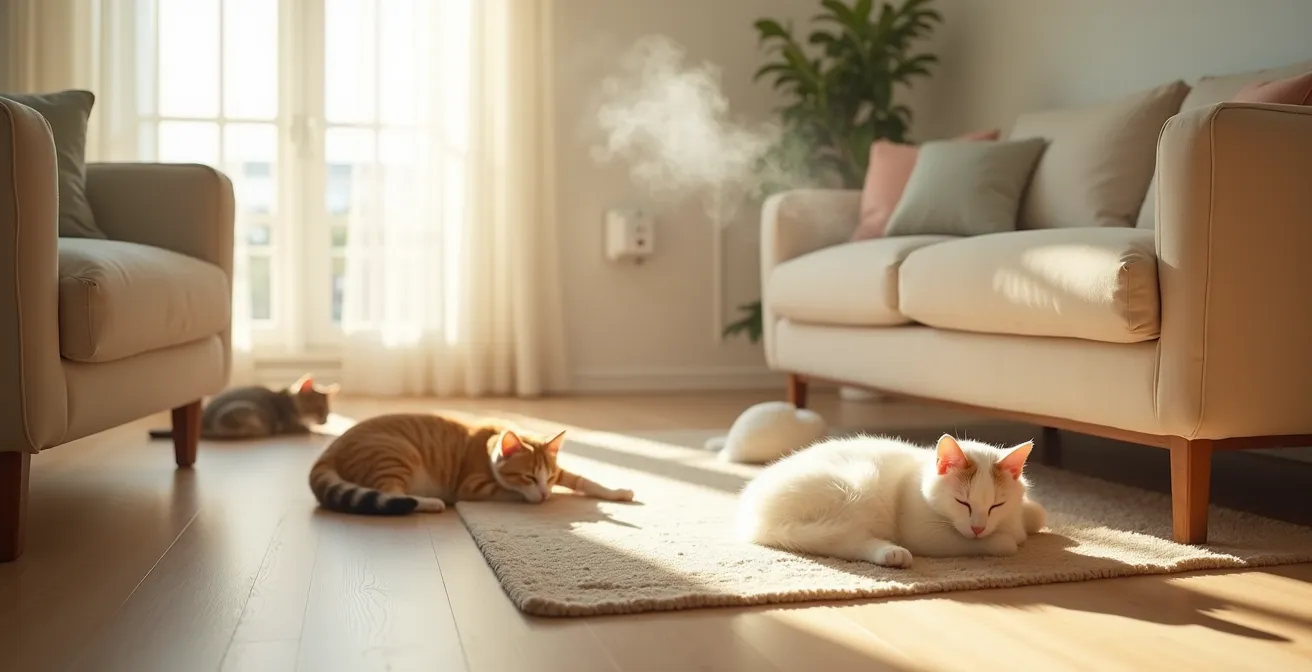
Contrary to popular belief, synthetic pheromone diffusers are not a passive ‘magic fix’ for cat conflict; their effectiveness hinges entirely on being used as a tool to support active behavior modification.
- Pheromones work by altering a cat’s perception of its environment, creating a temporary “window of opportunity” where the animal is more receptive to positive training.
- Their failure is almost always due to a ‘plug-and-play’ expectation, ignoring the need for concurrent environmental management and structured behavioral plans.
Recommendation: Use pheromone diffusers not as a solution, but as environmental scaffolding to make your counter-conditioning and desensitization efforts more effective.
The sound of cats fighting is one of the most stressful experiences for any multi-cat household owner. It’s a chaotic blend of hissing, growling, and flying fur that leaves everyone on edge. In the search for peace, many cat owners are led to a seemingly simple solution: the synthetic pheromone diffuser. The promise is alluring—a simple plug-in that emits “calming signals” to magically resolve tension, stop urine marking, and end the conflict. These products are marketed as an effortless answer to a complex behavioral problem, and their popularity has soared.
But as a veterinary behaviorist, my perspective is one of skeptical inquiry. The market is saturated with claims that often outpace the scientific evidence. While the concept of using olfactory communication is sound, the idea that a diffuser alone can resolve deep-seated territorial or social anxiety is a significant oversimplification. The real question isn’t just “do they work?” but rather, “what is their actual role in a comprehensive behavior plan?” Too often, these devices are purchased with the hope of being a cure, when they are, at best, a single tool in a much larger toolbox.
This article will dissect the claims versus the reality. We will explore the specific mechanisms of different pheromones, the critical importance of correct placement, and how they stack up against other aids. Most importantly, we will dismantle the “magic plug-in” myth and reveal why these products are bound to fail without the crucial, non-negotiable component of active behavior modification. The goal is to shift your perspective from seeking a passive cure to strategically using pheromones to create a window of opportunity for real, lasting change.
To fully understand their application, this guide breaks down the science, the strategy, and the common pitfalls of using pheromone diffusers. The following sections will provide a clear roadmap for integrating these tools correctly and realistically.
Contents: Do Pheromone Diffusers Truly Resolve Cat Conflict?
- Why facial pheromones make a carrier feel safe during travel?
- How to position a diffuser in the room for maximum airflow and effect?
- Pheromones vs CBD: Which is more effective for situational noise anxiety?
- The “Magic Plug-In” Trap: Why pheromones fail without behavior modification
- When to plug in the diffuser before a new baby arrives?
- Thundershirt vs Calming Cap: Which reduces visual stimuli effectively?
- How to train your cat to accept handling before the vet visit without scratches?
- How Your Home’s Lighting and Sound Environment Is Secretly Stressing Your Sensitive Pet?
Why facial pheromones make a carrier feel safe during travel?
To understand the potential of pheromones, we must first look at a specific, well-studied application: the feline facial pheromone (F3 fraction). When a cat feels safe and comfortable, it rubs its face on objects, depositing this pheromone to mark the area as “known” and secure. A synthetic version of F3 is designed to create this same sense of familiarity in a new or stressful environment, such as a travel carrier. By applying it, we are essentially pre-writing an olfactory narrative of safety before the cat even enters the space. It’s a message that says, “This place is secure; you’ve been here before.”
The evidence for this specific use is more robust than for general multi-cat conflict. For instance, a 2024 study in Frontiers in Veterinary Science noted a significant reduction in stress-related behaviors like scratching over time when F3 diffusers were used. This suggests that the pheromone helps change the cat’s perception of its environment from threatening to benign. However, this effect is not instantaneous. The pheromone doesn’t sedate the cat; it creates a foundation of calm that makes positive association training far more effective.
Simply spraying a carrier and forcing a cat inside is a recipe for failure. The pheromone must be part of a larger desensitization protocol. The goal is to change the carrier from a symbol of impending doom into a comfortable, voluntary resting spot. The F3 pheromone acts as a catalyst in this process. Here is a practical protocol:
- Step 1: Place the carrier in a quiet room 4 weeks before travel.
- Step 2: Spray the pheromone inside the carrier 10-15 minutes before allowing the cat to approach it.
- Step 3: Allow the cat to explore the carrier freely with the door open daily.
- Step 4: Place high-value treats and familiar, soft bedding inside to build strong positive associations.
- Step 5: Gradually begin closing the door for a few seconds at a time, only while the cat is completely calm, and reward heavily upon opening it.
How to position a diffuser in the room for maximum airflow and effect?
When dealing with multi-cat conflict, the product typically used is a synthetic feline appeasing pheromone, which mimics the pheromone a mother cat produces to promote harmony among her kittens. Unlike the targeted use of a facial pheromone spray in a carrier, a diffuser is meant to manage the ambient environment of an entire room. Its efficacy is therefore highly dependent on physics: specifically, airflow and dispersal. Plugging a diffuser behind a sofa, under a curtain, or in an outlet with no overhead space is equivalent to not using one at all.
The diffuser works by gently heating the pheromone-infused liquid, which then rises with natural air convection currents and spreads throughout the space. To work effectively, it requires an unobstructed path. The manufacturer Feliway, for example, recommends plugging the diffuser into an outlet with at least 4 feet (1.2m) of clear space above it. This allows the warm, pheromone-laden air to rise and circulate without being blocked or redirected. It should be placed in the room where the cats spend the most time or where conflict most often occurs, but never in a hallway or near a litter box, as cats may develop an aversion.
Understanding the proper placement is key to giving the product a fair chance to work. The goal is to create a consistent, low-level “cloud” of the appeasing message. Can you use too many? It’s less about the number and more about strategic coverage. A large home with multiple conflict zones may require more than one diffuser placed in key social areas to create an effective environmental scaffolding that supports peace.
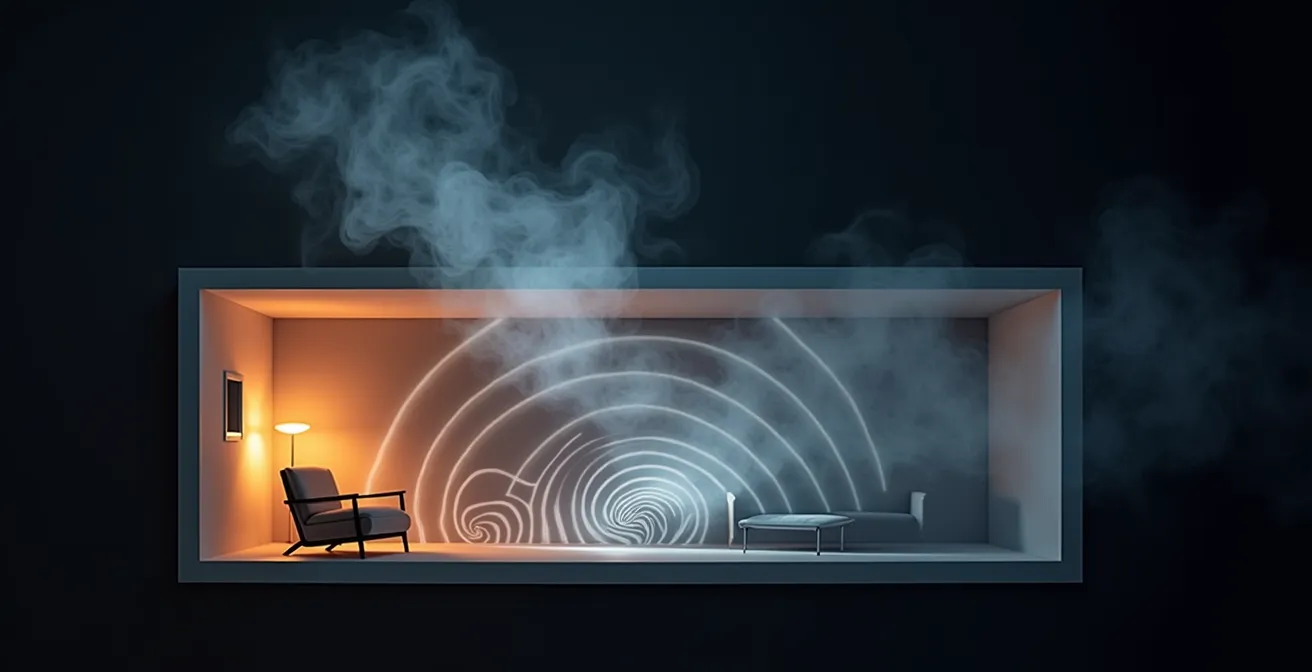
As this visualization demonstrates, the warm air rises and spreads. Placing it on an open wall ensures these convection currents can carry the pheromone throughout the room, reaching doorways and high-traffic areas where tensions often flare. Poor placement wastes the product and leads to the conclusion that “it doesn’t work,” when in fact, it was never given a chance to perform.
Pheromones vs CBD: Which is more effective for situational noise anxiety?
When managing feline anxiety, owners are often presented with a growing array of options, with pheromones and CBD being two of the most popular. However, they are not interchangeable. From a behaviorist’s perspective, they are different tools for different jobs because they work through fundamentally different mechanisms. Pheromones are a form of external, environmental communication; they work by changing the cat’s perception of the safety of its space. CBD (cannabidiol), on the other hand, works internally by interacting with the body’s endocannabinoid system to modulate physiological responses to stress.
This difference is critical when choosing a tool for a specific problem like situational noise anxiety (e.g., fireworks, thunderstorms). Pheromones are designed for continuous, background support. They take days or even weeks to build up an effective environmental concentration and are best suited for managing generalized, ongoing stress like territorial insecurity in a multi-cat home. For a sudden, acute event like a fireworks display, their slow onset makes them a poor primary choice. CBD, with an onset of 30-60 minutes, is far better suited for “in-the-moment” relief. It directly addresses the physiological panic response.
The choice is not about which is “better” but which is appropriate for the context. Attempting to use a pheromone diffuser to instantly calm a cat during a thunderstorm is a misuse of the tool and will inevitably lead to disappointment. A comparative analysis highlights their distinct roles.
This table breaks down the key differences to help guide an informed decision, with data synthesized from guidelines provided by veterinary professionals.
| Factor | Pheromones | CBD |
|---|---|---|
| Mechanism | External/Environmental – Changes perception of space | Internal/Physiological – Affects endocannabinoid system |
| Onset Time | Days to build up effectiveness | 30-60 minutes |
| Duration | Continuous 24/7 background support | 4-6 hours per dose |
| Best For | General anxiety, territorial stress | Acute events (fireworks, vet visits) |
| Safety | No known side effects, safe for all ages | Requires vet consultation for dosing and safety |
The “Magic Plug-In” Trap: Why pheromones fail without behavior modification
Here we arrive at the central thesis of this entire discussion and the single biggest reason owners report that “pheromone diffusers don’t work.” The trap is believing the product is an active solution when it is, in fact, a passive facilitator. A diffuser does not teach a cat not to be aggressive, nor does it resolve the underlying cause of conflict. What it *can* do is lower the general level of ambient stress just enough to create a “window of opportunity” for effective behavior modification to take hold.
Imagine two cats whose relationship is so strained that they are constantly on high alert. Their stress levels are so high that they cannot learn. Any attempt at a positive interaction—like rewarding them for being calm in the same room—is doomed to fail because their fight-or-flight response is already triggered. A pheromone diffuser, correctly placed and given time to work (typically 2-4 weeks), can subtly lower that baseline anxiety. It’s not a cure, but it can make the cats less reactive and more receptive to training. This is the window of opportunity: the state in which learning becomes possible again.
If you plug in the diffuser and do nothing else, you are wasting this window. The real work involves structured, proactive techniques like desensitization and counter-conditioning. This means re-introducing the cats slowly, creating positive associations with each other’s presence using high-value treats, and carefully managing the environment to prevent conflict. The pheromone is the behavioral adjunct that makes this work easier, but it can never replace the work itself.
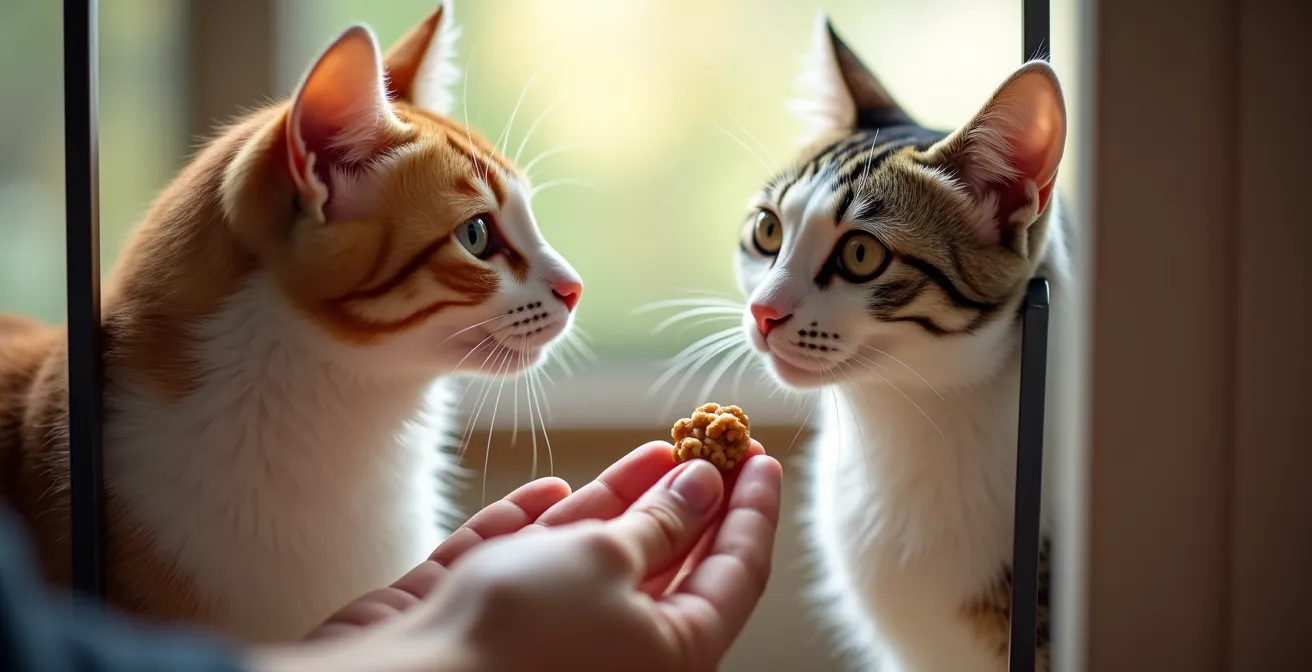
This image perfectly captures the concept. The pheromone isn’t solving the problem; it’s creating the calm atmosphere in which the owner can effectively implement a behavioral plan, such as a structured introduction across a barrier. Without the owner’s active participation, the cats will remain in their cycle of conflict, and the diffuser will be wrongly blamed for the failure.
When to plug in the diffuser before a new baby arrives?
The arrival of a new baby is a massive disruption to a cat’s predictable world. It introduces a flood of new sounds, smells, and a complete upheaval of routine. For a cat, this isn’t a joyful event; it’s a significant environmental stressor that can trigger anxiety and conflict. Using a pheromone diffuser proactively in this scenario is an excellent example of using the tool correctly—as part of a gradual preparation plan, not a reactive fix after problems start.
The key is to start long before the baby comes home. The goal is to establish a baseline of calm and then slowly associate the new stimuli with that calm state. Plugging in the diffuser the day the baby arrives is far too late. The cat will already be overwhelmed, and the pheromone’s subtle influence will be drowned out by the sensory overload. Instead, a phased approach is required to build a bridge between the “before” and “after.”
This is not just about the pheromone itself, but about using the window of opportunity it creates to introduce the new sights, sounds, and smells of a baby in a controlled, positive way. The timeline should be methodical, giving the cat ample time to adjust at each stage. The diffuser acts as the consistent, calming background music to this entire process of desensitization.
Here is a recommended timeline for integrating a pheromone diffuser before a baby’s arrival:
- 4 weeks before due date: Plug in the appeasing pheromone diffuser in the main living areas where the cat spends most of its time. This establishes the new, calmer olfactory baseline.
- 3 weeks before: Begin playing recordings of baby sounds (crying, gurgling) at a very low volume for short periods, gradually increasing the volume and duration as long as the cat remains calm.
- 2 weeks before: Set up the nursery furniture (crib, changing table). Allow the cat to explore these new items while the diffuser is running, creating a neutral or positive association.
- 1 week before: Start applying baby lotion or powder to your hands before interacting with the cat, or place a baby-scented blanket near the diffuser to create a scent association.
- Day of arrival and beyond: Maintain the diffuser continuously, especially in common areas. Continue using it for at least one month after the baby is home to support the cat through the adjustment period.
Thundershirt vs Calming Cap: Which reduces visual stimuli effectively?
While pheromones manage the olfactory environment, other tools focus on different sensory inputs. The Thundershirt and the Calming Cap are two such examples, but they address anxiety in very different ways. A Thundershirt applies gentle, constant pressure to the cat’s torso. This technique, known as deep pressure therapy, can have a calming effect on the nervous system, similar to swaddling an infant. It primarily targets the sense of touch (proprioception) and is useful for generalized anxiety or fear of loud noises.
The Calming Cap, on the other hand, is designed to directly reduce visual stimuli. It’s a fabric hood that covers the cat’s eyes with a sheer material, reducing what the cat can see without blocking vision entirely. This is particularly useful for cats that become over-stimulated or aggressive during specific events like car rides or vet visits, where the rapid movement of visual information is a primary trigger. By filtering the visual input, it can prevent the cat from reaching a state of over-arousal.
However, from a behavioral standpoint, there is a critical trade-off to consider when using a tool like the Calming Cap. As noted in observations by veterinary professionals, when one sense is dampened, an animal may experience sensory compensation, heightening its reliance on other senses. A cat wearing a Calming Cap might become more sensitive and reactive to sounds or smells. This is a crucial consideration. If you block the visual triggers for a cat that is also sound-sensitive, you may inadvertently make the auditory environment more stressful. The choice between these tools, therefore, depends on a careful assessment of the individual cat’s primary triggers. One is not universally better than the other; their effectiveness is entirely dependent on the specific context and the cat’s unique sensory profile.
How to train your cat to accept handling before the vet visit without scratches?
The fear of being handled, poked, and prodded is a primary driver of vet-visit anxiety. This is a learned response, often stemming from past negative experiences. The solution lies not in sedation or restraint, but in proactively teaching the cat that handling is a predictable and rewarding experience. This is a classic application of desensitization and counter-conditioning, and it is a skill every cat owner should cultivate, completely independent of any calming product.
The core principle is to break down the vet exam into tiny, manageable pieces and associate each piece with something highly positive. This is sometimes called the “Body Part Buffet.” You are not conducting an exam; you are briefly “touching” a body part and then immediately delivering a high-value reward (like a lickable treat or a piece of chicken). The touch must be so brief that the cat does not have time to react negatively. Over many sessions, you gradually increase the duration and intensity of the handling, always staying below the cat’s stress threshold.
For cats with significant handling anxiety, a pheromone spray can be a useful behavioral adjunct. In her expert guide, veterinary behaviorist Dr. Valarie Tynes offers a precise protocol:
Apply the spray to a blanket, bandana or even your own clothing about 10 minutes before you introduce the cat to the carrier or in the car. After administration, the pheromone will be present for approximately four hours.
– Dr. Valarie Tynes, DVM, PetMD Expert Guide on Calming Pheromones
This creates a calmer baseline, making the cat more amenable to the training session. The following is a sample protocol for handling desensitization:
- Days 1-3: Gently touch one paw for one second, then immediately provide a high-value treat. Repeat 3-5 times in a session.
- Days 4-6: Gently lift the cat’s lip to see its teeth for one second, then immediately reward.
- Days 7-9: Briefly look inside one ear, then reward generously.
- Days 10-12: Gently hold and extend one leg for a moment, then reward.
- Days 13-15: Place the cat on a specific “exam towel” on a table for 5 seconds, and provide a jackpot reward (multiple treats).
- Day 16+: Start combining two movements in a quick, mock exam sequence, always ending on a positive note with a reward.
Key Takeaways
- Synthetic pheromones are behavioral adjuncts, not solutions. Their primary function is to create a “window of opportunity” where behavior modification is more likely to succeed.
- The effectiveness of diffusers is highly dependent on correct placement to ensure proper airflow and dispersal, following manufacturer guidelines for clearance.
- Pheromones will fail if used with the expectation of a “magic plug-in” fix. Success is entirely contingent on concurrent, active training and environmental management by the owner.
How Your Home’s Lighting and Sound Environment Is Secretly Stressing Your Sensitive Pet?
In our quest to manage inter-cat conflict, we often focus on the visible interactions between the cats themselves. However, a cat’s world is a rich sensory landscape, and we may be inadvertently creating a stressful environment through sources we barely notice. A cat’s hearing and vision are far more acute than ours. High-frequency sounds from electronics and subtle flickering from modern lighting can create a constant, low-level sensory load that contributes to chronic anxiety and irritability, making conflict more likely.
Many modern homes are filled with ultrasonic pest repellers, “smart” devices, and security systems that emit frequencies well outside the range of human hearing but squarely within a cat’s. To a sensitive cat, this can be the equivalent of a constant, high-pitched whine. Similarly, LED and fluorescent lights can have a flicker rate that is imperceptible to us but visible and jarring to a cat, creating a disorienting “strobe” effect. Even reflective surfaces like glass tables or polished floors can create sudden flashes of light that startle and stress an anxious animal.
Addressing these hidden stressors is a critical and often-overlooked aspect of environmental management. It requires us to become sensory detectives in our own homes, looking and listening from our cat’s perspective. Using a pheromone diffuser to calm a cat that is being constantly bombarded by ultrasonic noise is like offering a pillow to someone trying to sleep at a rock concert. It’s a well-intentioned but ultimately futile gesture. A truly holistic approach requires identifying and mitigating these invisible environmental triggers first.
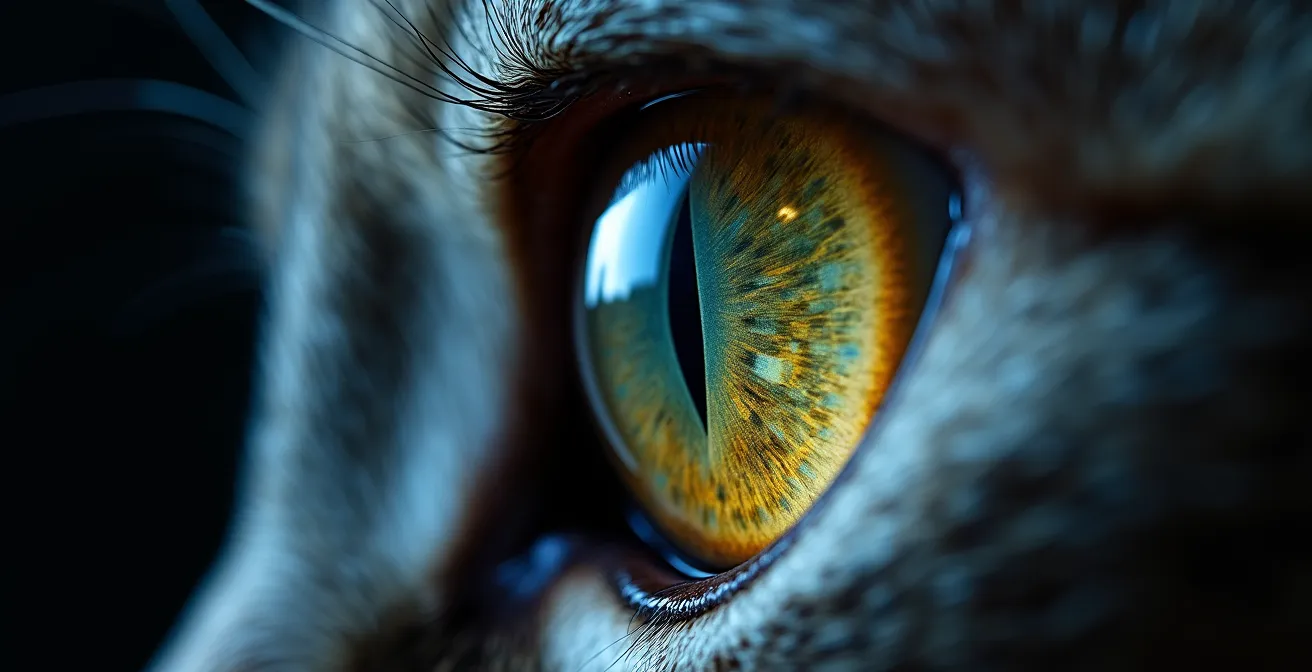
This powerful image of a cat’s eye reflecting various light sources serves as a metaphor for their sensitive world. Before investing heavily in behavioral products, conducting a sensory audit of your home can yield significant results by simply reducing the overall sensory burden on your pets. This checklist can help you identify potential sources of hidden stress.
Action Plan: Your Home Sensory Audit Checklist
- Audit Lighting: Use your smartphone’s slow-motion video function to record LED and fluorescent bulbs. Visible banding or strobing on the screen indicates a flicker that your cat can likely see.
- Identify Ultrasonics: Take inventory of all electronic devices, especially pest repellers, some air purifiers, and smart home hubs, which may emit high-frequency sounds. Research their specifications or consider unplugging them temporarily to observe for changes in your cat’s behavior.
- Map Light Reflections: During a sunny day, walk through your home and note where mirrors, glass surfaces, or even shiny metal appliances create sudden, startling flashes of light. Consider using window films or moving objects to reduce glare.
- Log Sudden Noises: List all appliances that make sudden, sharp sounds, such as ice makers, HVAC systems kicking on, or dishwashers changing cycles. These can be particularly jarring for a sound-sensitive cat.
- Assess High-Frequency Emissions: Use a smartphone app designed to detect high-frequency sounds to test electronics like TVs and computer monitors, even when they are on standby.
Now that you understand the true, supportive role of pheromones and the critical importance of a holistic approach, the next logical step is to move from passive hope to active planning. Assess your home, identify your cats’ specific triggers, and begin implementing a structured behavior modification plan. This is where real, lasting change is forged.