In summary:
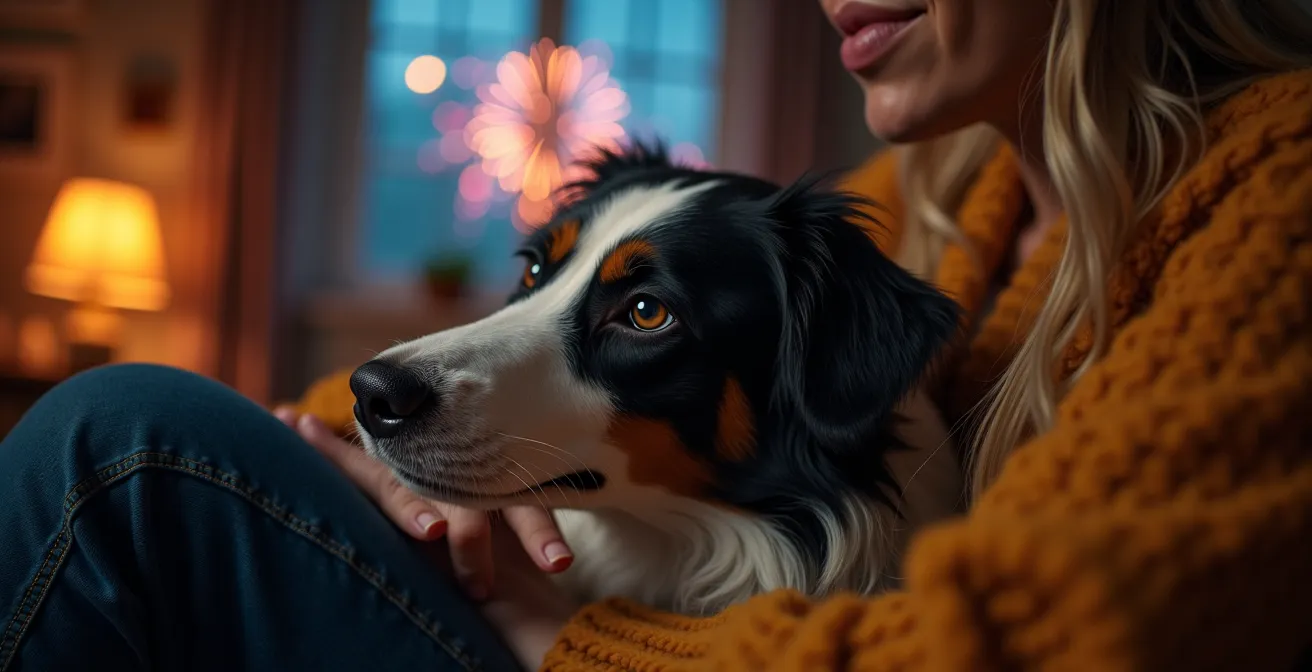
- Your immediate role is to be an emotional anchor, not a trainer; comfort is crucial and does not reinforce fear.
- Instantly create a makeshift “safe room” in a windowless area like a bathroom, using blankets and white noise to muffle sound and light.
- Use deep pressure touch, either with your hands or a DIY wrap (like a scarf), for an immediate calming effect.
- Identify and unplug hidden household stressors like ultrasonic pest repellers that amplify your dog’s auditory distress.
- Once the crisis passes, commit to off-season desensitization training to prevent future panic.
The first boom cracks through the night, unexpected and sharp. You see your dog’s body go rigid. The panting starts, the eyes widen, and the trembling begins. In this moment, you haven’t had time to prepare, to give a calming supplement, or to see your vet for sedation. You are caught in the middle of a full-blown panic episode. The internet is full of advice about long-term desensitization or using prescription medications, but that doesn’t help you right now, with the explosions getting louder and your dog’s terror escalating.
Many owners feel helpless, believing the common but mistaken advice that comforting a scared dog will only “reward” the fear. They might try to distract with a toy the dog is too terrified to notice, or simply wait it out, watching their companion suffer. But what if the most effective approach in a crisis isn’t about training or ignoring the problem? What if your most powerful tool is becoming a calm, confident emotional anchor for your dog, managing their physiological response to the sensory overload in real-time?
This guide is your emergency protocol. It’s not about long-term training; it’s about immediate crisis management. We’ll walk through the urgent steps to de-escalate panic, create a sense of security using what you have on hand, and understand the true nature of fear in your dog. Forget everything you thought you knew about “coddling” and get ready to provide the effective, comforting leadership your dog desperately needs right now.
To navigate this crisis, we will explore the critical actions you can take immediately. The following sections break down your emergency plan, from understanding your dog’s sensitivity to creating an instant sanctuary.
Summary: A Vet’s No-Sedation Crisis Plan for Your Dog’s Panic
- Why Herding Breeds are more susceptible to sound sensitivity than others?
- How to soundproof a “safe room” using household items effectively?
- Thundershirt vs Sileo: Which works faster for sudden thunderstorms?
- The “Codding” Myth: Why comforting a terrified dog does NOT reinforce the fear
- How to use YouTube sounds to train for fireworks in the off-season?
- Thundershirt vs Calming Cap: Which reduces visual stimuli effectively?
- Why your plug-in pest repeller might be torture for your dog’s hearing?
- How to Leave Your Dog Alone for 30 Minutes Without Panic or Destruction?
Why Herding Breeds are more susceptible to sound sensitivity than others?
When the fireworks begin, you may notice that certain dogs, particularly herding breeds like Border Collies, Australian Shepherds, and German Shepherds, seem to react with a heightened level of terror. This isn’t your imagination; it’s rooted in their genetics. These breeds have been selectively bred for centuries to be acutely aware of their environment. A sheepdog needs to react to the subtle crack of a twig or a distant shepherd’s whistle. This hyper-awareness of environmental stimuli, an asset on the farm, becomes a liability during a fireworks display.
Their brains are wired for sensitivity. Research confirms this predisposition, showing that noise sensitivity is a highly heritable trait. A landmark 2020 study in *Scientific Reports* examining over 13,700 dogs found that 51.5% of dogs studied showed some form of noise sensitivity, with herding breeds consistently ranking among the most affected. Their job has always been to detect potential threats to the flock, and their nervous system interprets the unpredictable booms and flashes of fireworks as a direct, imminent danger.
This isn’t a behavioral flaw or a sign of a “bad dog”; it’s a feature of their breeding that has been misapplied in a modern, noisy world. Understanding this genetic foundation is the first step in managing their panic. You’re not dealing with simple disobedience; you’re dealing with a deep-seated physiological response to what their instincts are screaming is a threat. This is why your role as a calm anchor is so vital—you must consciously override their instinctual panic with a message of safety and security.
How to soundproof a “safe room” using household items effectively?
When panic strikes, your immediate goal is to reduce the sensory input overwhelming your dog. You need to create an emergency safe room, or “den,” with items you can grab in seconds. Don’t worry about perfection; focus on effectiveness. The best location is often an interior, windowless room like a bathroom, walk-in closet, or basement. These spaces naturally have fewer windows and more insulation against outside noise.
Once you’ve chosen a spot, your mission is to dampen sound and block light. Drape thick blankets, quilts, or even mattresses over the entrance or any windows. Cover your dog’s crate with blankets, leaving an opening for air, to create a smaller, more secure cave. Towels can be stuffed under doors to block drafts and muffle sound. Inside the room, use pillows, dog beds, and cushions to create a soft, sound-absorbing nest where your dog can burrow.
Next, fight sound with sound. Turn on a box fan, air conditioner, or play white noise on a speaker. An often-overlooked trick is to use your stereo or a bluetooth speaker and turn up the bass. The low-frequency rumbles can help mask the sharp cracks of fireworks more effectively than high-pitched music. Finally, close all curtains and blinds in the house, but leave the lights on inside the safe room. This minimizes the jarring contrast of bright flashes against a dark room, making the visual stimuli less startling.
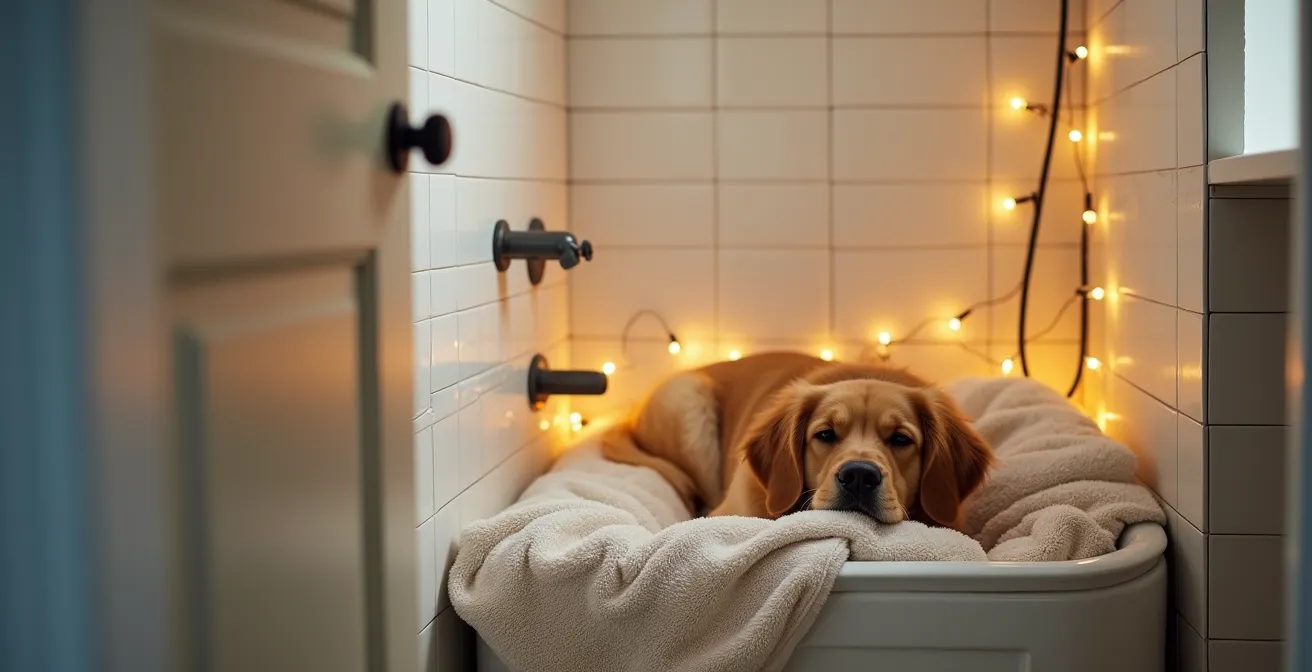
This makeshift den provides a sense of enclosure and control, directly countering the feeling of being exposed to an unpredictable threat. You are not just hiding your dog; you are actively managing their environment to reduce the sensory assault on their nervous system, allowing them to begin the process of calming down.
Thundershirt vs Sileo: Which works faster for sudden thunderstorms?
In a sudden crisis like unexpected fireworks, you need a solution that works *now*, not in an hour. This is where understanding the difference between mechanical aids and pharmaceutical ones is critical. The two common options are pressure wraps (like the Thundershirt or even a DIY version) and a prescription medication like Sileo gel. For a “caught-off-guard” scenario, one is vastly superior.
A Thundershirt, or any form of deep pressure wrap, works by applying gentle, constant pressure to the dog’s torso. This is known as Deep Pressure Touch (DPT), a therapeutic technique that stimulates the release of calming neurotransmitters like oxytocin. The effect is almost instantaneous. You don’t have one? You can create a DIY version in seconds using a scarf or an Ace bandage, applying a snug, comforting wrap. Its primary advantage is immediate availability and action.
Sileo, on the other hand, is a prescription oromucosal gel containing dexmedetomidine. It works by blocking norepinephrine, a key chemical in the anxiety and fear response. While effective, it has two major drawbacks in an emergency: it requires a prior vet prescription, and it takes 30-60 minutes to take full effect. If the fireworks have already started, Sileo will not provide immediate relief. It is a tool for planned events, not sudden crises.
The following comparison, based on a breakdown of emergency anxiety tools, makes the choice clear for unexpected events.
| Factor | Thundershirt/DIY Wrap | Sileo |
|---|---|---|
| Immediate Availability | Can use household items (scarf, ace bandage) | Requires vet prescription |
| Onset Time | Almost instant calming pressure | 30-60 minutes |
| Mechanism | Deep pressure touch triggers oxytocin | Blocks norepinephrine receptors |
| Effectiveness Rate | Varies per dog | 75% show good to excellent results |
| Emergency Use | Ideal for caught-off-guard situations | Requires advance planning |
For an owner caught off guard, the answer is unequivocal. A pressure wrap, whether store-bought or a DIY improvisation, is the faster, more practical tool for immediate intervention.
The “Codding” Myth: Why comforting a terrified dog does NOT reinforce the fear
One of the most damaging myths in dog ownership is the idea that comforting a frightened dog will reinforce their fear. The logic goes that by petting and soothing them, you are “rewarding” the fearful behavior, making it more likely to happen again. This is fundamentally wrong because it confuses an emotion (fear) with a learned behavior (like begging for food). Fear is an involuntary emotional response, not a calculated action to get attention.
When your dog is trembling during fireworks, they are in a state of genuine panic. Their fight-or-flight system is activated, flooding their body with stress hormones like cortisol. They are not “acting” scared; they *are* scared. Ignoring them or, worse, punishing them, will only confirm their belief that the world is a terrifying place and they are alone in their distress. Your calm, steady presence is the only thing that can counteract this physiological storm. Providing comfort is not reinforcement; it is co-regulation. You are lending them your calm to help them regulate their own emotional state.
Certified behavior consultants and trainers are now adamant about debunking this myth. As Jenn Stanley, a certified behavior consultant, states in guidance from the American Kennel Club:
You absolutely can and should comfort your dog if he’s afraid. The key here is in how you do so. It’s important to remain calm and use a soothing, even tone. Petting them can be comforting — long, slow, firm strokes along the length of their body are typically very soothing.
– Jenn Stanley, Certified behavior consultant and professional dog trainer
Your goal is to be a stable anchor, not a frantic source of more anxiety. Sit with your dog in their safe space. Speak in a low, calm voice. Use long, slow, firm pets—not frantic, fast patting. This physical contact provides grounding and reassurance, telling their nervous system that despite the chaos outside, their pack leader is calm and in control, and therefore they are safe.
How to use YouTube sounds to train for fireworks in the off-season?
While this guide focuses on crisis management, the only way to truly solve firework phobia is through proactive, off-season training. The goal is desensitization and counter-conditioning: gradually teaching your dog that the scary sounds are not a threat, and can even predict good things, like treats. YouTube is an invaluable and free tool for this process.
The process must be slow and controlled, always keeping your dog “below threshold”—meaning the stimulus is noticeable but not strong enough to cause a stress reaction. If your dog starts panting, pacing, or whining, the volume is too high, and you’ve taken a step backward. The aim is to build positive associations, not to flood them with fear. This requires patience and careful observation of your dog’s body language.
Start months before firework season. Find a high-quality video of firework sounds. The key is to control the volume with extreme precision. At first, the sound should be barely audible. While the sound plays, engage in a calm, positive activity your dog loves, like a gentle game of tug, a puzzle toy, or receiving high-value treats. The sound becomes background noise to a positive experience. Over many sessions spanning weeks or months, you can gradually increase the volume, notch by tiny notch, always watching for any sign of stress.
This long-term strategy rewires your dog’s emotional response. The sound of a distant pop no longer predicts terror; it predicts cheese. This is a powerful investment in your dog’s future well-being, turning a night of dread into just another evening.
Action Plan: Off-Season Desensitization
- Find Your Sound: Select several high-quality firework videos on YouTube. Variety prevents the dog from habituating to a single track.
- Set the Stage: Have high-value treats (chicken, cheese) or a favorite toy ready. Choose a time when your dog is calm and relaxed.
- Calibrate the Volume: With your dog out of the room, start the video. Turn the volume on your device and within the YouTube player to the absolute lowest setting possible.
- Test the Threshold: Bring your dog in. The sound should be so quiet that they might notice it with a slight ear twitch but show no other signs of stress (panting, pacing, hiding). This is “below threshold.”
- Build Positive Association: As the quiet sound plays for a short duration (30-60 seconds), give your dog treats or play a calm game. Then stop the sound and the treats. Repeat this several times. Gradually increase the duration and, over many sessions, the volume, always staying below their stress threshold.
Thundershirt vs Calming Cap: Which reduces visual stimuli effectively?
When managing firework phobia, we often focus on the “booms,” but the bright, unpredictable flashes of light can be just as terrifying for many dogs. Two popular tools that address different sensory aspects of this fear are the Thundershirt and the Calming Cap. Understanding their distinct functions is key to choosing the right aid for your dog’s specific triggers.
The Thundershirt, as we’ve discussed, targets the proprioceptive system. Its primary function is to provide calming deep pressure to the dog’s torso, helping to soothe the anxiety caused by the loud, concussive sounds. While it does not directly address visual stimuli, by lowering the dog’s overall anxiety level, it can make them less reactive to the flashes of light. It’s a general anxiety-reduction tool.
The Calming Cap, in contrast, is designed specifically to tackle visual input. It’s a sheer, lightweight hood that fits over the dog’s face, reducing their field of vision and softening the intensity of light. It doesn’t blind the dog; it simply filters their visual world, making sudden flashes less jarring. However, it’s a tool that requires extensive, positive conditioning *before* a stressful event. Placing it on a panicking dog for the first time would likely increase their fear. Therefore, it is not an emergency tool for a caught-off-guard situation.
For immediate, on-the-spot management of visual stimuli, your best bet is environmental control. Guide your dog to a windowless room, like a bathroom or closet. This completely eliminates the visual trigger, which is a more effective and less stressful emergency solution than introducing a new, strange piece of equipment like a Calming Cap mid-panic. A comparative look at these anxiety solutions clarifies their roles.
| Product | Primary Target | Fireworks Application | Training Required |
|---|---|---|---|
| Thundershirt | Proprioceptive system (pressure) | Helps with panic from booms | Minimal – can use immediately |
| Calming Cap | Visual input reduction | Helps with anxiety from flashes | Extensive – never first use during panic |
| Emergency Alternative | Complete visual elimination | Guide dog to windowless room (bathroom/closet) | None – immediate solution |
In a crisis, focus on what you can control. Use a pressure wrap for the sound-induced anxiety and use your environment to eliminate the light.
Why your plug-in pest repeller might be torture for your dog’s hearing?
In your frantic effort to create a calm environment, you may be overlooking a hidden source of auditory torture for your dog: the ultrasonic pest repeller. These devices are designed to emit a high-frequency sound that is silent to humans but intensely irritating to rodents and insects. The problem is that your dog’s hearing is far more sensitive than yours.
Humans typically hear in a range of 20-20,000 Hertz (Hz). Anything above that is “ultrasonic.” However, dogs can hear up to 45,000-65,000 Hz, making those “silent” pest repellers perfectly audible and potentially distressing to them. During a fireworks event, when your dog’s auditory system is already on high alert, the constant, high-pitched whine from one of these devices can add an unbearable layer of sensory stress, escalating their panic and anxiety.
Your dog can’t tell you that the noise is bothering them, but they may show subtle signs of distress. If you use these devices, it’s crucial to be aware of the potential impact. Signs of ultrasonic distress can include:
- Head shaking or tilting for no apparent reason.
- Sudden avoidance of certain rooms or areas where a device is plugged in.
- Unexplained whining or restlessness.
- Increased irritability or sudden behavioral changes.
- Flattened ears or a worried expression when entering a specific space.
As an immediate crisis action, your first step should be to go through your home and unplug every single ultrasonic device. This includes pest repellers, and some “bark deterrent” devices that work on the same principle. Removing this hidden layer of auditory stress is a simple, fast, and free way to lower your dog’s overall anxiety level and can make a significant difference in their ability to cope with the fireworks outside.
Key takeaways
- Your primary job in a crisis is to be a calm “emotional anchor,” as comforting your dog does not reinforce fear.
- Immediately create a makeshift den in an interior room using blankets and white noise to dampen both sound and light.
- Use immediate-acting tools like a Thundershirt or a DIY scarf wrap for deep pressure, which works much faster than any medication in a surprise event.
How to Leave Your Dog Alone for 30 Minutes Without Panic or Destruction?
The intense fear experienced during fireworks doesn’t just vanish when the explosions stop. It can have lasting consequences, often magnifying other anxieties like separation anxiety. A dog who has recently been terrorized by noises may become hyper-vigilant and unable to cope with being left alone, associating your absence with a loss of their “safety anchor” at a time when they feel most vulnerable. This is especially true for sensitive and deeply bonded breeds.
World-renowned trainer Victoria Stilwell notes the connection between breed traits and this type of anxiety, further reinforcing the genetic component of these fears.
Certain breeds like Border Collies or German Shepherds, known for their deep bonds with humans, might be more predisposed to feeling anxious when left alone. Herding dogs like Border Collies are more prone to separation anxiety because they are both sound and environmentally sensitive.
– Victoria Stilwell, World-renowned pet expert and positive dog trainer
If you must leave your dog alone in the aftermath of a stressful event, even for 30 minutes, you must re-establish a sense of safety. Do not just walk out the door. First, ensure they have had a chance to decompress. Provide a high-value chew toy (like a stuffed KONG) in their safe space to create a positive association and a calming activity. Play soft, classical music or keep the white noise running. A quick, confident departure is better than a long, drawn-out goodbye, which can increase anxiety.
It’s crucial to recognize that noise phobia is a progressive condition. If left unaddressed, it will worsen with each event, and the associated behaviors like separation anxiety and destruction will likely escalate. The panic your dog feels is real, and their coping mechanisms—or lack thereof—are a direct result. Managing their environment and your departures in the short term is key to preventing the fear from spiraling into a chronic, debilitating condition.
By applying these immediate crisis management techniques and committing to long-term desensitization training, you can transform future holidays from a time of terror into a time of peace for your dog. Your calm, informed leadership is the most powerful tool you have.