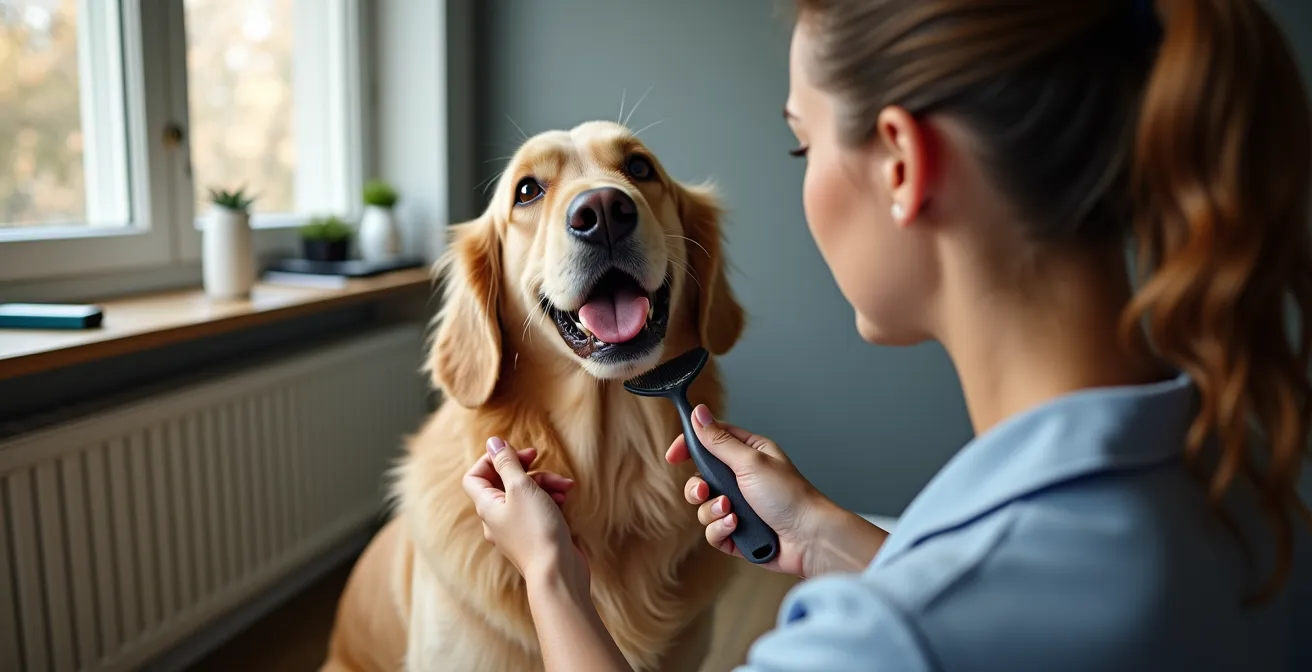
Shaving or skipping grooming isn’t saving your double-coated dog from the heat; it’s dismantling their natural health system.
- The coat is a complex dermal-respiratory system that requires mechanical clearing, not removal, to function.
- Matting is a medical emergency in waiting, causing painful hematomas and trapping infection against the skin.
- Flea infestations start silently inside your home during winter, not on your dog in summer.
Recommendation: Treat professional grooming as a recurring health appointment, essential every 8-12 weeks, regardless of the season, to ensure your dog’s skin and coat remain healthy.
As a master groomer, I see the same look of concern on the faces of loving owners of Huskies, Retrievers, and Collies every summer. Their dog is panting, and the immediate, logical conclusion is that the thick, beautiful coat is the culprit. The temptation to “just shave it off” is powerful, born from a desire to provide relief. This is often followed by the well-meaning but incomplete advice you’ve heard a thousand times: “Don’t shave a double coat” and “just brush them more.”
But this advice barely scratches the surface. It misses the fundamental truth I have dedicated my career to understanding and managing. A double coat is not just hair; it is a sophisticated, self-regulating organ. I call it the dermal-respiratory system. It is designed to protect your dog from heat, cold, sun, and moisture. The real danger isn’t the presence of this coat, but the consequence of its neglect: a state of “coat stagnation,” where the natural processes of shedding and air circulation fail. This failure turns the dog’s greatest defense into a liability, trapping heat and moisture against the skin and creating a breeding ground for painful and dangerous health issues.
This article will dismantle the myths surrounding double-coat care. We will move beyond the superficial and explore the critical health reasons why professional grooming is not an aesthetic luxury but a non-negotiable component of your dog’s well-being. We will explore the mechanics of painful injuries caused by home grooming mistakes, the proper techniques for at-home maintenance, and the invisible threats that thrive in a poorly managed coat. Prepare to see your dog’s grooming needs in a completely new light.
To help you navigate this essential topic, this guide breaks down the most critical aspects of double-coat health management. The following sections will provide in-depth, practical knowledge to empower you as a responsible pet owner.
Summary: A Master Groomer’s Guide to Double-Coat Health
- Why matting causes painful hematomas when removed incorrectly at home?
- How to maintain a doodle’s coat between professional visits without ruining the texture?
- Mobile Groomer vs Salon: Which is safer for an anxious senior dog?
- The Slicker Brush Mistake That Causes Brush Burn on Sensitive Skin
- When to book the first puppy groom: The socialization window you must not miss
- How to spot hidden animal testing in shampoo brands that claim “Cruelty-Free”?
- Why 95% of the flea population lives in your carpet, not on your dog?
- Why Stopping Flea Prevention in Winter Leads to Home Infestations by Spring?
Why matting causes painful hematomas when removed incorrectly at home?
One of the most dangerous myths is that matting is just a cosmetic issue of tangled hair. In reality, it is a medical emergency in the making. The risk of injury during grooming is significant, with studies showing that 42% of dogs experience some form of minor injury during grooming sessions, many of which stem from attempts to remove severe mats at home. A mat is not loose hair; it’s a tight, dense mass of tangled dead and live hair that pulls constantly on the skin. This tension restricts blood flow, creating a fragile, ischemic area.
When an owner tries to cut or forcefully brush out these mats, the sudden release of this tension is what causes severe trauma. As blood rushes back into the deprived capillaries, they can burst, causing a large, painful blood blister known as an aural hematoma, especially on the delicate tissue of the ears. This is not a simple bruise; it’s a significant injury that requires immediate veterinary intervention to drain and treat, often involving stitches or surgery. The process is excruciating for the dog and stressful for the owner.
As a professional, I never use scissors to cut out a mat. The skin is often pulled up into the base of the mat, making it impossible to see where the hair ends and the skin begins. The only safe way to remove severe matting is with clippers, carefully working between the skin and the mat—a skill that requires experience to perform without cutting the skin. Daryl Conner, a Certified Master Groomer, explains the physiology perfectly:
The ears have a rich blood supply, and if the dog shakes its head repeatedly or scratches at the ear, blood can seep from the capillaries and become trapped between the layers. The tissue will swell and be very uncomfortable.
– Daryl Conner, MPS Meritus, CMCG, Frank Rowe and Son – Preventing Aural Hematomas During Dog Grooming
Preventing mats through proper, regular grooming is the only way to avoid this painful and dangerous outcome. It’s a fundamental aspect of health, not just appearance.
How to maintain a doodle’s coat between professional visits without ruining the texture?
While doodles are not traditional double-coated breeds, their thick, curly hair presents a similar and often more challenging maintenance reality. Their coats are highly prone to matting and require consistent at-home care to maintain the health of the skin and the texture of the coat. The key is not just brushing, but performing the correct mechanical intervention to ensure air can reach the skin. The most effective technique is known as line brushing.
This method involves parting the hair in a straight line down to the skin and brushing the hair away from the part, section by section. You are not just skimming the surface; you are methodically working from the skin outwards. This ensures that the dense undercoat is cleared of shed hair and that no small tangles are left behind to grow into mats. Always follow up your work with a metal “greyhound” comb. If the comb cannot pass smoothly from the skin to the tip of the hair, that section is not finished.
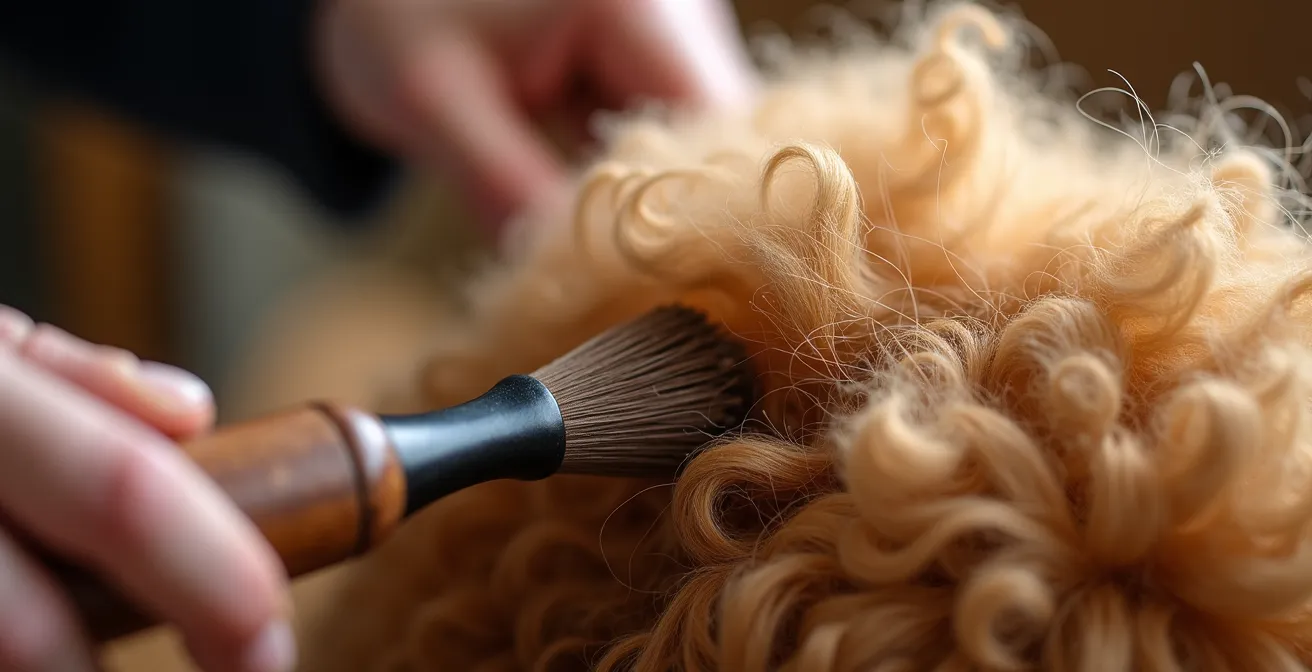
As you can see in the image, the goal is to create fluffy, separated strands, allowing the dermal-respiratory system to function. A critical mistake many owners make is bathing a tangled dog. Water tightens tangles into felt-like mats, making them impossible to remove without shaving. Always, without exception, brush and comb your dog out completely before they get wet. Using a high-quality detangler spray can make this process easier by giving the hair “slip” and reducing static.
Your Action Plan: Essential Doodle Coat Maintenance
- Section and Separate: Divide the fur into manageable sections. Part the hair to create a line, exposing the skin.
- Brush from the Skin Out: Use a slicker brush to work on the section below the part, brushing from the root outwards until the hair is tangle-free.
- The Comb Test: After brushing a section, run a metal comb through it. If it glides freely from skin to tip, you can move to the next section. If not, continue brushing.
- Pre-Bath Prep is Mandatory: Always perform a full line-brushing and comb-through before any bath. Wetting a tangled coat creates instant, severe matting.
- Weekly Consistency: Commit to this routine at least once or twice a week. Consistent maintenance is far less work than a crisis de-matting session.
Mobile Groomer vs Salon: Which is safer for an anxious senior dog?
Choosing the right grooming environment becomes even more critical as a dog ages, especially for senior dogs with anxiety or physical limitations. The goal is to minimize stress while ensuring their health needs are met. This is a vital decision, as consistent care is non-negotiable; it’s often recommended that professional grooming for double-coated breeds occurs every 8 to 12 weeks to prevent matting and maintain skin health. For an anxious senior, the environment can make the difference between a tolerable experience and a terrifying one.
A traditional salon is a high-stimulus environment. The sounds of other barking dogs, the smells of various products, and the noise from high-velocity dryers can be overwhelming. Furthermore, there’s the physical risk in a busy space of being knocked over or feeling pressured by younger, more boisterous dogs. In contrast, a mobile groomer provides a one-on-one experience in a quiet, controlled setting. The groomer comes to you, which eliminates stressful car rides and long waits in a crate. The entire process is tailored to your dog’s specific needs, with the groomer able to focus solely on their comfort and safety, minimizing standing time and adapting to their pace.
The table below breaks down the key environmental differences, making it clear why a mobile service is often the superior choice for ensuring the safety and well-being of a nervous or elderly dog.
| Factor | Mobile Grooming | Traditional Salon |
|---|---|---|
| Sensory Environment | One-on-one, quiet, predictable environment | Multiple barking dogs, chemical smells, high-velocity dryer noise |
| Social Pressure Risk | Guaranteed solitary experience | Risk of pressure from younger dogs, even in ‘cage-free’ salons |
| Physical Safety | Tailored experience, minimized standing time | Risk of being knocked over or strained joints |
| Stress Level | Lower cortisol-spiking stress | Higher stress from multiple stimuli |
| Customization | More flexible for senior dog needs | Standard procedures may be less adaptable |
For a senior dog, reducing cortisol-spiking stress isn’t a luxury; it’s a health imperative. The predictable, solitary, and customized nature of mobile grooming makes it the demonstrably safer and more compassionate choice.
The Slicker Brush Mistake That Causes Brush Burn on Sensitive Skin
The slicker brush is an indispensable tool for double-coat maintenance, but in inexperienced hands, it can easily cause a painful condition known as brush burn. This isn’t a burn from heat, but an abrasion caused by the fine metal bristles scraping repeatedly against the skin. Many owners believe more pressure and more speed will get through tangles faster, but this is the primary cause of injury. The goal is to brush the *hair*, not scrub the *skin*.
Dogs can have sensitive skin that isn’t visibly apparent. When a groomer—or an owner at home—focuses on a tangled area with repetitive, high-pressure strokes, the friction irritates and inflames the epidermis. It’s similar to the razor burn humans experience. The dog’s skin becomes red, raw, and incredibly sore. This not only causes immediate pain but can also lead to secondary skin infections as the dog licks or scratches the irritated area, introducing bacteria to the compromised skin barrier.
The correct technique requires patience and a light touch. You must let the tool do the work. Focus on short, gentle, pat-and-pull motions rather than long, raking strokes. Always be aware of the angle of the brush and the pressure you’re applying. If you are creating red marks on your own skin when testing the brush, you are using far too much force for your dog. Proper technique is the only thing that separates a helpful tool from a harmful one.
Action Plan: Mastering the Slicker Brush to Prevent Brush Burn
- Check Your Pressure: Before you start, lightly tap the slicker brush on the back of your own hand. If it’s uncomfortable or leaves red marks, you’re using too much pressure.
- Use a “Pat and Pull” Motion: Instead of long, scraping strokes, gently place the brush on the coat and pull it through with a light flick of the wrist. This lifts the hair away from the skin.
- Work in Sections: Part the fur to create a line and brush the hair below the part. This prevents you from repeatedly going over the same patch of skin.
- Mind the Angle: Keep the brush head relatively parallel to the dog’s body. Angling the bristles directly into the skin is what causes the scraping and irritation.
- Never Attack a Mat: A slicker brush is for maintenance and minor tangles. Do not use it to try and rip through a dense mat. This guarantees brush burn and causes extreme pain.
When to book the first puppy groom: The socialization window you must not miss
The most important grooming appointment of your dog’s life is their very first one. This experience sets the foundation for a lifetime of tolerance and cooperation, or one of fear and anxiety. There is a critical socialization window that you cannot afford to miss. While many owners wait until their puppy “looks like they need a haircut,” the first visit should be scheduled for a much more strategic reason: positive association. Experts agree that the ideal time for this introduction is around 12 weeks old, right after they have completed their final round of puppy vaccinations.
This initial visit isn’t about a full, complex haircut. It’s about desensitization. The goal is a short, overwhelmingly positive experience that introduces the puppy to the sounds, smells, and sensations of a grooming salon. This includes the noise of a dryer, the feeling of water, the vibration of clippers (without necessarily cutting hair), and being handled on a table. A good groomer will use high-value treats, praise, and a gentle approach to ensure the puppy leaves feeling happy and safe.
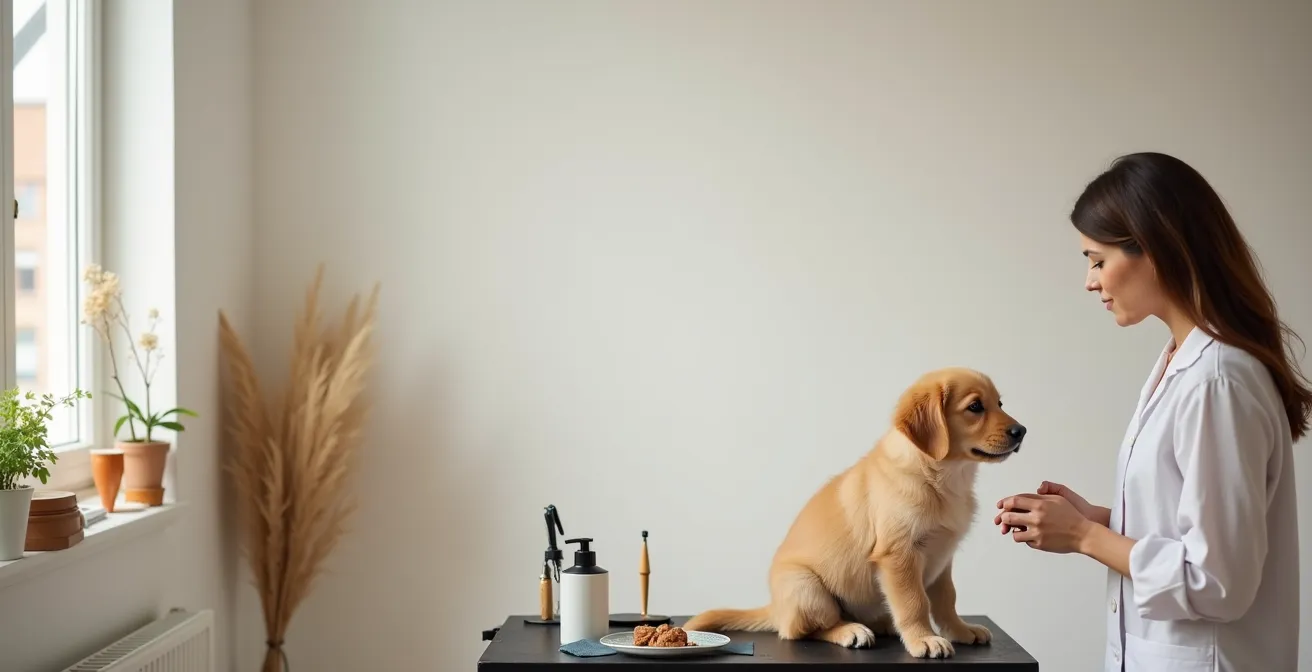
This crucial work starts even earlier, at home. As professional groomer Dale Martins advises, this early handling is non-negotiable for creating a well-adjusted adult dog.
A puppy should be groomed from the day you bring them home. Get them used to gentle brushing, touch a soft toothbrush to their gums, handle their feet and nails, look in their ears, and check their eyes.
– Dale Martins, Professional dog groomer with 40+ years experience, AKC Expert Advice
Missing this window can result in a dog that fights grooming for the rest of its life, making essential healthcare a traumatic event. By investing in a positive first experience, you are giving your dog the gift of a low-stress future.
How to spot hidden animal testing in shampoo brands that claim “Cruelty-Free”?
As a groomer dedicated to animal health, the ethics behind the products I use are just as important as their effectiveness. The term “cruelty-free” is unfortunately not regulated, and many brands use it as a marketing tactic while still being complicit in animal testing. As a discerning owner, you must learn to look beyond the simple bunny logo on the bottle and understand the common loopholes that hide the truth.
The most prevalent deception is the “Parent Company Loophole.” A specific brand of shampoo might not test on animals, but it could be owned by a massive multinational corporation that conducts extensive animal testing for its other cosmetic or household brands. When you buy that shampoo, your money is ultimately funding the parent company and, by extension, its testing practices. It’s essential to research not just the brand but who owns it.
Another major red flag is the “Required by Law” clause. For many years, the Chinese government required animal testing for all cosmetics sold in physical stores in mainland China. Any brand that chose to sell their products on those shelves was therefore complicit. While regulations have been changing, this remains a quick way to vet a brand’s historical commitment to cruelty-free practices. If they sell in physical retail stores in China, further investigation is required.
Finally, understand that not all certifications are equal. A generic bunny logo designed by the brand’s marketing team means nothing. PETA’s “Beauty Without Bunnies” program is a good starting point, but the gold standard is the Leaping Bunny certification. This program is the most rigorous, requiring a brand to prove that no new animal testing is used in any phase of product development by the company, its laboratories, or its ingredient suppliers. It involves auditing the entire supply chain, offering the highest level of assurance.
Why 95% of the flea population lives in your carpet, not on your dog?
One of the most critical misunderstandings I encounter is the belief that treating the dog is enough to solve a flea problem. This approach is doomed to fail because it ignores the fundamental nature of the enemy. The adult fleas you see on your dog are merely the tip of the “Flea Iceberg.” They represent only about 5% of the total flea population in your home. The other, invisible 95%—the eggs, larvae, and pupae—are submerged in your environment, primarily in your carpets, bedding, and furniture.
The life cycle of a flea is what makes this so dangerous. An adult female flea on your dog is a tiny egg factory. After a blood meal, she begins laying eggs, which are not sticky. They immediately fall off your dog and into the environment, concentrating in “Drop-Zones” where your dog rests and sleeps. These eggs hatch into larvae, which burrow deep into carpet fibers and upholstery, feeding on organic debris. After a period of growth, the larvae spin a cocoon and become pupae.
This pupae stage is the secret weapon of the flea population. The cocoon is incredibly resilient, sticky, and resistant to most household insecticides. The pupa can lie dormant inside this protective casing for months, waiting for the right signal—vibrations, heat, or carbon dioxide—that a host is nearby. This is why you can treat your dog and vacuum your house, only to have a fresh wave of fleas “magically” appear weeks later. You weren’t re-infested; you were simply experiencing the hatching of the hidden 95% that was already there.
A poorly managed double coat exacerbates this problem. The dense, stagnant fur acts as a perfect taxi service, allowing adult fleas to thrive long enough to lay thousands of eggs that seed your entire home. Effective flea control must be a two-pronged attack: treating the dog and aggressively treating the environment.
Key takeaways
- Matting is a medical issue, not a cosmetic one, and can cause painful hematomas if removed incorrectly.
- The goal of brushing is not just detangling but ensuring the skin can breathe by clearing the undercoat.
- Flea control is a year-round, home-environment battle, not a seasonal, on-dog treatment.
Why Stopping Flea Prevention in Winter Leads to Home Infestations by Spring?
The persistent myth that you can safely stop flea and tick prevention during the winter is one of the most dangerous pieces of advice a pet owner can follow. It is based on the flawed assumption that fleas die off in the cold. While fleas may be less active outdoors, our homes provide the perfect year-round incubator. Modern central heating maintains stable, warm temperatures that allow the flea life cycle to continue unabated, turning your home into a flea factory while your guard is down.
This phenomenon is called the “Central Heating Incubator Effect.” While you’ve stopped the monthly preventative, any flea that found its way inside can still feed and lay eggs. A single female flea can lay up to 50 eggs per day, leading to an exponential problem. Throughout the winter months, a phase of “Silent Accumulation” occurs. Flea pupae, with their indestructible cocoons, are steadily building up in your carpets, under furniture, and in your pet’s bedding. They are not dying; they are waiting.
The “spring explosion” of fleas that many owners experience is not a new invasion from the outside. It is the coordinated hatching of the massive population that accumulated silently and invisibly inside your home all winter. The slight increase in warmth and humidity of spring acts as a trigger, and suddenly you are facing an overwhelming infestation that seems to have come from nowhere. In reality, it was a predictable outcome of dropping preventative measures during the winter.
For owners of double-coated dogs, this is especially perilous. The dense coat can hide a small number of adult fleas for weeks, allowing them to seed the home environment long before the owner is even aware of a problem. The only effective strategy is diligent, year-round prevention for every pet in the household, combined with regular, thorough grooming to ensure the coat is not providing a safe haven for these parasites.
Treating your dog’s coat as the vital organ system it is requires a proactive, not reactive, approach. This means establishing a consistent partnership with a professional who understands the unique health needs of a double coat. Now is the time to schedule a professional grooming appointment to get a baseline assessment of your dog’s skin and coat health and create a year-round maintenance plan.
Frequently Asked Questions About Choosing Safe Grooming Products
What is the ‘Parent Company Loophole’?
A brand can be individually ‘cruelty-free’ but owned by a parent corporation that actively tests other products on animals, meaning the consumer’s money ultimately supports the practice.
What’s the difference between certification levels?
There’s a hierarchy from simple unregulated ‘cruelty-free’ bunny logos, to PETA’s certification, to the ‘gold standard’ Leaping Bunny certification which audits the entire supply chain.
What is the ‘Required by Law’ red flag?
Any brand selling products in physical stores in mainland China is often complicit in animal testing, as it was a legal requirement for many years. This is a quick way to vet brands.